
Beneath the Sand: The Quiet Kingdom of the Western Cape Moles
Beneath the fynbos and dunes of the Western Cape, golden moles move unseen. This story explores what is common, what is endangered, and why species clarity matters before action.
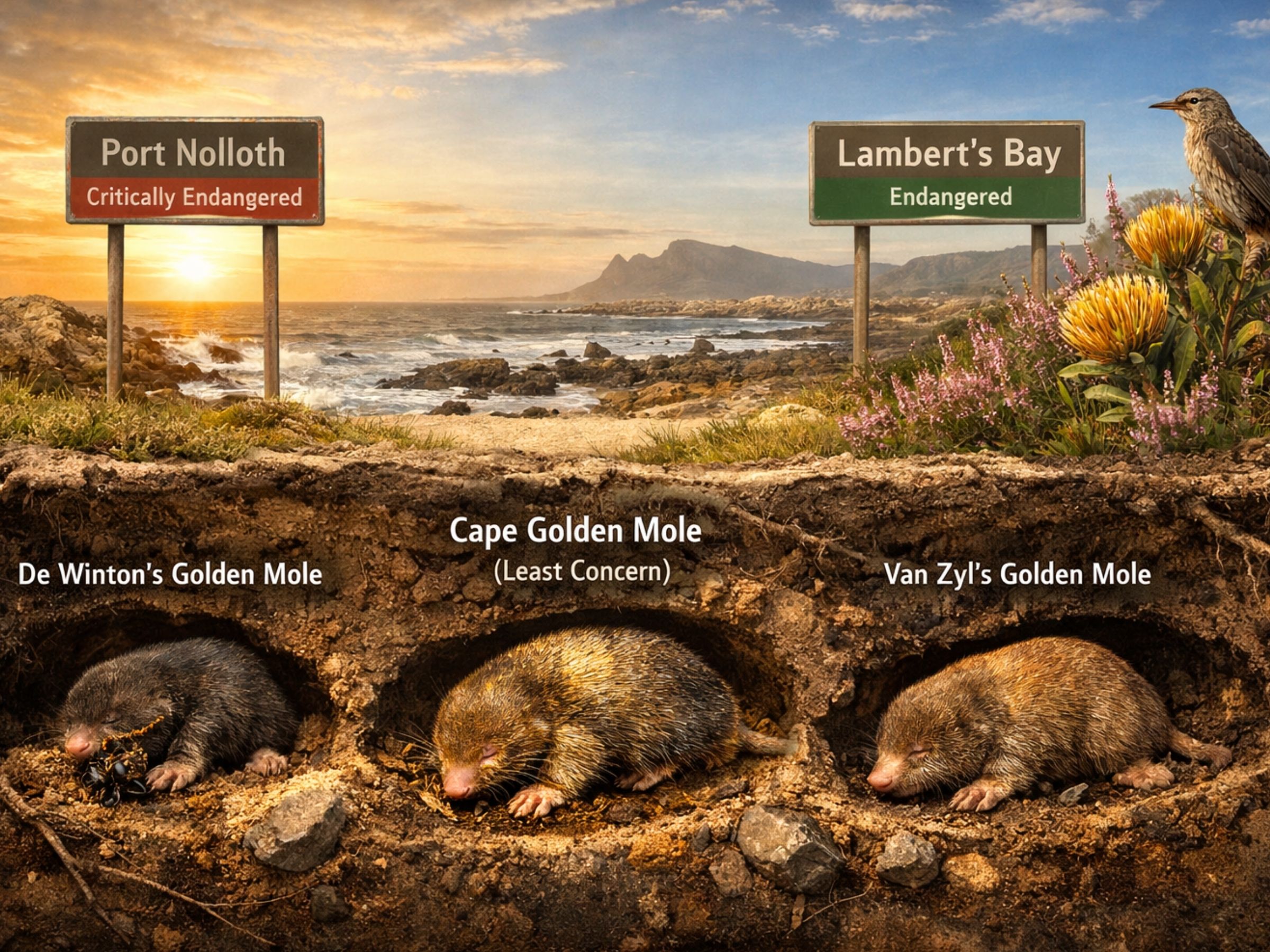
There is a silence beneath the Western Cape that few ever consider.
Not the silence of stillness — but the silence of movement without sound.
Beneath the fynbos, under the lawns of Constantia, along the windswept dunes of the Atlantic coast, something ancient moves. Not seen. Rarely heard. But always there.
The golden moles.
The Invisible Engineers of the Cape
They are not moles as most imagine them.
No raised tunnels, no open burrows, no obvious signs of passage.
Golden moles swim through sand.
Their bodies are built for it — muscular shoulders, fused neck vertebrae, and a wedge-shaped head that parts the soil like water. Their fur, iridescent in sunlight, gives them their name, but they spend their lives in darkness.
In the Western Cape, they are part of a hidden system — one that aerates soil, regulates insect populations, and shapes the ground beneath our feet.
And yet, almost everything about them is misunderstood.
The Name That Misleads: Cape Golden Mole
Ask anyone in Cape Town about moles, and a pattern emerges.
Confusion.
The Cape Golden Mole (Chrysochloris asiatica) is often spoken of in the same breath as “endangered species.” It sounds rare. Precious. On the brink.
But it is not.
According to the South African National Biodiversity Institute Red List, the Cape Golden Mole is classified as Least Concern — widespread and resilient across the Western Cape.
From the Cape Flats to Bredasdorp…
North along the Atlantic coast…
Through gardens, coastal sands, and open ground…
It survives.
Quietly. Successfully.
The confusion comes not from carelessness — but from proximity.
Because hidden among its relatives are species that truly are at the edge.
The Ones That Are Fading
Further north, where the land hardens into Namaqualand and the Atlantic wind carries salt deep into the dunes, another story unfolds.
The story of De Winton’s Golden Mole (Cryptochloris wintoni).
For decades, it was believed lost.
Only one confirmed location: Port Nolloth.
A creature known more from absence than presence.
A name preserved in records, not sightings.
Then, against expectation, signs appeared again — faint traces in the sand, genetic whispers confirming what many had feared was gone.
Research supported by conservation groups like Endangered Wildlife Trust suggests that its range may extend along the west coast — perhaps even brushing the northern edges of the Western Cape.
But “perhaps” is a fragile word in conservation.
It lives in uncertainty.
Not far from there, another species moves through the same coastal sands.
Van Zyl’s Golden Mole (Cryptochloris zyli).
Unlike its elusive cousin, it is known — but only just.
Its presence is recorded near Lambert’s Bay, and further north toward Groenriviermond.
Its status: Endangered.
Its habitat: narrow, specific, vulnerable.
A strip of coastline. A fragile ecosystem. A species bound tightly to both.
Why People Get It Wrong
The misunderstanding is almost inevitable.
To the untrained eye — and even to many professionals — golden moles are indistinguishable.
They do not surface to introduce themselves.
They leave no obvious markers of identity.
And so, the presence of moles becomes associated with rarity.
With fragility.
With the idea that every movement beneath the soil might belong to something endangered.
But in truth:
The Cape Golden Mole is common, adaptable, and widespread.
The truly endangered species are localized, rare, and often unseen entirely.
The difference is not visible in the garden.
It exists in distribution maps, field studies, and the quiet work of researchers.
The Ground Beneath Us
In the suburbs of Cape Town, a homeowner may notice subtle ridges in the lawn.
Soft shifts in soil.
Disruptions beneath paving.
It feels invasive. Unwelcome.
But beneath that surface disturbance is an animal doing exactly what it was shaped to do.
Moving. Hunting. Sustaining.
And in most cases — it is not an endangered species at all.
It is the Cape Golden Mole, continuing a lineage that has survived climates, predators, and time itself.
A Landscape of Two Realities
The Western Cape holds two truths at once:
A resilient, widespread species thriving beneath urban and coastal environments.
And fragile, endangered relatives, confined to narrow strips of land where survival is uncertain.
They share a name.
They share a form.
But they do not share the same fate.
Understanding Before Action
This is where clarity matters.
Not every mole is endangered.
Not every disturbance is ecological crisis.
But neither is the underground world irrelevant.
The soil beneath the Western Cape is alive with movement — some of it common, some of it rare beyond measure.
To understand the difference is not just academic.
It is the line between assumption and knowledge.
Between reaction and precision.
The Silent Kingdom Continues
The golden moles will never announce themselves.
They will not rise to the surface to correct misunderstanding.
They will not distinguish their species for those above them.
They will continue as they always have:
Silent. Hidden. Essential.
And beneath the gardens of Cape Town — beneath the dunes of the west coast — their world endures, unseen but never absent.
Main Research Links
-
SANBI — Cape Golden Mole (Chrysochloris asiatica), Least Concern; broad Western Cape and west coast range.
https://speciesstatus.sanbi.org/assessment/last-assessment/01893/ -
SANBI — De Winton’s Golden Mole (Cryptochloris wintoni), Critically Endangered; historically recorded only from Port Nolloth.
https://speciesstatus.sanbi.org/assessment/last-assessment/01841/ -
SANBI — Van Zyl’s Golden Mole (Cryptochloris zyli), Endangered; recorded near Lambert’s Bay and Groenriviermond.
https://speciesstatus.sanbi.org/assessment/last-assessment/1842/ -
Endangered Wildlife Trust — rediscovery of De Winton’s Golden Mole; newer west-coast survey context.
https://ewt.org/a-quest-for-gold/
Key Citations for the Story
- The Cape Golden Mole is not endangered. SANBI lists it as Least Concern, describing it as widespread and not in decline.
- Its range extends from the Cape Peninsula across the Cape Flats to Bredasdorp and Swellendam, and north along the Atlantic coast to Port Nolloth.
- De Winton’s Golden Mole is listed by SANBI as Critically Endangered, with the 2014 assessment stating it was recorded only from the type locality at Port Nolloth.
- The more recent rediscovery work by the Endangered Wildlife Trust says evidence was found not only at Port Nolloth but at multiple additional sites along the west coast, after surveys from the Groen River mouth northwards to Alexander Bay.
- Van Zyl’s Golden Mole is listed by SANBI as Endangered. SANBI says it was originally known only from near Lambert’s Bay in the Western Cape, with another specimen later collected at Groenriviermond in the Northern Cape.
Areas of the Endangered Species
De Winton’s Golden Mole
Conservative SANBI position: Port Nolloth only.
Newer field evidence: west coast sites from around the Groen River mouth northwards to Alexander Bay, including Port Nolloth / McDougall’s Bay area.
Van Zyl’s Golden Mole
Western Cape: near Lambert’s Bay.
Northern Cape: Groenriviermond, roughly 150 km farther north.
Cape Golden Mole
Not endangered.
Wide range through much of the Western Cape, including Cape Peninsula, Cape Flats, Bredasdorp, Swellendam, and north up the Atlantic coast.