
Moles in Your Garden? A Newlands Homeowner's Story
In the quiet green folds of Newlands, Thomas believed he was preserving a rare creature. What followed became a story of care, misread facts, and knowing when to call in professionals.
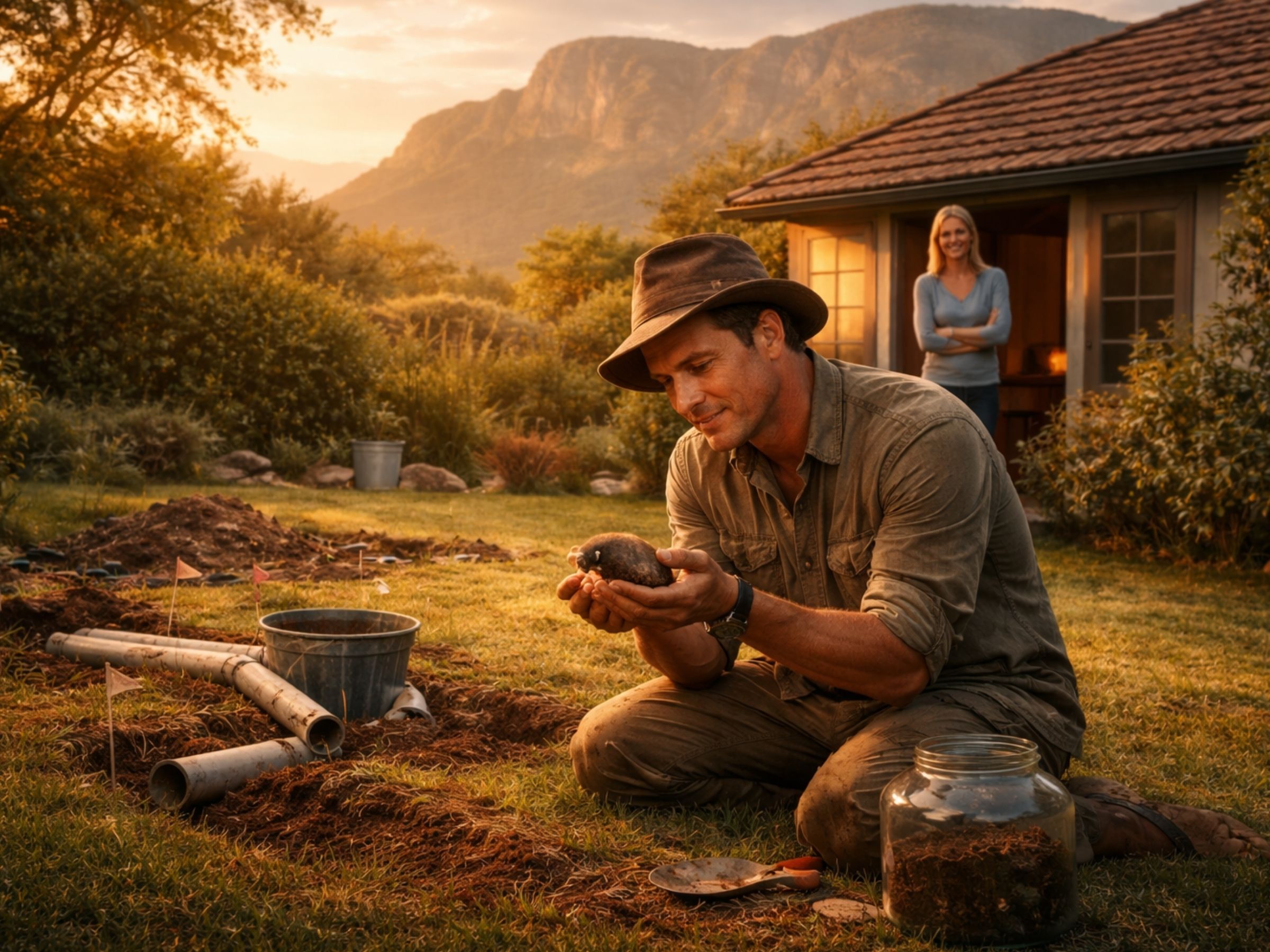
In the quiet green folds of Newlands, where the mountain leans close and the soil lies rich and forgiving, there lived a man who believed himself a guardian of rare things.
His name was Thomas, though in his own mind he had, over recent weeks, become something closer to a conservationist of renown. It had begun, as these things often do, with a single raised ridge across the lawn—a soft upheaval of earth that spoke of unseen movement beneath.
He stood over it one early morning, coffee in hand, the mist still clinging low across the grass. There was something ancient in that small disturbance, something deliberate. He crouched, touched the soil, and felt the faintest tremor of life.
“A mole,” he said aloud, though it sounded more like a discovery than a deduction.
His wife, Anna, watched from the kitchen window. She had seen this look before—the narrowing of his eyes, the quiet ignition of purpose. It was the same look he had worn when he had once decided to fix the roof himself, or rewire the garden lights, or build a braai from reclaimed stone and optimism.
But this was different. This, he would later declare, was about preservation.
By the second day, Thomas had constructed his first contraption.
It was an assembly of buckets, tubing, and what he insisted was a “non-invasive directional guidance system,” though to Anna it resembled a plumbing accident. He had studied the lines in the lawn, traced them like a cartographer of the unseen, and set his device carefully along what he called “the primary corridor.”
“I’m not trapping it,” he explained, kneeling in the damp grass. “I’m redirecting it. Catch and release.”
“Where will you release it?” Anna asked, leaning on the doorframe, her arms folded in patient curiosity.
He paused only briefly. “Somewhere safe.”
This, it seemed, was enough.
The mole did not oblige him that night. Nor the next.
But Thomas was not a man easily discouraged. Each morning revealed new ridges, new movements beneath the earth, and each one he greeted with a kind of reverence. He began to speak of the creature as though it were singular, a lone survivor threading its way through suburban gardens.
By the end of the week, the lawn had become a theatre of invention.
There were gentle funnels made of garden edging, carefully buried at angles. There were marked zones, flagged with small sticks and pieces of string. At one point, Anna found him lying flat on his stomach, ear pressed to the ground, listening.
“It’s close,” he whispered, raising a hand for silence.
She stood above him, watching, her expression a delicate balance of concern and admiration. There was something earnest in his efforts, something almost noble in the way he approached the task—not as a nuisance to be removed, but as a life to be preserved.
One afternoon, she returned from the shops to find a large glass container on the kitchen counter, filled with layered soil.
“What’s this?” she asked.
“A temporary habitat,” he replied. “If I catch it, I don’t want to stress it before relocation.”
He spoke with the calm certainty of a man who had crossed some unseen threshold into expertise.
It was on the tenth day that he finally succeeded.
Anna heard the shout from the garden—a triumphant cry that carried through the open windows. She stepped outside to find him kneeling beside one of his carefully constructed channels, holding a small, velvet-dark creature cupped gently in his hands.
For a moment, the world seemed to pause.
The mole was smaller than she had imagined, its body sleek and powerful in its own quiet way. Its eyes were hidden, its snout twitching faintly as it sensed a world it would never see.
Thomas looked up at her, his face lit with something close to wonder.
“I told you,” he said softly. “Extraordinary.”
She came closer, crouching beside him. There was no urgency in her movements, no need to rush this moment. She studied the animal, then glanced at her husband, taking in the soil on his knees, the careful way he held the creature, the unmistakable pride in his posture.
“Thomas,” she said gently, “why are you catching it?”
He blinked, surprised by the question.
“Because it’s endangered,” he replied. “They’re rare. You can’t just… leave it here.”
She smiled then, not unkindly, but with a warmth that carried both affection and understanding.
“They’re not endangered,” she said. “The Cape Golden Mole is quite common here.”
There was a silence that followed, soft and unbroken.
Thomas looked down at the small creature in his hands. The mole shifted slightly, pressing its snout against his palm, as if testing the boundaries of this brief, strange captivity.
He did not drop it. He did not laugh.
Instead, something in his expression changed—not the collapse of effort, but the quiet settling of it. All the mornings, the plans, the careful constructions—none of it seemed wasted in that moment. It had simply been… misplaced.
“Well,” he said after a while, his voice steady, “it’s still better to be careful.”
Anna nodded.
“Yes,” she said. “It is.”
Together, they walked to the far edge of the garden, where the soil lay loose beneath a stand of shrubs. Thomas knelt once more and opened his hands. The mole slipped back into the earth with effortless grace, vanishing as though it had never been.
He remained there a moment longer, watching the ground, as if expecting some sign of farewell.
When he stood, Anna took his hand, brushing the soil from his fingers.
The lawn, though marked and disturbed, seemed no worse for it. If anything, it carried a story now—a quiet testament to a man who had, for a time, chosen to see beneath the surface and act with care, even when the facts did not demand it.
And in the evenings that followed, when new ridges appeared in the grass, Thomas no longer reached for his tools.
He simply watched, and sometimes, he smiled.
Yet there are seasons when the earth grows restless, when what moves beneath begins to shape what stands above. And in such times, when the lines in the lawn speak not of wonder but of consequence, a wiser man does not wage his own quiet war with spades and schemes.
He calls for those who understand the hidden kingdom beneath the soil—men who do not chase the creature, but the colony; who do not disturb the surface, but master what lies below it.
And so, when the ground stirs beyond patience, one does not contrive.
One sends for Verminator.