Weed species guide
National weed methodology: weeds hub, how we treat weeds, weed guarantees, weed control by area. Identification: weed identification. Safety: treatment safety.
Medicago lupulina · clover lookalike · prostrate legume
Black medick (Medicago lupulina) is often misidentified because it resembles clover or oxalis at a glance. It is a clover-like legume that stays low, spreads from a central root, and commonly appears in lawns and disturbed sites.
Black medick is a small trifoliate legume in the genus Medicago, not a true clover in Trifolium. It is commonly described as an annual or short-lived perennial broadleaf found in turf, fields, and disturbed ground.
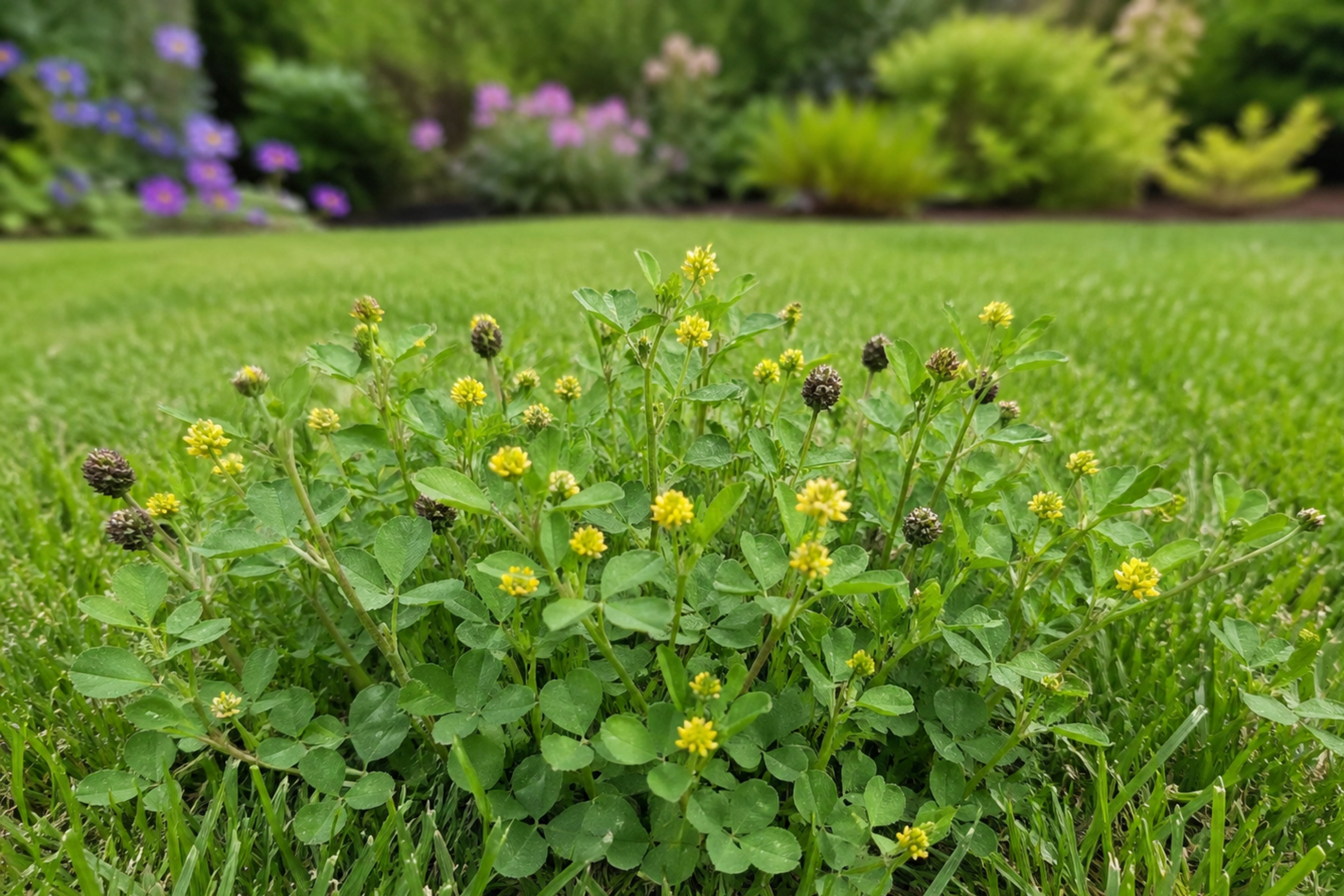
Identify black medick by leaf structure, tiny yellow flower clusters, and dark mature pods.
Black medick succeeds by combining low growth, quick seed output, and legume biology. It often thrives in weak turf, open patches, and lower-fertility sites where grass competition is poor.
Its special power is lean-soil opportunism: staying below the competition line while spreading laterally from a central root and benefiting from nitrogen-fixing legume ecology.
It does not need dramatic height. It wins by occupying low gaps in stressed turf and reproducing efficiently.
The plant often indicates site condition. Frequent black medick can signal thin, stressed, or underperforming turf where gaps are not closing.
Myth: Black medick is just clover. Truth: It is clover-like but belongs to Medicago, not Trifolium.
Myth: It is the same as oxalis. Truth: These are different weeds with different flower and seed structures.
Myth: Mowing will solve it. Truth: Prostrate growth helps it survive routine mowing.
Myth: All three leaflets are identical. Truth: The center leaflet often has a short stalk and can show a small tip spur.
Myth: The name comes from dark leaves. Truth: The mature seed pods turn dark or black.
Myth: It is only useless. Truth: It can be a turf nuisance while still having forage or soil value in other contexts.
What is black medick?
Black medick is a small clover-like legume, Medicago lupulina, commonly found in lawns, disturbed areas, fields, and pastures.
Is black medick true clover?
No. It is in the genus Medicago, not Trifolium.
How do you identify black medick?
Look for a low spreading plant with three oval leaflets, tiny yellow flower clusters, and dark seed pods when mature. The center leaflet usually has a short stalk.
Why does black medick show up in lawns?
It often appears where turf is thin, stressed, or open, because its low growth and legume traits let it exploit those gaps.
Does mowing remove black medick?
Usually not completely. Its prostrate habit helps it survive ordinary mowing.
What is its hidden advantage?
Its hidden advantage is lean-soil opportunism: the ability to stay low, spread outward, and cope well in weaker turf through legume-based biology.
Black medick looks small and harmless, but it is a tactical ground-level invader. It holds position from a central root, spreads low, reproduces efficiently, and exploits exactly the weak turf conditions that many grasses fail to outcompete.