Weed species guide
National weed methodology: weeds hub, how we treat weeds, weed guarantees, weed control by area. Identification: weed identification. Safety: treatment safety.
Trifolium spp. · legume · creeping stolons
Clover is one of the most familiar lawn and pasture plants, but also one of the most misunderstood. It belongs to the genus Trifolium in the pea family, with white clover (Trifolium repens) being a common lawn species.
Clover is a leguminous plant group in the genus Trifolium. For lawn and weed management, the critical point is that clover is not a random broadleaf. It combines creeping stems, node-rooting spread, and nitrogen-fixing biology.
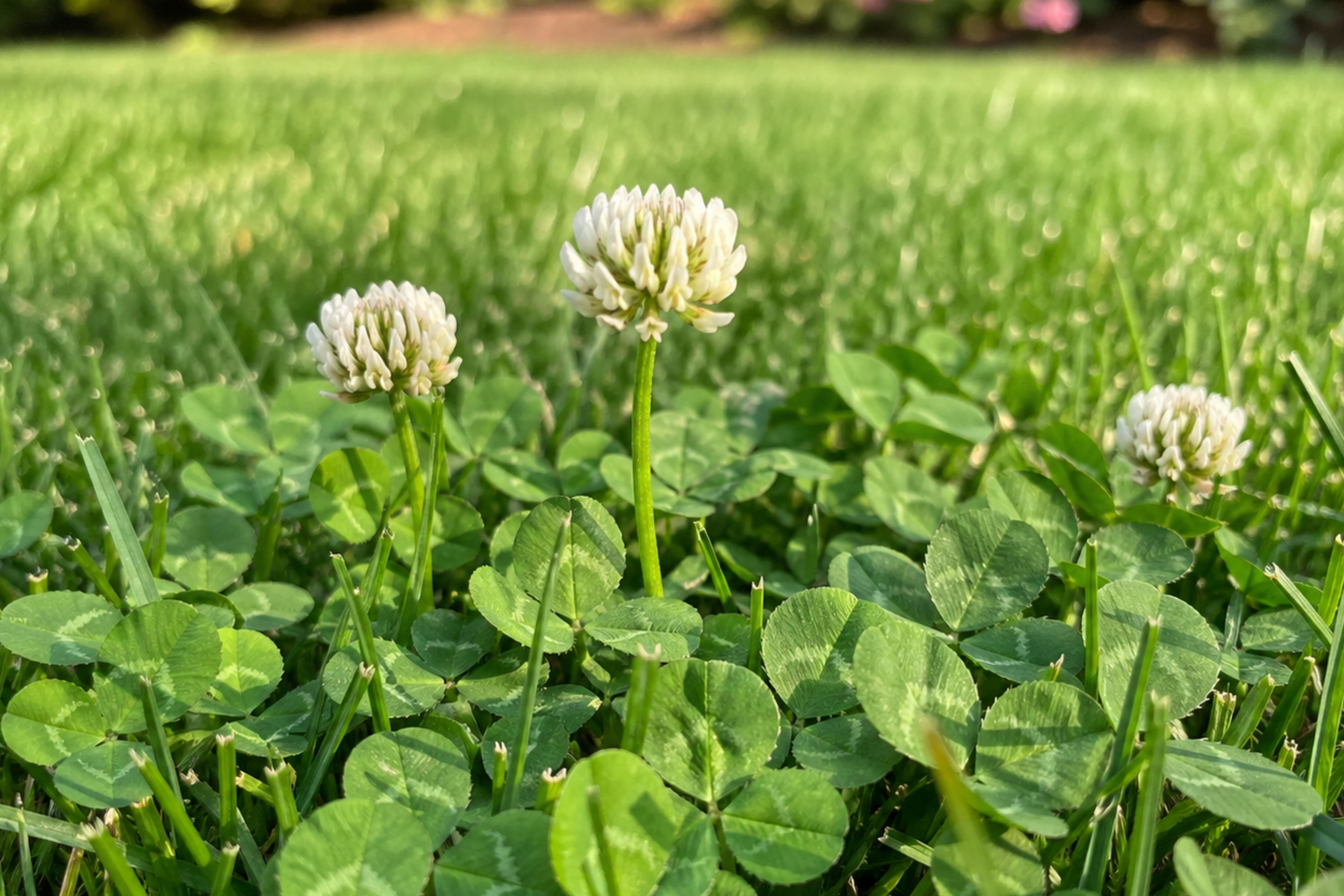
Clover is identified by trifoliate leaves, low creeping growth, and small clustered flowers.
Clover succeeds by combining creeping spread, repeated node-rooting, and nitrogen-fixing capacity. It often appears to dominate when turf is thin or low in fertility, not because it is magic, but because it is better suited to those conditions.
The most important advantage is not just the three-leaf look. It is nitrogen independence.
That is why clover can stay competitive where grass weakens.
White clover does not rely on seed alone. It can expand as a living network through creeping stems that root at the nodes, forming persistent lateral patches.
Myth: Clover means soil is healthy. Truth: It can improve soil, but in turf it often indicates weak grass and low nitrogen.
Myth: It only spreads by seed. Truth: It spreads by seed and node-rooting creeping stems.
Myth: All clover is the same. Truth: Clover is a genus with annual and perennial species.
Myth: If it is low and soft, it is harmless to lawns. Truth: It can form persistent competitive patches in thin turf.
Myth: More fertiliser always makes it vanish instantly. Truth: Nitrogen shifts competition, but established patches remain persistent.
Myth: Clover is useless except as a weed. Truth: It can be valuable as forage and a soil-improving plant in other contexts.
What is clover?
Clover is a group of leguminous plants in the genus Trifolium, with white clover (Trifolium repens) being one of the most common lawn species.
Why does clover show up in lawns?
It commonly establishes where turf is thin or low in nitrogen, because clover can fix nitrogen and compete well in those conditions.
Does clover spread by seed only?
No. White clover also spreads by creeping stems that root at the nodes.
Is clover good or bad?
That depends on context. It is valuable as a forage and soil-improving plant, but in turf it is often considered a weed when it forms unwanted patches.
Why is clover so hard to outcompete?
It combines low growth, sideways spread, and nitrogen-fixing biology, giving it an advantage where grass is weak.
What is its hidden advantage?
Its hidden advantage is nitrogen independence: the ability to persist using legume nitrogen fixation while spreading laterally across the ground.
Clover is underestimated because it looks soft and harmless. Its real supremacy is quiet efficiency: it hugs the ground, roots as it spreads, and carries a nutrient advantage that helps it persist where turf is weak.