Weed species guide
National weed methodology: weeds hub, how we treat weeds, weed guarantees, weed control by area. Identification: weed identification. Safety: treatment safety.
Oxalis corniculata · mat-former · ballistic seed
Creeping woodsorrel (Oxalis corniculata) is one of the most misidentified lawn weeds because it looks clover-like at first glance, yet belongs to a different plant group. Kew treats Oxalis corniculata as an accepted species. Its real strength is ground-level spread plus active seed launch.
It is a broadleaf weed in the genus Oxalis, not a true clover. Weed references describe it as a rapid-establishing landscape weed, and Kew describes the species as annual or perennial. In practical terms, it is a persistent low spreader in disturbed managed ground.
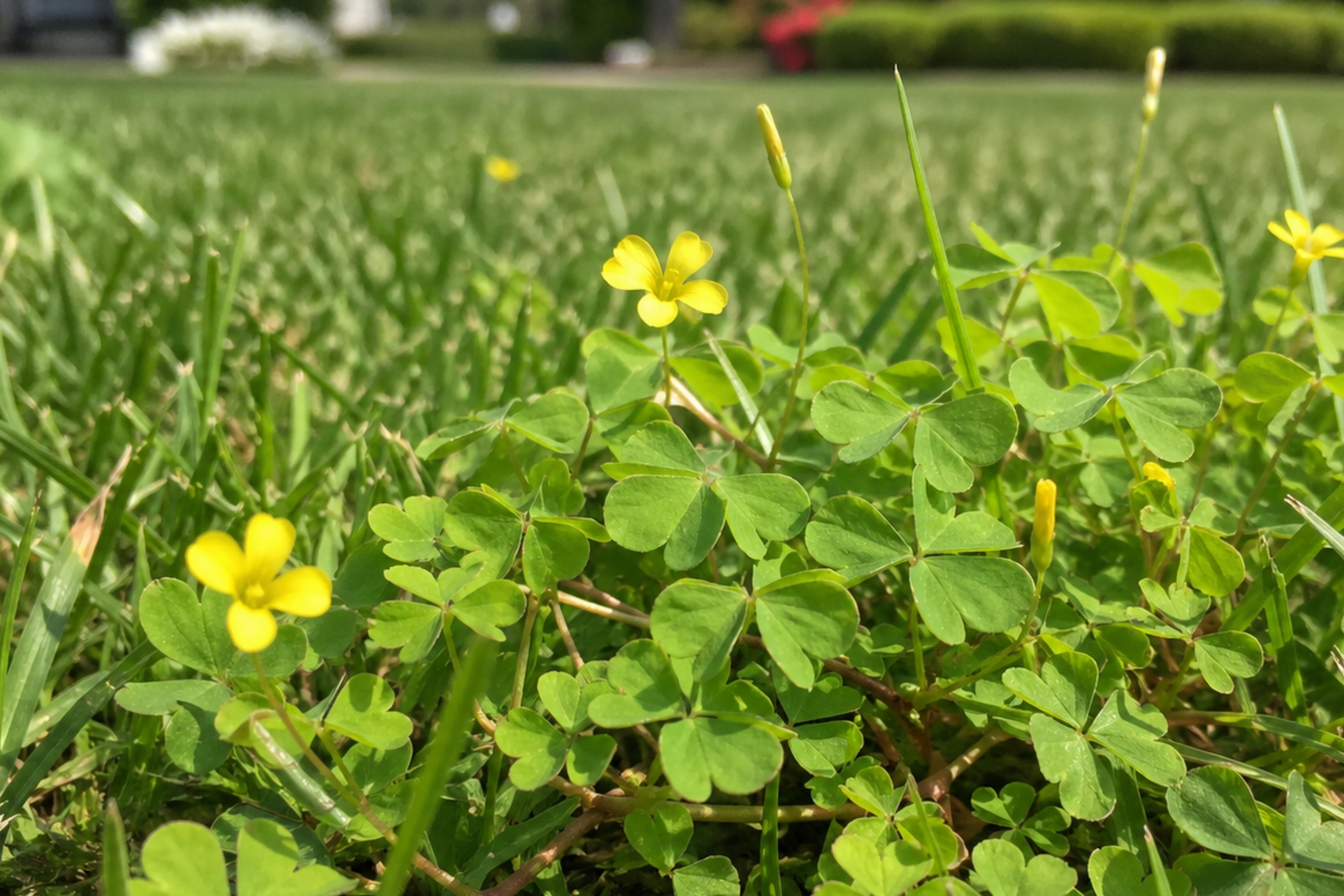
Creeping woodsorrel is identified by leaf shape, flower structure, and growth form.
Creeping woodsorrel succeeds because it combines rapid establishment, mat-forming ground spread, and efficient seed dispersal. It can hold local space while continuously creating nearby colonisation opportunities.
Its special power is seed catapulting. Oxalis seed structures can eject seeds mechanically, so dispersal is not only passive.
Creeping woodsorrel is often an opportunist of openings. Recurrent problems can indicate weak ground cover, bare patches, or repeated disturbance rather than a single isolated weed event.
Myth: It is just clover. Truth: It is an Oxalis species, not Trifolium clover.
Myth: Three leaves always means clover. Truth: Flower and fruit structures are more reliable identifiers.
Myth: Mowing gets rid of it. Truth: Its low mat-forming habit helps it survive ordinary mowing.
Myth: It spreads only when wind blows seed in. Truth: Oxalis also has ballistic seed ejection.
Myth: It is only a shade weed. Truth: Shade can favor it, but it can establish in disturbed open surfaces too.
What is creeping woodsorrel?
Creeping woodsorrel is Oxalis corniculata, a low-growing broadleaf weed in the Oxalis group.
Is creeping woodsorrel clover?
No. It only looks similar because both have three-part leaves. Creeping woodsorrel is an Oxalis species, not a clover.
How do you identify it?
Look for a low creeping patch, three heart-shaped leaflets, and small yellow five-petalled flowers.
Why is it so persistent?
It spreads low across the surface and also reproduces through a very effective seed system.
Does it only grow in shade?
No. It is often noted in shady inland beds, but it can also establish in other disturbed open surfaces.
What is its hidden advantage?
Its hidden advantage is seed catapulting: the ability to combine creeping spread with explosive seed ejection.
Creeping woodsorrel is easy to underestimate because it looks tiny and familiar. Its real supremacy is quiet precision: a ground-hugging habit plus a seed-launch mechanism that helps it repeatedly expand from local patches.