Weed species guide
National weed methodology: weeds hub, how we treat weeds, weed guarantees, weed control by area. Identification: weed identification. Safety: treatment safety.
Taraxacum officinale · rosette perennial · wind-dispersed achenes
The dandelion is one of the world's most recognisable plants, but also one of the most misunderstood. Usually labelled as Taraxacum officinale, it is treated by Kew within a wider Taraxacum complex, which is one reason naming can be more complicated than people expect.
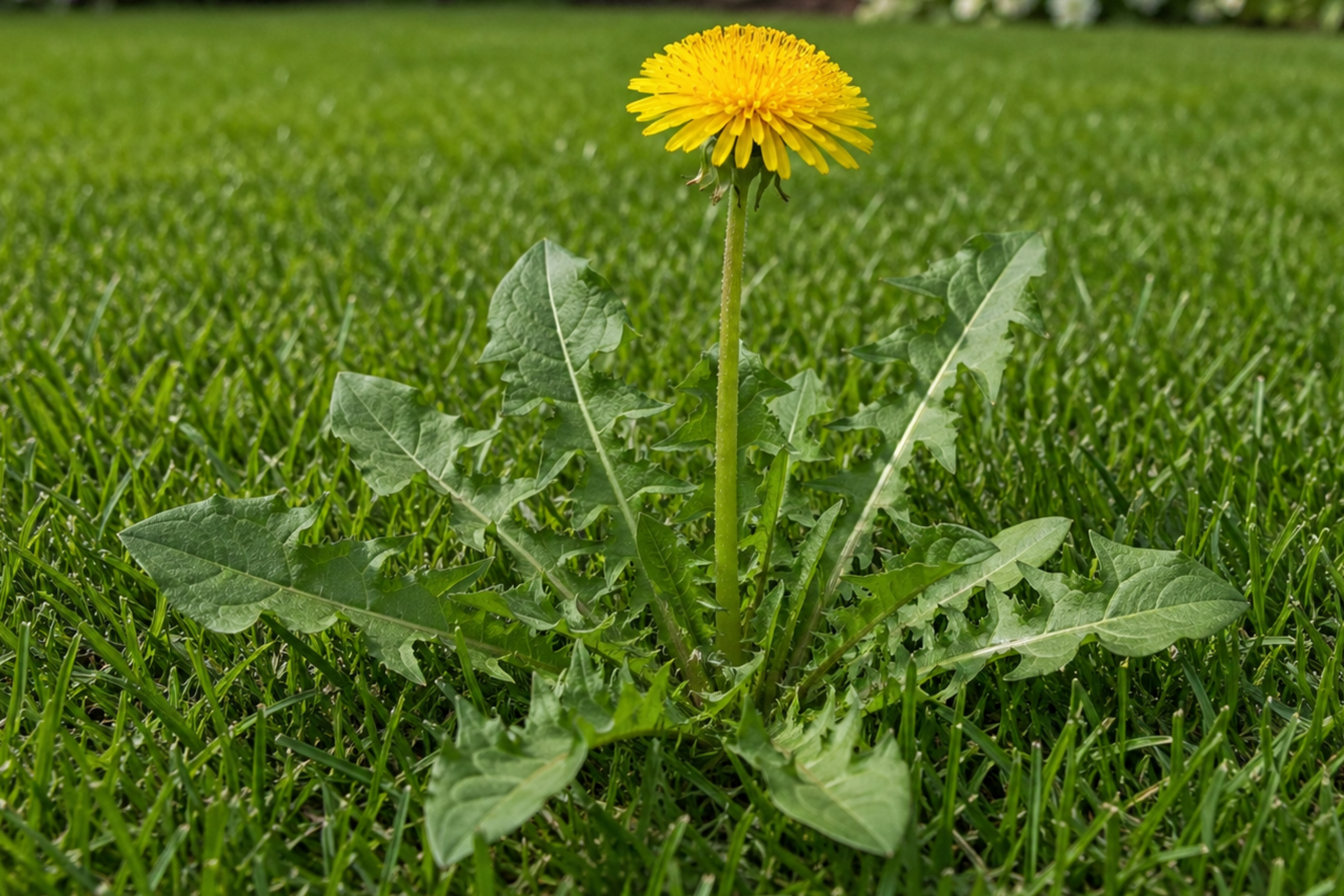
A dandelion is a perennial broadleaf plant in the genus Taraxacum. It forms a low basal rosette, yellow flower heads, and the familiar white seed clock. It thrives in moist sunny areas but tolerates shade and drier conditions once established.
The key practical truth for management is this: dandelion is not a random lawn weed. It is a specialised disturbance survivor built to stay low, root deeply, and spread efficiently.
Dandelions are identified by leaf form, flower, seed head, and growth pattern.
Dandelion combines low-profile survival with long-distance reproduction. The rosette keeps growth near the ground, the taproot stores resources for regrowth, and the seed stage allows rapid spread into open ground.
Its strength is not loud aggression. It is a quieter strategy: stay low, stay rooted, and spread often.
Most people focus only on wind-blown seeds. The deeper advantage is split-strategy survival.
Some plants stay put, some spread. Dandelion does both. That means it can regrow after cutting while its seeds establish elsewhere.
What looks like one flower is actually a composite head made of many florets (Asteraceae). This helps explain how one flower head can produce a dense globe of many wind-borne fruits, each with its own pappus.
Myth: Dandelion is useless. Truth: It can be troublesome in turf while still having ecological and historical uses.
Myth: If you mow it, it is gone. Truth: Mowing often suppresses appearance more than the rooted plant.
Myth: The puffball is one seed. Truth: It is a cluster of many fruits with pappi.
Myth: All yellow lawn flowers are dandelions. Truth: Proper ID depends on rosette, hollow stalks, toothed leaves, and seed head.
Myth: It only grows in rich wet places. Truth: It prefers moist sun but tolerates wider conditions once established.
Myth: It spreads only by seed. Truth: It spreads by seed and persists as a perennial rooted individual.
What is dandelion?
Dandelion is a perennial broadleaf plant in the genus Taraxacum, commonly referred to as Taraxacum officinale in everyday use.
Is dandelion a flower or a weed?
Both, depending on context. Botanically it is a flowering plant in the daisy family; in lawns and turf it is often treated as a weed.
Why does it keep coming back?
It is a perennial with a strong root system and a basal crown that can regrow after top growth is removed.
What is the white puffball?
It is a mature seed head made up of many individual fruits, each with a parachute-like pappus for wind dispersal.
Does dandelion only spread by wind?
Wind dispersal is a major part of its spread, but its persistence also comes from its perennial rooted habit.
What is its hidden advantage?
Its hidden advantage is split-strategy survival: staying alive through a strong root system while also spreading efficiently by air.
The dandelion is underestimated because it looks simple. Its supremacy is quiet resilience: ground-hugging growth, stored strength below the surface, then a cloud of parachute-borne offspring. That is why it is far more impressive than the word "weed" suggests.