Weed species guide
National weed methodology: weeds hub, how we treat weeds, weed guarantees, weed control by area. Identification: weed identification. Safety: treatment safety.
Plantago spp. · rosette · compaction-linked
Plantain is often underestimated because it looks low and harmless. In lawn contexts, it usually refers to Plantago species such as broadleaf plantain (P. major) and ribwort plantain (P. lanceolata), both known for rosette growth and upright seed spikes.
Plantain, in the weed sense, is a broadleaf herb in the genus Plantago. The most important practical truth is that plantain is a disturbance specialist: a rosette-forming survivor that handles hard ground and weakened turf competition.
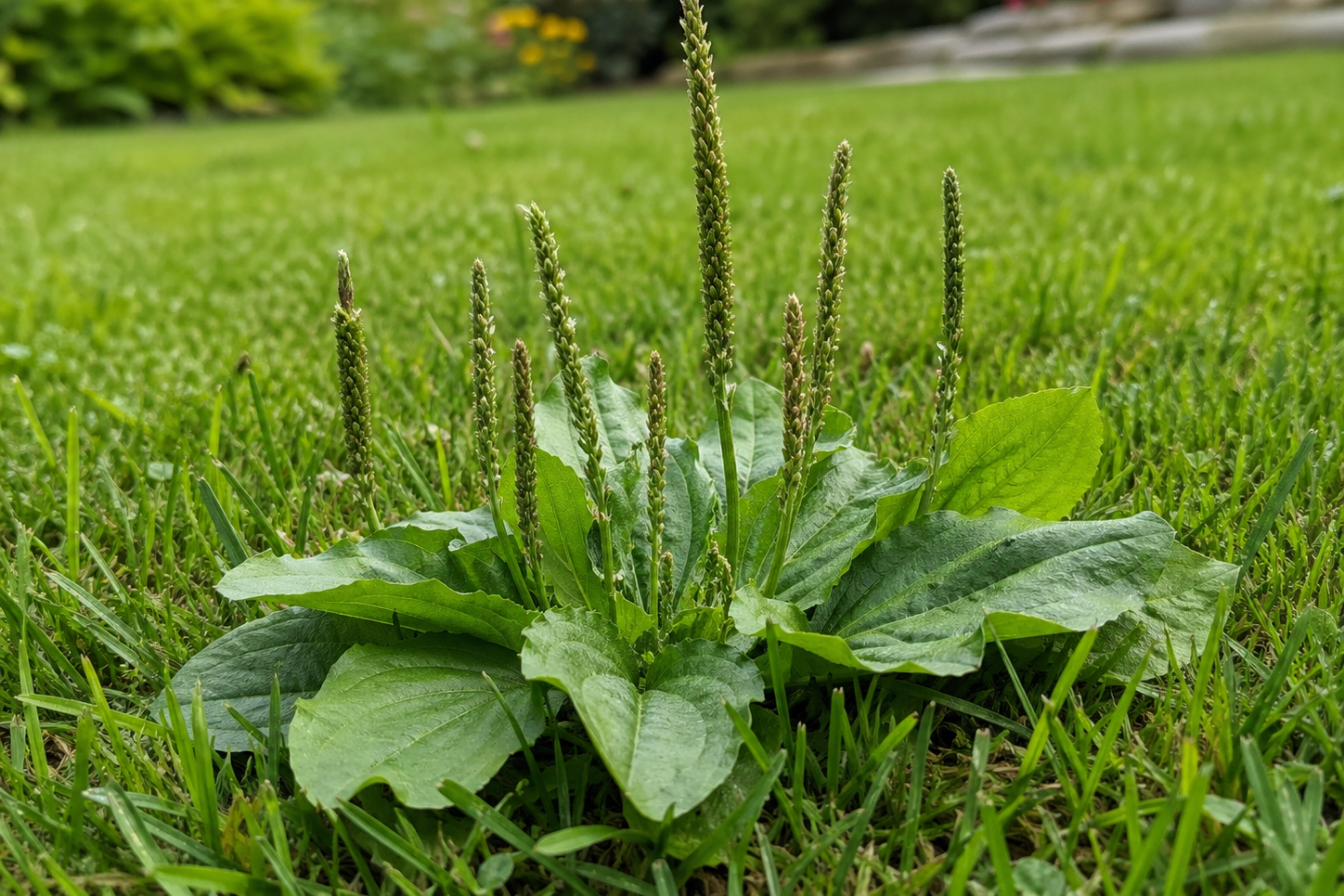
Plantain is identified by basal rosette growth, ribbed leaves, and upright seed spikes.
Plantain combines low-profile growth with tolerance for difficult ground. Its rosette growth helps it survive mowing and traffic, while weak, compacted turf creates openings it can occupy.
The key advantage is not only seed count. It is compression survival.
This allows persistence in hard-used areas where upright competitors fail.
Plantain produces many seeds, and seeds in this genus are known for wet-stick or mucilaginous behavior that supports movement and persistence. The plant can survive locally and continue colonising nearby gaps.
Myth: Plantain means banana. Truth: In lawn context, plantain refers to Plantago weeds.
Myth: All plantain is the same. Truth: Broadleaf and ribwort forms differ in leaf and spike shape.
Myth: If you mow it, it will go away. Truth: Mowing often removes upper growth but leaves the rosette and crown.
Myth: It only grows in poor soil. Truth: It is mainly a disturbance and compaction indicator.
Myth: The spikes are not flowers. Truth: They are flowering and seed-producing structures.
Myth: It is harmless because it stays low. Truth: Its low form is a competitive survival advantage.
What is plantain?
In a lawn or weed context, plantain means species in the genus Plantago, especially broadleaf plantain (Plantago major) and ribwort plantain (Plantago lanceolata).
Why does plantain show up in lawns?
It commonly shows up where the ground is compacted, disturbed, or the turf is thin and stressed.
How do you identify plantain?
Look for a flat rosette of ribbed leaves and upright stalks with dense flower or seed spikes. Broadleaf plantain has broad leaves; ribwort plantain has narrow leaves.
Is plantain annual or perennial?
The common lawn plantains are generally perennial weeds.
Why is it so persistent?
Its low rosette helps it survive mowing and traffic, and it produces many seeds.
What is its hidden advantage?
Its hidden advantage is compression survival: the ability to thrive where the soil is hard and competitors are weakened.
Plantain does not look dramatic, but it is strategically built for pressure. It tolerates compaction, hugs the ground, reproduces efficiently, and persists where turf competition weakens.