Pest guide · silverfish
National silverfish methodology: silverfish hub, how we treat silverfish, silverfish guarantees, silverfish control by area. Identification: silverfish identification.
Lepisma saccharinum
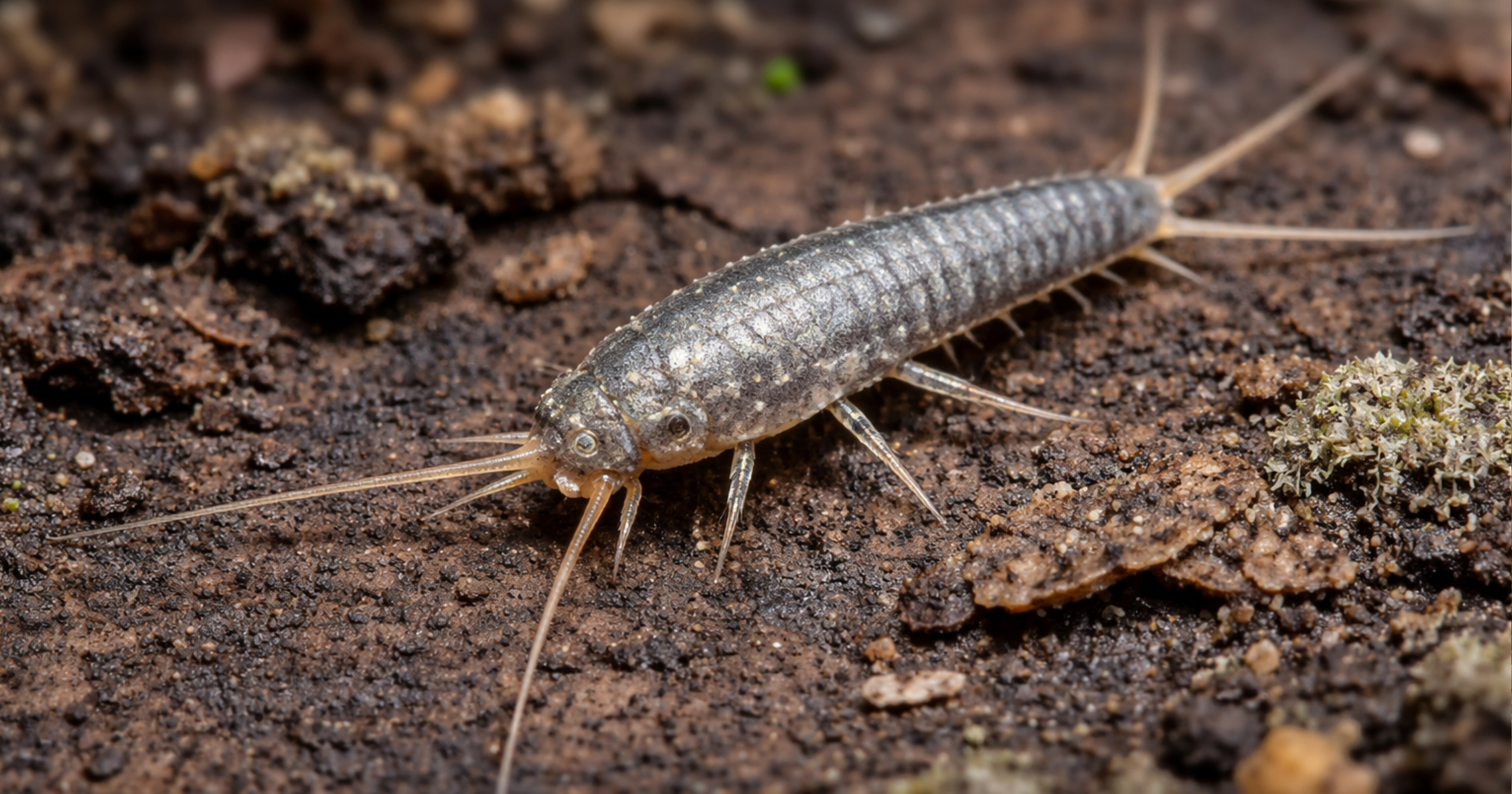
The common silverfish is Lepisma saccharinum, a small, wingless household insect known for its silvery scales, carrot-shaped body, long antennae, and three tail filaments. Britannica describes it as a primitive wingless insect, and university extension sources note that it is closely associated with indoor spaces where humidity and food sources are available.
Silverfish are not beetles, not moths, and not baby cockroaches. They belong to the order Zygentoma, a very old lineage of wingless insects. The nickname fishmoth comes from the way they move: fast, wriggling, and slightly fish-like. Britannica and extension references consistently describe the body as flattened, tapering, and covered in scales that give the insect its metallic sheen.
A common silverfish is usually:
One of the easiest field clues is the body texture. Silverfish are covered in tiny scales, which give them the powdery metallic look people notice on walls, floors, books, or bathroom surfaces. Their movement is also distinctive: quick, darting, and side-to-side rather than smooth like a cockroach.
Common silverfish prefer dark, sheltered, humid areas. University and extension sources commonly place them in bathrooms, kitchens, roof spaces, basements, laundry rooms, cupboards, book storage areas, and cracks around skirtings or shelves. They are strongly associated with moisture, but they can also persist in drier rooms if there is enough food and hidden harbourage.
This is where silverfish become more important than many people realise.
They feed on starches, sugars, paper-sized carbohydrates, and glues. That includes book bindings, wallpaper paste, paper, cardboard, some fabrics, photographs, and food residues. Extension sources also note they may feed on dead insects, dandruff, and other organic debris when available.
That means silverfish are not just “bathroom insects.” They are really stored-material and surface-feeding insects that happen to love humid hiding places.
Silverfish succeed because they combine:
They often remain unnoticed for a long time because they are mostly active at night and avoid open, bright spaces. By the time people see them regularly, the environment has usually been suitable for them for quite a while.
Most people think the silverfish's greatest strength is moisture tolerance or speed.
Those matter, but the more interesting biological advantage is this:
It keeps moulting even after becoming an adult
Britannica notes that silverfish continue to moult throughout life. That is unusual compared with many insects, which stop moulting once adulthood is reached. This means the silverfish keeps renewing its outer body covering instead of reaching a fixed final stage and simply wearing out.
That lifelong moulting ability is a major hidden strength.
It means the silverfish is built for long persistence, not just quick survival. Many household pests win by breeding explosively. Silverfish also win by lasting, staying hidden, and continuing to develop and renew over time. That makes them especially well suited to quiet indoor environments like archives, cupboards, ceiling voids, linen storage, and book areas. This is an inference based directly on their documented lifelong moulting biology and slow, persistent indoor habit.
Its special power is not aggression.
It is not venom.
It is not brute reproduction.
It is durable persistence: a body plan and life cycle built for slow, repeated renewal and long-term survival indoors.
Silverfish are unusually good at turning ordinary household materials into nutrition. Sources consistently note their attraction to starches, polysaccharide-rich materials, paper products, adhesives, and similar substrates. That is one reason they are so frustrating: the building itself often contains food for them.
In plain language, a silverfish can treat your stored paper goods, book glue, cardboard, wallpaper paste, and overlooked food residues as a buffet. That makes them very different from pests that depend mainly on fresh food spills.
Silverfish are difficult because they combine:
That means control often fails when people focus only on the visible insect and not the conditions behind it, especially moisture, paper clutter, adhesive-rich materials, and inaccessible cracks.
Silverfish are among the more ancient-looking household insects, and part of what makes them fascinating is how simple and effective their body plan is. A flattened form lets them disappear into tiny spaces. Scales reduce abrasion. Nocturnal movement keeps them away from danger. Lifelong moulting helps them endure. And a starch-based diet lets them exploit buildings in a way many insects cannot. That combination makes the common silverfish far more specialised than people think. This is a synthesis supported by the cited identification and biology sources.
The common silverfish is one of the most underestimated household pests. It does not dominate by force. It dominates by staying hidden, feeding on ordinary indoor materials, and lasting far longer than people expect. Its real power is quiet persistence, and that is exactly what makes it such a stubborn pest in homes, offices, libraries, and storage areas.
Next: how we treat silverfish, silverfish guarantees, silverfish identification guide. Book silverfish control in Cape Town. Read silverfish treatment safety.
Lepisma saccharinum — humidity, harbourages, and stored starch sources; your quoted programme and cooperation items prevail.
Damage to books or wallpaper? Use get a quote for a survey-led plan.
We map harbourages, treat where they hide, and pair it with practical moisture and storage advice—national silverfish methodology; your quote prevails.
How we treat silverfish, Silverfish guarantees, Silverfish control by area, Silverfish identification guide. Hub: silverfish control.