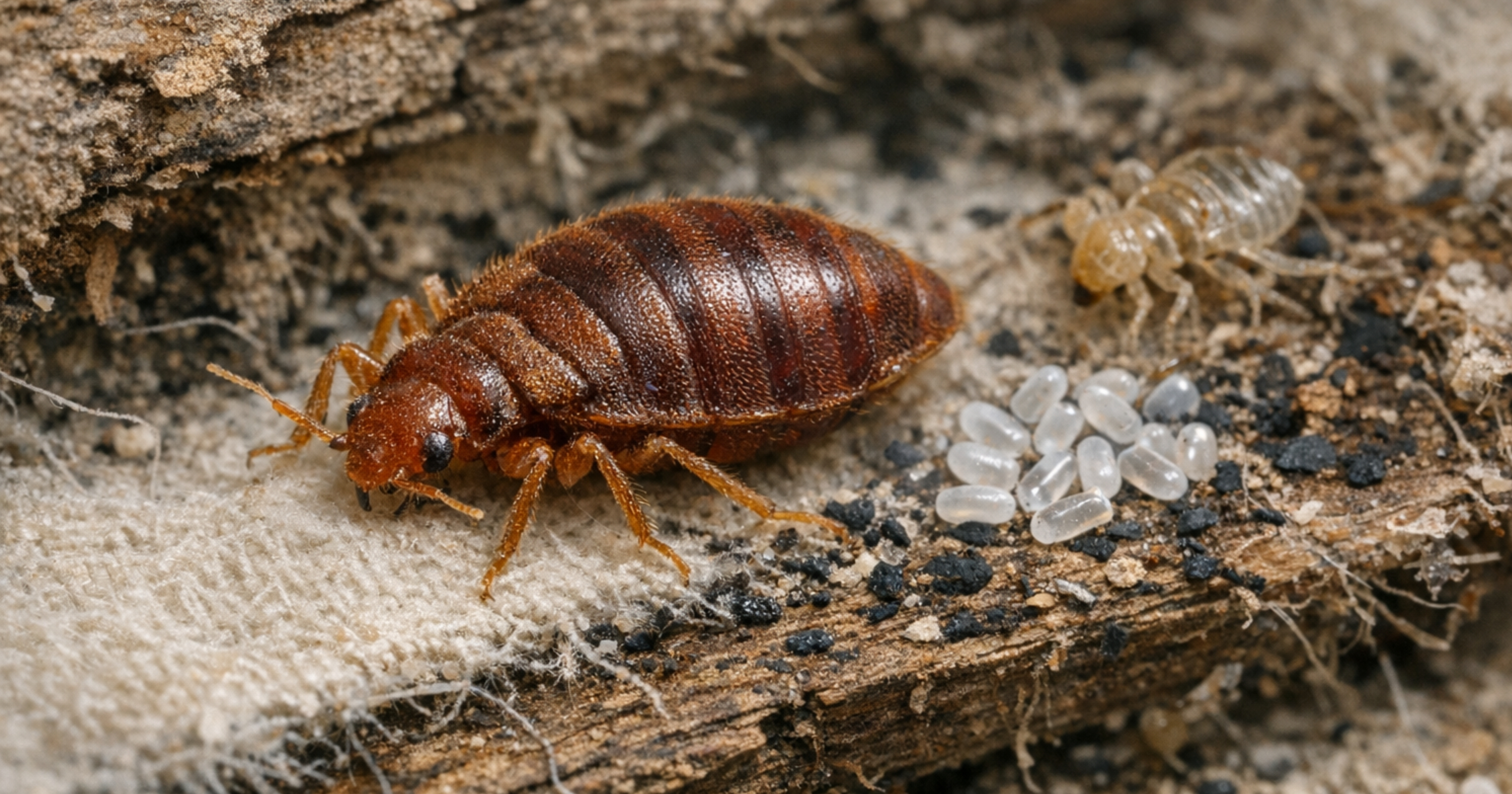
Pest guide · bed bug family
Species anchor: Cimex lectularius. Public-health sources also track Cimex hemipterus as a second key human-associated species in warmer regions; this page focuses on the common bed bug.
Cimex lectularius
The common bed bug is one of the most misunderstood pests in homes, hospitality, and shared accommodation. It is not powerful because it is fast, big, or visibly dangerous. It is powerful because it is flat, secretive, blood-specialised, resilient, and biologically built to survive long periods with very little opportunity. The CDC describes adults as oval, dorsoventrally flattened insects with piercing-sucking mouthparts, and notes that nymphs resemble smaller, paler adults.
The common bed bug, Cimex lectularius, is a wingless, blood-feeding insect in the family Cimicidae. It feeds on humans, but can also feed on other mammals and birds when available. Its main medical importance is not disease transmission, but the skin reactions, irritation, anxiety, discomfort, and sleep disruption associated with infestations and bites. The CDC states that although bed bugs have been found naturally infected with various pathogens, they are not effective vectors of disease.
Adult common bed bugs are typically about 5 mm long, oval, flattened, reddish-brown to brown, and wingless. The CDC notes that the forewings are reduced to tiny pads and the hind wings are essentially absent. Nymphs look like smaller, paler versions of the adults and become redder or darker after a blood meal.
What to look for
Bed bugs are experts at remaining unseen. The CDC describes them as hiding in cracks and crevices close to where people rest, especially around beds and furniture. EPA guidance adds that control often fails because not all hiding places are found, including bed frames, nearby furniture, hampers, and adjacent rooms or flats in multi-unit buildings.
Bed bugs are serious pests because they combine stealth, persistence, and human proximity. They live where people sleep, they feed discreetly, and they are good at avoiding detection during the day. The CDC notes that their main health impact is usually inflammation and allergic reaction from bites, while CDC and EPA material also emphasize the anxiety, discomfort, sleeplessness, and quality-of-life effects associated with infestations.
Most people think a bed bug's greatest power is its bite.
That is not the real answer.
Its deeper advantage is its extreme adaptation to a blood-only lifestyle combined with remarkable stress tolerance. Reviews on bed bug stress tolerance describe bed bugs as unusually resilient to dehydration, starvation, and environmental stress for an indoor pest. Other recent reviews explain that because blood is nutritionally incomplete, bed bugs rely on obligate bacterial symbionts to provide key nutrients, especially B vitamins. In other words, this insect is not just a parasite — it is a tightly engineered biological system built around blood feeding.
The common bed bug's lesser-known advantage is that it survives on a difficult, limited food source by partnering with nutritional symbionts that help correct what blood lacks. That partnership helps make strict blood feeding possible, and it is one of the reasons bed bugs are such specialised and successful parasites.
The flattened body of Cimex lectularius is not just a shape. It is a survival tool. The CDC's description of the adult as dorsoventrally flattened explains why bed bugs can hide in narrow seams, cracks, and furniture joints that many people would never suspect. This body plan makes inspection harder and helps small numbers persist after incomplete treatment.
Bed bugs are famous in biology for traumatic insemination. In this mating system, the male pierces the female's body wall rather than mating through a conventional genital opening. Modern and classic research both describe this as a defining feature of cimicid biology. Female bed bugs have evolved specialised structures and immune responses linked to this unusual reproductive cost. It is one of the strangest and most extreme reproductive systems in insects.
This does not mean traumatic insemination is what makes bed bugs hard to control on its own. But it does show something important: bed bugs are not simple insects. They are highly specialised, evolutionarily unusual parasites with biology shaped by intense survival pressures.
Bed bugs are difficult because they combine:
EPA's guidance is very clear that bed bug control works best as IPM, meaning a combination of careful inspection, non-chemical measures, monitoring, encasements, targeted treatment, and follow-up. One-off, casual spraying often fails because the bugs are not all found and not all harbourages are treated.
The common bed bug is a strict blood feeder, and that seems simple until you look deeper. Blood is not a balanced diet, which means bed bugs depend on their microbial partners to make that way of life work. Recent symbiont research shows that Wolbachia and associated bacteria are tied to nutrient support in bed bugs, especially B vitamins. This is one of the best examples of how a pest can appear simple from the outside while being biologically sophisticated underneath.
If you want one accurate answer, it is this:
It turns scarcity into survival.
Many pests need crumbs, moisture, or visible food sources. Bed bugs do not. They need a host, a crack, and patience. What makes them formidable is the combination of:
The common bed bug is one of the most refined household parasites on earth. Cimex lectularius is not impressive because it is dramatic. It is impressive because it is quietly specialised: flat enough to vanish into seams, resilient enough to survive hard conditions, and biologically sophisticated enough to live on blood with microbial help. That is what makes it such a formidable pest — and why controlling it properly takes more than spray alone.
Move from ID to programme: how we treat bed bugs, bed bug guarantees, and the bed bug identification guide. For Cimex hemipterus—pronotum clues, interceptor escape research, resistance and heat nuance—see the tropical bed bug pest guide. Book a get a quote. Read bed bug treatment safety.
Cimex lectularius — disease-vector claims, bite-only confirmation, symbiont-supported blood feeding, and IPM over spray-only thinking.
Suspected harbourages? Book through our quote flow when you want inspection-led bed bug control.
We map harbourages and align heat or integrated programmes to your quoted scope—not spray-only guesses.
National methodology: bed bug hub. Signs and species cards: identification guide. Tropical counterpart: tropical bed bug pest guide. Bat-roost lookalike: bat bug lookalike guide.