Pest guide · bed bug family
Species anchor: Cimex hemipterus. Pair with common bed bug (Cimex lectularius) context—both are primary human-associated cimicids, with different distribution and monitoring nuances.
The tropical bed bug is not just a warm-climate version of the common bed bug. Cimex hemipterus is a distinct human-biting bed bug species, found mostly in tropical and subtropical regions, and it has become increasingly important because of travel, geographic spread, strong insecticide resistance, and physical traits that can make monitoring harder. Its real advantage is not “strength.” It is a combination of stealth, resilience, and surface-gripping ability that helps it survive where people expect traps and sprays to be enough.
The tropical bed bug is Cimex hemipterus, one of the two main bed bug species associated with human infestations, alongside the common bed bug, Cimex lectularius. CDC's DPDx notes that C. hemipterus is found mostly in the tropics and subtropics, while clinical references note that both species are increasingly being found outside their older “traditional” zones.
That matters for a pest guide because people often assume every bed bug is the same species. They are not. The tropical bed bug is a different species with different practical implications for identification, monitoring, and control.
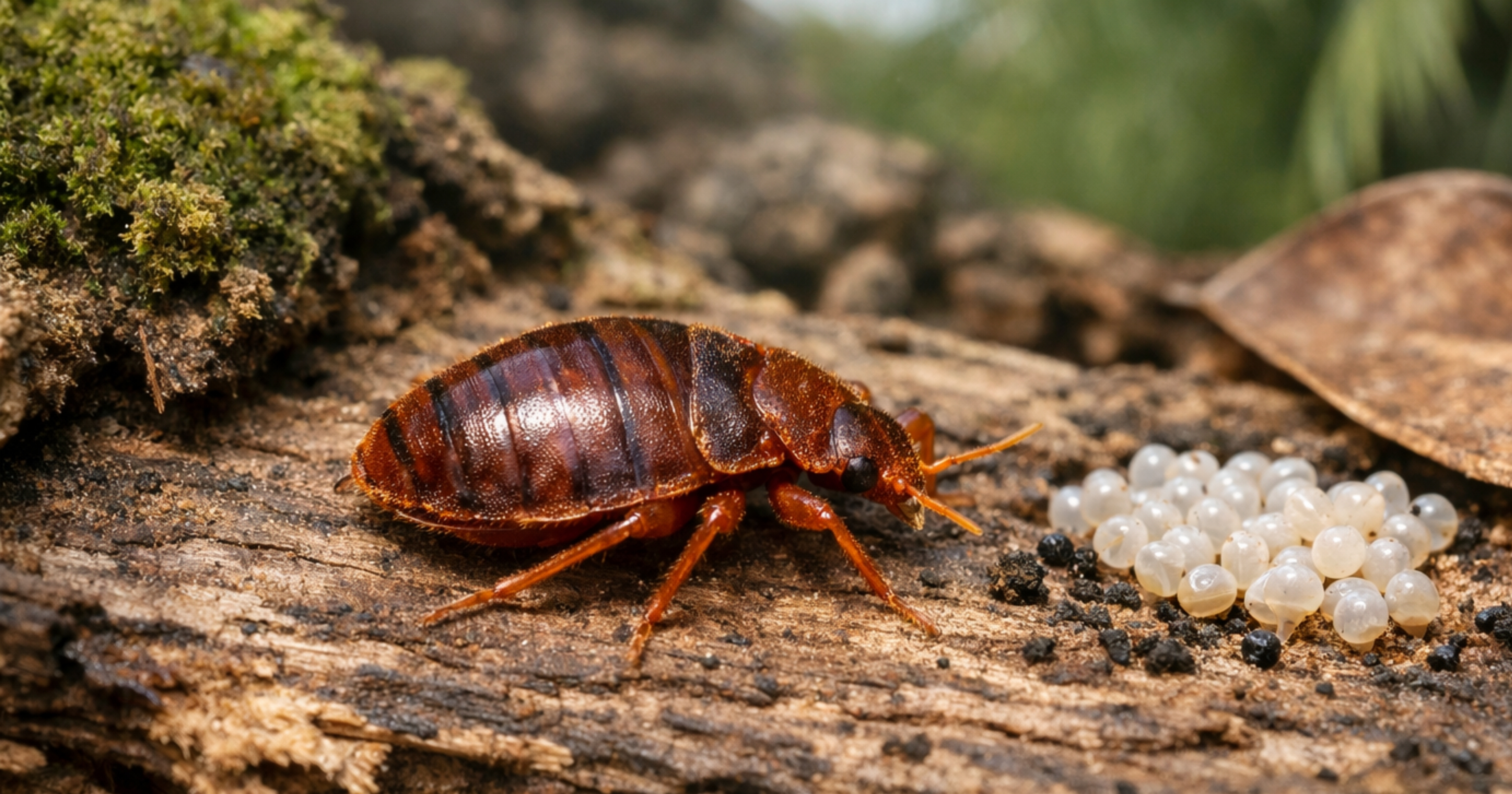
CDC describes adult bed bugs as oval, dorsoventrally flattened, and about 5 mm long, with piercing-sucking mouthparts and reduced wing pads rather than functional wings. For distinguishing C. hemipterus from C. lectularius, one of the classic clues is the narrower pronotum in C. hemipterus; studies and reviews repeatedly note that C. lectularius looks broader, especially across the pronotum.
What to look for
Tropical bed bugs are classically associated with tropical and subtropical climates, but newer records and reviews show that they are no longer confined neatly to those zones. Reviews describe the recent resurgence of both C. lectularius and C. hemipterus as being driven by global travel, commerce, and insecticide resistance, and there is published evidence of establishment of C. hemipterus in places where it was historically uncommon, including parts of Europe and Russia.
The practical truth: It is still fair to call C. hemipterus a tropical species, but it is not safe to assume it stays only in the tropics anymore.
Like other true bed bugs, Cimex hemipterus is a blood-feeding insect that uses piercing-sucking mouthparts. Reviews describe bed bugs as hematophagous ectoparasites of humans and sometimes other hosts, but in homes and accommodation settings the operational issue is human blood-feeding and harbourage close to resting places.
The tropical bed bug matters because it combines:
Clinically, bites can cause itching and irritation, but reactions vary a lot between people. Public-health reviews also note that although bed bugs have been studied for pathogen carriage, they are not established as important disease vectors in everyday human infestations the way mosquitoes or kissing bugs are.
The lesser-known trait that really stands out is this:
It is a better climber than the common bed bug.
A 2017 study comparing Cimex lectularius and Cimex hemipterus found that adult C. hemipterus had much better escape ability from smooth-surface pitfall traps, and the researchers linked this to morphological differences in the legs, including better-developed structures associated with grip. In plain language, tropical bed bugs can defeat some interceptor-style monitors more easily than people expect.
That is a huge operational advantage. Many monitoring tools were designed and validated mainly around C. lectularius. If C. hemipterus can climb out more effectively, then:
Not speed. Not “poison.” Not a painful bite.
Its hidden power is surface-gripping escape ability that helps it beat some common trap assumptions.
Reviews on bed bug resurgence repeatedly point to insecticide resistance as one of the main reasons bed bugs have become so difficult again, and this includes C. hemipterus. Research on tropical bed bug populations has documented resistance to multiple insecticide classes, while later reviews describe multiple resistance mechanisms operating in bed bugs, including metabolic detoxification, reduced cuticular penetration, target-site changes, and other broad-spectrum mechanisms.
The tropical bed bug is not difficult just because it hides well. It is difficult because many populations are biologically equipped to survive products that used to work far better.
A stress-tolerance review notes that C. hemipterus is slightly more heat tolerant than C. lectularius, and experimental work showed survival is strongly affected by temperature and humidity, with longest survival under cooler temperatures paired with high humidity. That does not mean heat treatment is useless; it means environmental tolerance in bed bugs is nuanced, and species differences matter.
Bed bugs, including cimicids, are famous for traumatic insemination: mating involves the male piercing the female's body wall rather than using a conventional genital opening. Work on cimicids and bed bugs describes this as one of the most unusual reproductive systems in insects. Females have evolved a specialised structure called a spermalege that helps reduce the damage.
This is not the reason they are hard to control, but it is one of the most extraordinary facts about the group and part of what makes bed bug biology so unusual.
They are difficult because they combine:
That is why serious control almost always requires integrated management, not just casual spraying. Reviews of bed bug control emphasize combining inspection, non-chemical measures, heat or other physical methods where appropriate, and carefully chosen chemical tools rather than relying on a single product.
The tropical bed bug is a superb survivor. Cimex hemipterus succeeds not because it is dramatic, but because it is biologically efficient: flat enough to hide, resilient enough to survive, mobile enough to travel with people, and in some cases agile enough to beat the very traps meant to detect it. That combination is what makes it such a formidable pest.
Programme context: how we treat bed bugs, guarantees, common bed bug pest guide, and the identification guide. Book a get a quote. Read bed bug treatment safety.
Cimex hemipterus — pronotum shape, interceptor escape research, resistance mechanisms, IPM vs spray-only framing.
Monitoring gaps or stubborn harbourages? Book through our quote flow for inspection-led bed bug control.
We map harbourages and align heat or integrated programmes to your quoted scope—species nuance informs inspection, not DIY spray roulette.
Compare common bed bug, bat bug lookalike (roost context), then bed bug hub.