Pest guide · learn more from the flea family
The cat flea, Ctenocephalides felis, is the dominant flea on both cats and dogs in much of the world. It is not a cats-only pest: it is a highly successful blood-feeding insect that also bites people, can be involved in pathogen spread, triggers severe allergic skin disease in pets, and acts as an intermediate host for some tapeworms. Veterinary and public-health references consistently identify it as the most prevalent flea on companion animals.
What makes cat fleas so hard to beat is that the adults you notice on the pet are only the visible fraction. Most of the population is usually off the animal—as eggs, larvae, and pupae in carpets, bedding, cracks, soil, and resting areas. People often treat the pet, see short improvement, then conclude the treatment “failed” when new adults appear. In reality, more fleas are still maturing off the animal.
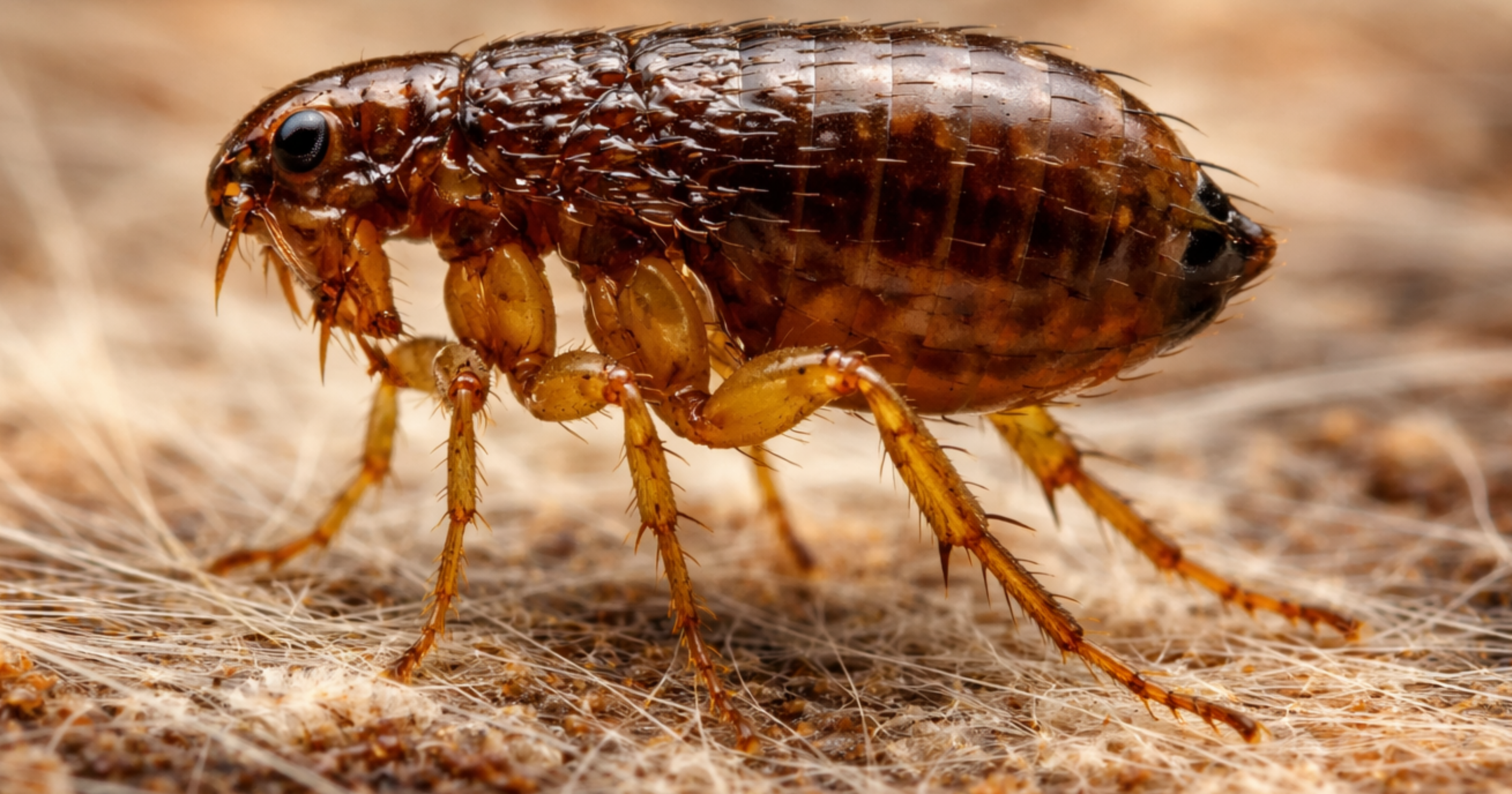
Cat fleas are tiny, wingless, laterally compressed insects—typically about 3–4 mm as adults—reddish-brown to dark in colour, built to move through fur rather than fly through air. Their flattened shape is functional: it helps them slip through hair and resist crushing. Identification references note that the cat flea tends to show a more elongated head than the dog flea; both species carry comb-like spines called ctenidia.
Adults are obligate blood feeders. Once they emerge and find a host, they feed quickly; females begin laying eggs soon after. Eggs are laid on the host but do not stay fixed—they fall into the environment. That single fact is central to why infestations are usually site infestations, not merely “pet infestations.”
You often hear that “fleas live on cats and dogs.” That is only partly true: adults live on the host, while eggs, larvae, and pupae develop mainly in the environment. Fleas pass through egg, larva, pupa, and adult—larvae develop off-host and later spin a cocoon. Eggs drop from the coat into bedding, carpets, soil, and similar sites where hatching occurs.
Infestations concentrate where pets rest, sleep, groom, or travel repeatedly. An apparently clean pet does not guarantee a flea-free home—immature stages may be developing in floor cracks, upholstery, kennel runs, shaded outdoor soil, or vehicle interiors while adults are only briefly on the animal.
After a blood meal, adults mate; females begin laying eggs. Depending on temperature and humidity, eggs may hatch in roughly a few days to about two weeks. Larvae feed on organic matter and flea dirt (partially digested blood from adults)—not directly from the host's bloodstream. In effect, adults feed the next generation. Under favourable conditions, a female may begin laying eggs within a couple of days of her first blood meal and average on the order of two dozen eggs per day (figures vary by source and climate). Small numbers can scale into a major site problem quickly.
Larvae develop for several days, then spin a cocoon. Inside, the pupa is protected—emerging later when signals align. That staggered emergence is why populations feel like they “come in waves.”
Fleas store and release energy through elastic structures in the cuticle; muscle power alone does not explain take-off. Comparative work reports impressive jump performance across flea species. Biologically, jumping supports rapid host access, escape from disturbance, and movement among resting sites—but in pest-control terms it is only one tool beside rapid feeding, fast egg production, off-host development, cocoon protection, and timed emergence.
Beyond itching, fleas drive flea allergy dermatitis—a hypersensitivity to salivary antigens—where intense signs may dwarf the number of adults you can find. Heavy infestations can contribute to anaemia in small animals. Fleas are also discussed as vectors for some pathogens and as intermediate hosts for tapeworms such as Dipylidium caninum: fleas ingest egg packets; pets can become infected by swallowing infected fleas. Flea control therefore overlaps rational worm-control conversations. Another line of research concerns Bartonella transmission among cats—with flea management part of the broader risk picture.
Verminator treats premises and advises coordination with your veterinarian for on-animal products and diagnostics. This guide is educational context—not a substitute for veterinary diagnosis or medication decisions.
Lateral compression and ctenidia assist movement among hairs; adults feed and reproduce quickly; eggs drop into protected microhabitats; larvae avoid light and recycle adult waste; pupae gain a shielded wait-state; adults time emergence to host cues. Alone, none of those traits is invincible. Together they form an efficient domestic parasite system—often underestimated because people focus on size instead of staging.
The headline is not “fleas jump high.” It is that cat fleas are biologically staged: adults on the host; eggs falling into the environment; larvae feeding on flea dirt; pupae waiting in cocoons; adults emerging when cues say a host is near. That is the honest explanation for recurring infestations, post-treatment flare-ups, and the familiar question—“We treated the pet; why are there still fleas?” Fighting only visible adults while ignoring the timing system underneath is how control programmes fail in practice.
The cat flea is a tiny parasite with an advanced survival strategy—common on cats and dogs, capable of biting humans, implicated in allergy and some disease contexts, and central to lifecycle-linked worm risk. Its real strength is lifecycle engineering: rapid reproduction, off-host development, larval use of flea dirt, and pupal emergence timed to host arrival. That combination makes Ctenocephalides felis one of the most successful domestic pests worldwide—and it is why professional premises treatment aligned with vet-led pet care is the coherent response when the whole system needs interrupting.
Short answers tied to real biology—not slogans.
Ready for premises-led flea control? Get a fast quote when you're ready.
We target where fleas breed and align with your vet's pet plan so the whole lifecycle is addressed. Fast quote.
For what “dog flea” usually means on dogs, see dog flea pest guide. For bites without pets or Pulex irritans context, see human flea pest guide. For species comparison and signs, start with our flea identification guide. For methodology and timelines, see how we treat fleas and flea guarantees.