Pest guide · learn more from the flea family
Fleas are among the most misunderstood household pests. People often treat them as a simple “dirty dog problem,” assume they only live on the pet, or expect a quick bath to fix everything. None of that is quite true. Fleas are specialised blood-feeding insects built for survival, concealment, and rapid reinfestation. On dogs, the biggest surprise is this: the flea you find is often not the true dog flea. In many regions, the cat flea—Ctenocephalides felis—is by far the most common flea found on dogs. The true dog flea, Ctenocephalides canis, exists, but it is often less common than people assume.
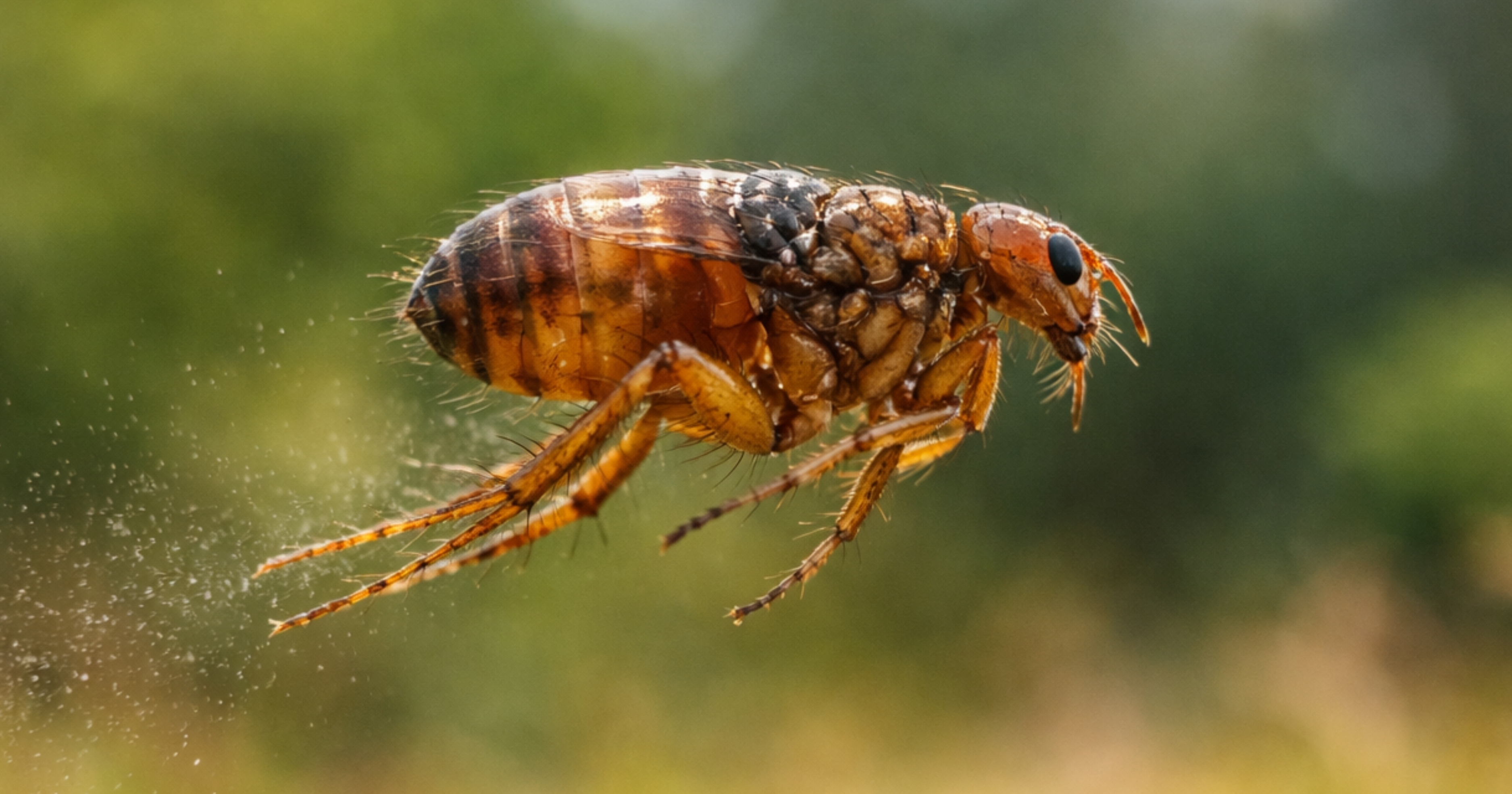
That matters because homeowners, pet owners, and casual conversation still use “dog flea” loosely, as though it were one pest with one simple treatment pattern. Flea control has to follow biology—not the nickname. Fleas are wingless, laterally compressed parasites that feed on blood, irritate skin, trigger allergic reactions, and can play roles in pathogen transmission or intermediate hosting for parasites such as tapeworms.
The true dog flea is Ctenocephalides canis. It is a valid species and can infest dogs, cats, and sometimes other mammals. Morphologically it differs from the cat flea in head shape and in details of the hind legs. For example, identification references describe C. canis with a more strongly rounded anterior head profile, while C. felis tends toward a more elongated head.
The practical truth: most flea infestations on dogs are driven by cat fleas, not true dog fleas. Major veterinary and entomology references consistently point to Ctenocephalides felis as the dominant flea on both dogs and cats in many settings. So when someone says, “My dog has dog fleas,” that may reflect everyday language—but scientifically it is often inaccurate. The dog has fleas, yes; the species is usually still the cat flea.
Fleas are not merely tiny biters. They are ectoparasites built around a coherent strategy: find a host, feed fast, reproduce quickly, and seed the next generation into the environment. After feeding and mating, females ramp up egg production. Published summaries vary by study and climate; peak output on the order of dozens of eggs per day is commonly cited for cat fleas, with averages over many days lower than the peak and egg production potentially continuing for extended periods in favourable conditions.
Those eggs do not stay neatly on the dog. They fall off into bedding, carpets, cracks, upholstery, shaded outdoor pockets, and resting sites. Larvae hatch and develop in the environment—typically away from light—not deep inside the coat. That is a core reason problems “come back” after adults are knocked down on the pet. Veterinary control guidance frames fleas as a patient + premises + reinfestation pressure problem: reduce fleas on the animal, reduce biomass in the building, and prevent new establishment—not “pet only.”
“If I can't see fleas on the dog, there's no flea problem.” Reasonable—and often wrong. Adults may be scarce because of grooming, low counts, or timing; allergy can flare when few bites occur. In flea allergy dermatitis (FAD), hypersensitivity to salivary proteins—not raw flea counts—often drives the clinical picture.
“Indoor dogs don't get fleas.” Also false. Even confined dogs join a flea cycle when fleas arrive via other animals, people, wildlife, prior occupants, or reservoirs in the home. Tapeworm cycles involving fleas illustrate how indoor animals can still be pulled into parasite pathways that include fleas.
“One treatment should finish it.” Usually not. Pupae inside cocoons are comparatively protected; movement, pressure, and heat can stimulate emergence. A “sudden” outbreak is often an old infestation surfacing on cue—not a brand-new invasion from nowhere.
Biomechanics work shows fleas using a catapult-like release of stored elastic energy—including resilin-rich structures—rather than relying on direct muscle power alone at the instant of take-off. Alongside that, lateral compression and comb-like anchorage (ctenidia) help fleas ride the coat and resist grooming. Jump, cocoon timing, and body design stack into a parasite that is hard to knock out casually.
Bites are not trivial punctures. Saliva carries biologically active compounds—enzymes, antigenic proteins, histamine-related chemistry—that irritate skin and can trigger hypersensitivity. FAD classically targets the mid-to-caudal dorsum, tailhead, and caudal thighs with chewing, hair loss, crusting, and secondary infection in sensitive dogs. Heavy burdens can contribute to meaningful blood loss in vulnerable animals such as young puppies; references also tie fleas to anaemia and to pathogen or parasite life stages under the right conditions.
Fleas are medically important and can be associated with pathogen transmission under real-world conditions—but precision matters. Public-health summaries link fleas to organisms that cause illnesses such as flea-borne typhus and plague in some contexts, and fleas factor into pathways that include Bartonella and Rickettsia discussions for species such as Ctenocephalides felis. That does not mean every flea on every dog is infected, or that every home infestation escalates into an emergency—it means fleas can serve as vectors or intermediate hosts when the chain of transmission lines up. Tapeworm cycles (Dipylidium caninum) involving ingested infected fleas during grooming are a familiar veterinary example.
Verminator treats premises and coordinates with your veterinarian for on-animal protocols. This page is general education—not a substitute for diagnosis, pathology testing, or prescription decisions.
People usually fight the visible adults on the dog while eggs have already dropped, larvae hide from light, and pupae resist exposure. Adults that emerge later—often cue-triggered—make product performance look inconsistent when the real issue is incomplete lifecycle interruption. Serious control means breaking the cycle, not only killing what is biting today.
No magic promises: durable outcomes usually coordinate three fronts—the host (vet-appropriate flea control), the environment (resting zones, textiles, cracks, shaded outdoors, repeated attention where biology demands), and future reproduction (immature stages and emergence, not adult knockdown alone). Modern programmes lean on residual chemistry, growth regulation, and schedules that match pupal emergence—not one-off dips.
That is also why premises-led professional treatment belongs in the same conversation as your vet's pet-side plan when the reservoir is environmental.
The biggest truth about “dog fleas” is that the label misleads. The pest on the dog is frequently the cat flea; suffering is often amplified by saliva allergy and hidden staging; and the flea's real mastery is synchronising emergence with host cues while pairing a spring-loaded escape with a body built to survive grooming. They are engineered for timing and persistence—not merely irritation.
Straight answers on species labels, indoors, itch, comeback fleas, and flea “superpowers.”
Need premises treatment aligned with your vet? Get a fast quote when you're ready.
We reduce environmental biomass on agreed scope and align with vet-led pet protocols. Quote when you're ready.
Compare species context on cat flea biology or human flea (Pulex irritans); use our flea identification guide for signs and tables. Methodology and warranties: how we treat fleas, flea guarantees.