Pest guide · learn more from the flea family
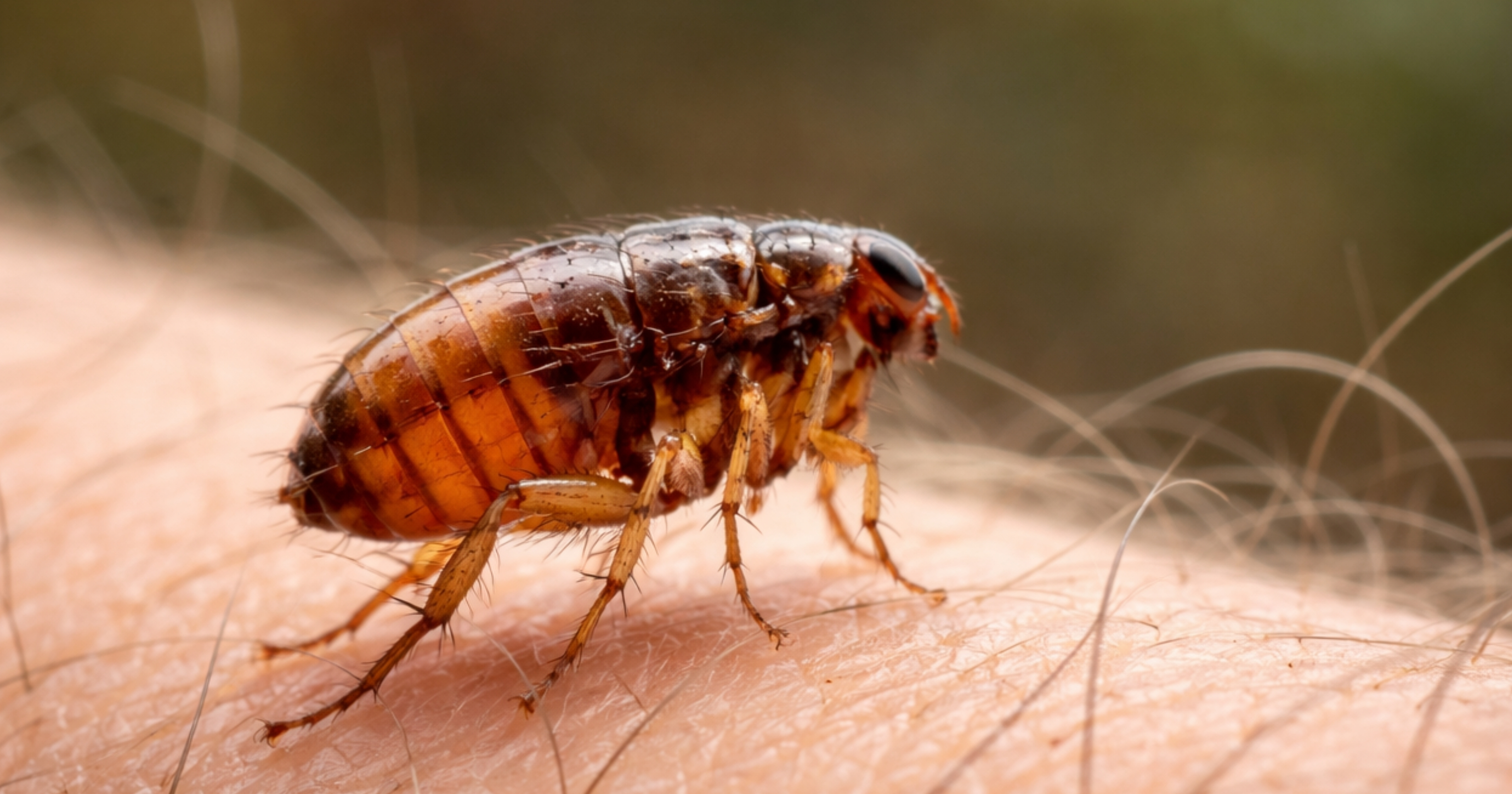
The human flea, Pulex irritans, is a real flea species historically tied to people, human dwellings, and animals living close to humans. It is small, wingless, laterally flattened, and built for slipping through hair, fibres, bedding, and clothing-like textures with little resistance. Morphologically, it is recognised by the absence of both genal and pronotal combs, a broadly rounded forehead, and an ocular bristle positioned below the eye.
One of the biggest misconceptions is that the human flea is the main flea biting people today. That is not reliably true. In many modern domestic infestations, people are more often bitten by cat fleas—or occasionally dog-associated fleas—from pets or shared environments. The human flea is absolutely real, but it is not always the default culprit just because a person is being bitten.
Another common half-truth is that the human flea only lives on humans. That is false. Pulex irritans can also be associated with dogs, cats, pigs, and other mammals, especially where animals and people live in close contact. Its name reflects historical association, not strict host loyalty.
The human flea is primarily a biting nuisance pest. Bites can cause itching, irritation, and allergic skin reactions because of salivary proteins introduced during feeding. Public-health summaries note it is not an efficient vector of flea-borne diseases—an important correction to exaggerated claims sometimes repeated online.
That said, “not an efficient vector” does not mean biologically irrelevant. The species appears in public-health and parasitology discussion because pathogen ecology can still matter in some settings. It may also act as an intermediate host for tapeworms such as Dipylidium caninum and certain Hymenolepis species. The balanced view: usually more irritating than epidemic—still serious enough to treat professionally when infestations persist.
For identification, human flea is often distinguished from cat and dog fleas by lack of comb-like spines (genal and pronotal ctenidia)—the structures many diagrams emphasise for pet fleas. That absence is a useful technical marker under microscopy. A broadly rounded frontal head profile also helps separate it from some common species in keys.
The human flea is a real, medically relevant flea species—but it sits in a fog of myths. Not every flea biting a person is Pulex irritans. It does not only live on humans. And it is not fairly described as always a major epidemic vector in typical domestic contexts. The accurate summary: a historically important, human-associated flea; flexible hosts; irritating or allergic bites; strong persistence in shared environments.
Human fleas are not just “people fleas.” They are opportunistic survivors built to exploit shared living spaces, mixed hosts, and overlooked environments.
Verminator focuses on premises treatment where fleas breed; persisting bites or skin concerns in people should stay with your clinician or pharmacist as appropriate. This guide is educational context—not personal medical advice.
For methodology when the environment needs interrupting alongside pet care, see how we treat fleas and compare species on our flea identification guide.
Bites, IDs, and vector talk—without the myths.
Need premises-led flea control? Get a fast quote when you're ready.
We target resting zones, textiles, and cracks—not guesswork—and align with coordinated pet protocols when animals share the space.
Pet-context fleas: cat flea pest guide, dog flea pest guide. Species comparison: flea identification guide. Methodology: how we treat fleas.