Pest guide · millipedes
National millipede methodology: millipede control hub, how we treat millipedes, millipede guarantees, millipede control by area. Identification: millipede identification · Shongololo guide.
Your quote names barrier footprint, moisture cooperation, and outdoor limits—this guide is educational and does not replace an on-site assessment.
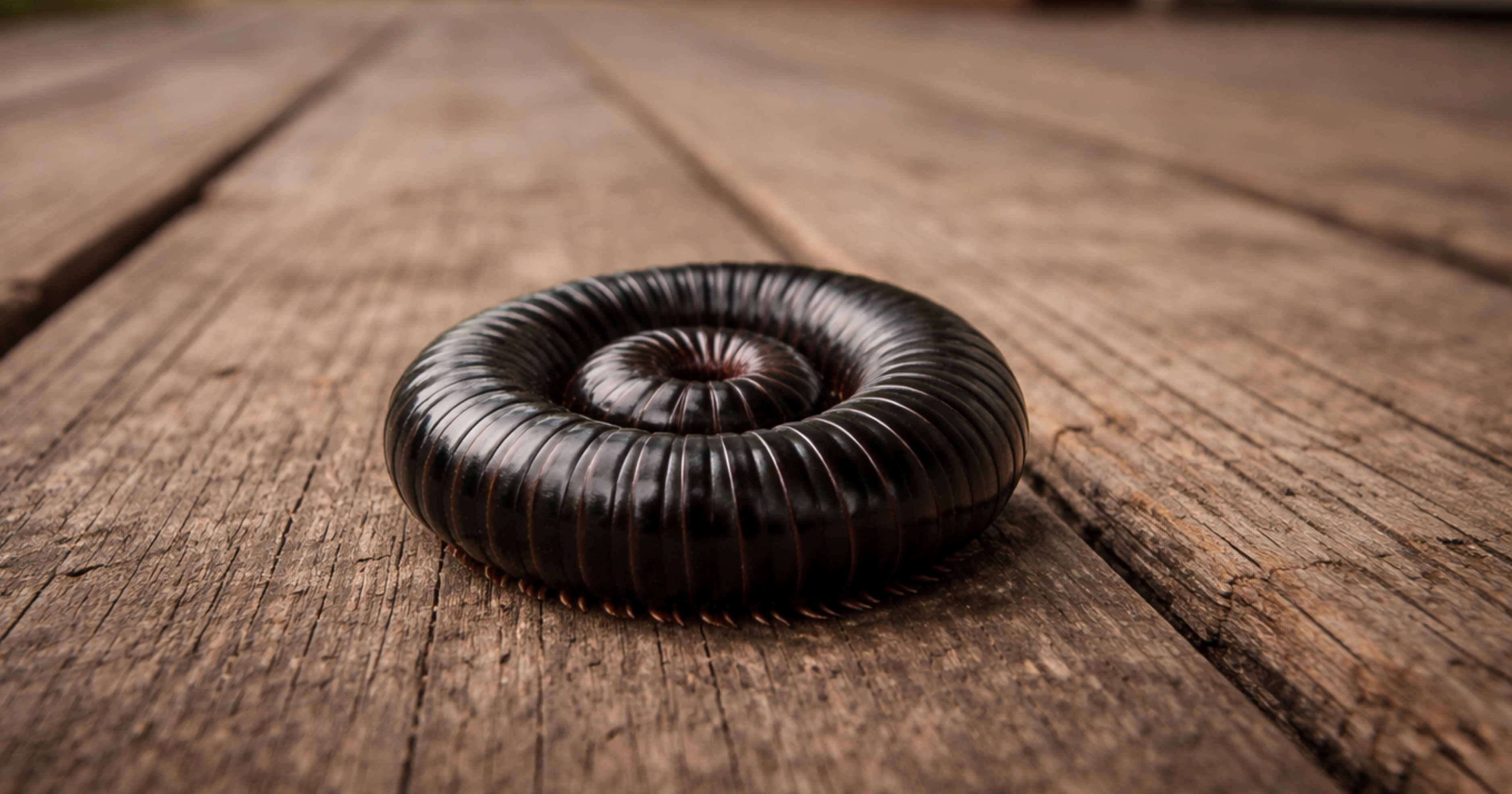
Various Diplopoda — common dark cylindrical types in mulch, litter, and at foundations
The garden or black millipede is not a dangerous household invader, but it is one of the most common moisture-linked nuisance arthropods people encounter around gardens, paving, mulch beds, and foundations. Its real strength is not speed or aggression. It is a combination of moisture-seeking behaviour, detritus feeding, powerful chemical defence, and an ability to exploit rich organic shelter that lets it thrive wherever damp plant matter accumulates.
A “garden millipede” or “black millipede” is usually a dark, cylindrical millipede found outdoors in moist, sheltered places such as:
Millipedes are not insects. They are arthropods in the class Diplopoda, and a key biological trait is that most body rings carry two pairs of legs, which helps separate them from centipedes. Extension material also notes that nuisance millipedes move slowly, often reach around 1 to 1½ inches in common household nuisance cases, and typically curl into a tight coil when disturbed.
What to look for
This is one of the easiest ways to distinguish them from centipedes. Centipedes are flatter, faster, and have one pair of legs per body segment, while millipedes are rounder-bodied, slower, and more defensive than predatory.
Millipedes are most strongly associated with moist, decaying organic matter. University of Minnesota Extension notes that they are commonly found in moist leaf litter or other organic material around building foundations, and that they are most active at night, hiding under objects where it is dark and damp.
That means the typical “black garden millipede” problem is not really a mystery pest problem. It is usually a habitat problem:
Millipedes are unusual because they are often both beneficial outdoors and annoying indoors. Outdoors, extension guidance describes them as useful recyclers of organic matter, helping break down decaying plant material. Indoors, they are mostly nuisance invaders rather than destructive pests. They are not harmful to people, food, clothes, furniture, or household items in the normal sense described for household pests.
They matter because:
Most people think the millipede's big advantage is simply “having lots of legs.”
That is not the real answer.
Its deeper advantage is chemical defence combined with armored coil protection. Millipedes are one of the best examples of arthropods that rely on chemical defence secretions, and modern research shows that millipedes evolved a remarkable diversity of defensive compounds. In many cylindrical millipede groups, especially the juliform types people commonly call black millipedes, the most widespread defensive chemistry includes benzoquinones and related compounds.
A slow animal should be easy prey. Millipedes solve that problem in a very elegant way:
The millipede's hidden strength is not speed, venom, or aggression.
It is the combination of body architecture, defensive curling, and powerful repellent chemistry.
That is what makes such a slow creature surprisingly successful.
One of the most overlooked truths about garden millipedes is that they are built to exploit what many animals ignore: wet, decaying plant material. Extension sources describe them as feeding on decaying organic matter, which means mulch beds, leaf litter, compost-rich edges, and damp garden debris are not just hiding places — they are also food bases.
That gives them an important ecological advantage. A creature that can live where there is both shelter and decomposing food has a built-in survival zone around many gardens and foundations. This is why heavily mulched, permanently damp borders can become millipede reservoirs. This is an inference directly supported by their moisture and feeding ecology.
Millipedes are difficult because the real infestation is often outside the building, not inside it. University of Minnesota Extension recommends focusing on:
That guidance reveals the key truth: millipedes are usually a landscape and moisture-management problem first, and only secondarily an indoor nuisance problem.
One of the most fascinating lesser-known facts about millipedes is that their chemical defence is so distinctive that other organisms can be attracted to or affected by it. Research has documented blow flies being attracted to benzoquinone-based defensive secretions of juliform millipedes, which shows just how chemically active and ecologically significant these secretions are.
That means the millipede is not just a passive decomposer. It is a chemically sophisticated arthropod with a defence system powerful enough to shape other interactions in nature.
If you want one accurate answer, it is this:
It turns decay into protection.
Many small animals need food. Many small animals need moisture. Many small animals are easy prey. But the millipede stands out because it combines:
That is what makes it so successful around mulch, compost, garden edges, and moist foundations.
The garden or black millipede is one of the clearest examples of a creature that looks harmless and slow, yet is biologically very well designed. It succeeds not by speed or aggression, but by living where decay provides both food and shelter, and by backing that up with a sophisticated chemical defence system. That is what makes it so common in wet gardens — and so persistent around buildings when conditions suit it.
Next: how we treat millipedes, millipede guarantees, Shongololo guide, millipede identification guide. Book millipede control in Cape Town or browse millipede control by area. Read millipede treatment safety.
Diplopoda nuisance biology vs barrier programmes—moisture and mulch cooperation per your quote.
Need a perimeter plan? Use get a quote—outdoor millipede pressure is never zero after every rain.
Barrier treatment pairs with sealing and moisture steps—your agreement names the footprint and cooperation that affect warranty eligibility.
How we treat millipedes, Millipede guarantees, Millipede control by area, Shongololo guide, Millipede identification guide. Hub: millipede control.