Pest guide · millipedes
National millipede methodology: millipede control hub, how we treat millipedes, millipede guarantees, millipede control by area. Identification: millipede identification. Garden / black millipede guide.
Mass indoor invasions of smaller millipedes are what we barrier-treat; giant shongololos are usually relocated or observed—your quote defines footprint and protected-species boundaries where they apply.
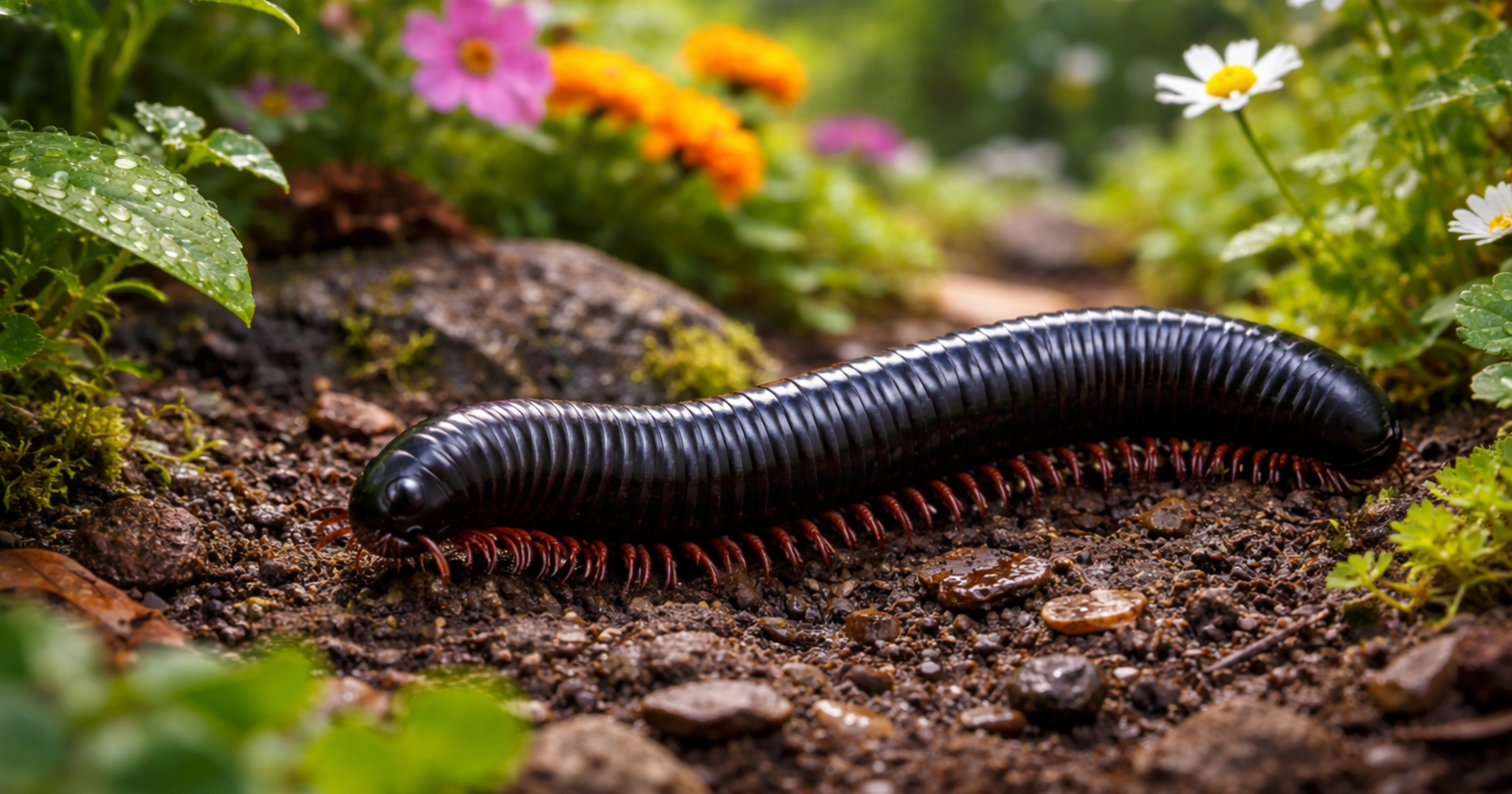
Giant African Millipede · Archispirostreptus gigas (reference species)
The shongololo is one of the most recognisable crawling animals in southern Africa, yet it is also one of the most misunderstood. It looks dramatic, moves in hypnotic waves, and can release defensive chemicals when disturbed, but it is not a dangerous biting predator. Its real strength is not aggression at all. It is a combination of armoured coiling, chemical defence, and an extraordinary ability to process dead plant matter, making it one of nature's most effective recyclers.
“Shongololo” is a southern African common name for large millipedes, especially the long, cylindrical kinds people see in gardens, leaf litter, compost-rich ground, and damp natural areas. For a webpage aimed at the giant form, the best-known reference animal is the giant African millipede, often given as Archispirostreptus gigas. San Diego Zoo describes giant African millipedes as reaching about 10 to 30 cm in length, and iNaturalist notes that this species can grow even larger in some reports.
The giant African millipede type has a long, rounded, segmented body with many pairs of short legs, usually dark brown to black, often with reddish-brown or rusty legs. It moves slowly in a smooth wave-like pattern and, when threatened, typically curls into a tight spiral. That coiling behavior is one of the easiest field clues that you are looking at a millipede rather than a centipede. Millipedes are also decomposers, not hunters.
What to look for
This is one of the biggest points of confusion.
Millipedes are mainly detritivores, meaning they feed on decaying plant material and other dead organic matter. Centipedes are mainly predators. Millipedes are typically slower, rounder, and more likely to curl into a spiral. Centipedes are flatter, faster, and built to hunt. Millipedes also do not have the same predatory venom-claw setup centipedes use.
Shongololos matter because they are part of the soil-cleanup workforce. Millipedes are a key group of soil macrodetritivores, and research describes them as important for nutrient cycling and soil quality. San Diego Zoo also describes giant African millipedes as decomposers whose waste helps become new soil.
They do not mainly destroy a garden.
They help break down dead material so nutrients return to the soil.
Usually, not in the normal sense. They are generally beneficial decomposers, not structural pests and not the kind of animal that invades a home to breed in walls or damage property. People mostly notice them after rain, in damp gardens, or when they wander into garages, patios, or houses by accident. Their appearance can be alarming, but their ecological role is far more helpful than harmful. That said, like many decomposers, they may nibble very soft, decaying, or already-damaged plant material, which sometimes leads people to blame them unfairly for damage that started elsewhere. The stronger ecological picture is that millipedes are detritivores central to breakdown of dead organic matter.
Most people think the shongololo's big advantage is having “so many legs.”
That is not the most interesting part.
Its deeper, lesser-known advantage is that it can smell and taste through much of its body. San Diego Zoo notes that giant African millipedes can effectively smell and taste with all parts of their body. That is an extraordinary sensory advantage for an animal that lives close to the ground in dark, cluttered, decomposing environments.
A slow animal cannot rely on speed to survive. It has to rely on early detection, chemical cues, and constant contact with its environment. For a decomposer moving through damp litter and rotting wood, being able to sense the world broadly across its body is a major advantage. It helps the animal locate suitable feeding areas and stay aware of danger despite poor speed and poor eyesight. This last point is an inference based on the sensory fact and the millipede's decomposer lifestyle.
The shongololo's hidden strength is not aggression.
It is full-body chemical awareness combined with patience and protection.
Millipedes have one of the smartest defensive strategies in the invertebrate world. Their first line of defence is to coil up tightly, protecting their softer legs and underside behind a harder outer body. Their second line is chemical: many millipedes release defensive compounds from glands along the body. Reviews of millipede defence describe a wide diversity of these secretions, with benzoquinones especially important in many groups.
That means the shongololo does not need to outrun predators.
It becomes a sealed, unpleasant package instead.
The shongololo looks alien, but its job is deeply useful. It is one of those animals that make ecosystems work quietly in the background. Millipedes help break down dead plant litter, contribute to soil formation, and support nutrient turnover. Research on soil systems describes them as key macrodetritivores with important functional roles.
One of the most overlooked facts about giant African millipedes is that they are part of a very ancient lineage. San Diego Zoo notes that fossil evidence shows millipedes were among the first animals to colonize land. That makes the shongololo not just an odd garden crawler, but a representative of one of the oldest successful land-animal body plans on Earth.
If you want one accurate answer, it is this:
It wins by recycling what others leave behind.
Many animals survive by hunting. Many survive by fleeing. Many survive by biting. The shongololo stands out because it combines:
That is what makes it such a remarkable survivor.
The shongololo is one of the clearest examples of how strange-looking animals can be deeply beneficial. It is slow, ancient, armoured, chemically defended, and brilliantly suited to a life of recycling the forest floor and garden litter. Once you understand what it really is, the giant African millipede stops being just a creepy crawler and becomes something far more impressive: a living soil engineer.
Next: how we treat millipedes, millipede guarantees, garden / black millipede guide, millipede identification guide. Book millipede control in Cape Town · get a quote. Read millipede treatment safety.
Archispirostreptus gigas-style giant millipedes vs mass rain migrants—barrier scope on your quote.
Questions about perimeter programmes after small millipede invasions? Use our quote flow.
We barrier-treat mass invasions of smaller millipedes per your footprint; giants are usually observe-and-relocate—your paperwork names what was sold.
How we treat millipedes, Millipede guarantees, Garden / black millipede guide, Millipede control by area, Millipede identification guide. Hub: millipede control.