Pest guide · pantry pests
National pantry methodology: pantry pest hub, how we treat pantry pests, pantry guarantees, pantry pest control by area. Identification: pantry pest identification. See also: Rice weevil / grain weevil guide, Flour beetle guide.
Oryzaephilus surinamensis — Purdue / Oklahoma State / extension framing on flat body, flight, and secondary feeding
The saw-toothed grain beetle is one of the most common and overlooked stored-product pests in the world. Small, flat, and highly mobile, it is built to invade packaged foods, exploit damaged grain and processed products, and hide in the tiniest cracks around kitchens, storerooms, and food facilities. Its greatest strength is not size or brute force. It is access — the ability to get into places and food sources many other pests cannot use as efficiently.
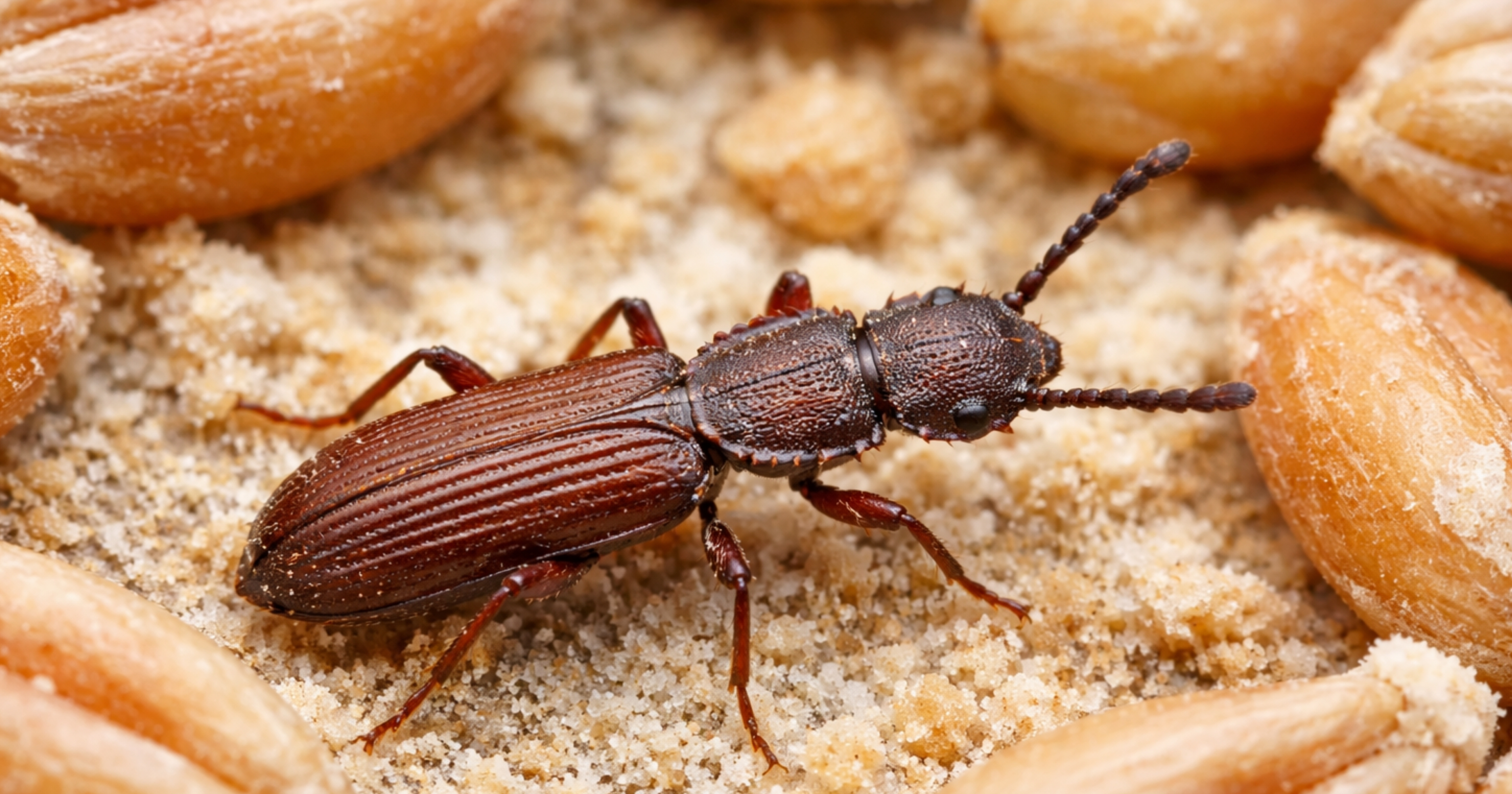
The Saw-toothed Grain Beetle is a stored-product beetle scientifically known as Oryzaephilus surinamensis. It is a major pest of stored foods worldwide and is commonly found in grain stores, food processing environments, retail food settings, and household pantries.
It is called “saw-toothed” because of the six tooth-like projections on each side of the thorax, which make it one of the easier stored-product beetles to recognise under close inspection.
This species is not a termite, wood borer, or field crop pest in the usual sense. It is a stored-product pest. That means it becomes a problem after food has been harvested, processed, packaged, or stored. It is especially important because it can infest:
That broad host range is one of the reasons it spreads so easily in homes and commercial food environments.
Adult saw-toothed grain beetles are typically about 2.4 to 3 mm long, slender, brown to dark brown, and distinctly flattened. Their body shape is one of the most important facts about them, because it explains both their success and their persistence.
Key features
Larvae are pale yellowish-white with a darker head and have three pairs of legs near the front of the body.
If you want the one trait that makes this beetle unusually successful, it is this:
Its flattened body
Purdue Extension states plainly that the body is very flat and well adapted for crawling into cracks and crevices. That sounds simple, but it is actually the beetle's great biological advantage.
This shape allows the beetle to:
That is what makes the beetle so formidable. It is not especially big, fast, or dramatic. It is architecturally suited to invasion.
Its hidden strength is micro-access. It can exploit small spaces around stored food systems better than many people realise, which is why infestations can linger even when the obvious food source has been removed.
This is one of the most important truth-versus-myth questions.
“It destroys sound whole grain.”
Mostly false.
Purdue Extension states that the saw-toothed grain beetle cannot attack perfectly sound grain, though it can feed on slightly damaged grain and is often found in association with other insects in whole grain. Research summaries likewise describe it as an external infesting pest and a secondary feeder, thriving on damaged kernels, processed material, or food debris rather than boring into intact kernels the way primary grain pests do.
This beetle is usually a secondary pest, not a primary kernel borer. It is especially successful where food is broken, milled, processed, dusty, previously damaged, or poorly stored.
“If it's in the grain, it must have started in the grain.”
Only partly true.
Sometimes infestation does begin in the purchased product. But because the beetle is small, flat, and able to hide in cracks and storage areas, it can also persist around stored food and later move into fresh products. University extension sources repeatedly note that it is common in storage areas and packaged materials, not just in exposed bulk food.
A saw-toothed grain beetle infestation may mean:
Under favourable conditions, the life cycle can be surprisingly fast. Oklahoma State reports that under ideal conditions the life cycle can be completed in about 30 days, while Bayer's agronomy summary notes that at 32–35°C development may take only about 20 days, but at 20°C it can take 12–15 weeks.
Adults are also relatively long-lived. Oklahoma State notes adults have been kept alive for over three years.
That combination is dangerous:
This is one reason infestations can seem to “come back” even after partial treatment.
“Saw-toothed grain beetles fly around the kitchen.”
Usually false.
Purdue says the wings are well developed but there is no record of this insect flying. Multiple extension sources also contrast it with the merchant grain beetle, which can fly, while the saw-toothed grain beetle is considered flightless.
If you are seeing active flight, you may be dealing with:
This is a very common mix-up.
The two species are closely related and look similar. The merchant grain beetle is often confused with the saw-toothed grain beetle, but extension sources note one key practical difference: the merchant grain beetle can fly, while the saw-toothed grain beetle cannot. Colorado State also notes that the merchant grain beetle is more likely to be associated with oil seeds and processed cereal grains, while the saw-toothed grain beetle more strongly prefers grains and grain products.
For a pest page, this matters because people often identify both simply as “grain beetles,” even though the control implications can differ slightly.
The saw-toothed grain beetle has a broad range of stored-food hosts. Extension and industry sources list infestations in:
A 2023 review described it as a major pest of a wide variety of stored products worldwide.
Purdue reports that this beetle has been observed feeding on eggs and dead adults of stored-product moths. That is a fascinating detail because it shows the insect is not just a simple cereal feeder. It can exploit additional food material in stored environments when the opportunity exists. That helps explain why this beetle can survive in food systems that contain more than one pest species.
Its survival strategy is not narrow. It is opportunistic enough to make use of damaged food, debris, and even remains of other stored-product insects.
The saw-toothed grain beetle is successful because it combines:
That combination makes it much more than “a little beetle in flour.” It is a highly adapted stored-product survivor.
You may be dealing with saw-toothed grain beetles when you notice:
The saw-toothed grain beetle is a master of stored food environments. It does not need to bore into whole grain to become a serious pest. Its real strength is far more subtle: it is built to exploit damaged food, hide in tiny spaces, survive for long periods, and spread quietly through storage systems. That is what makes it such a persistent pantry and warehouse pest — and why proper identification matters.
Next: how we treat pantry pests, pantry guarantees, pantry pest identification guide, Rice weevil / grain weevil guide, Flour beetle guide. Book pantry pest control in Cape Town · Pantry pests Cape Town hub. Read pantry pest treatment safety.
Oryzaephilus surinamensis — rigid sealed containers, discard infested goods, cupboard treatment on your quoted footprint; distinguish from flying merchant grain beetle and moths.
Flat beetles in seams? Use get a quote for a survey-led programme.
We map harbourages on your quoted pantry scope, then treat cupboards and cracks with discard-and-seal cooperation—your agreement prevails.
Rice weevil / grain weevil guide, Flour beetle guide, How we treat pantry pests, Pantry guarantees, Pantry pest control by area, Pantry pest identification guide. Hub: pantry pests.