Pest guide · pantry pests
National pantry methodology: pantry pest hub, how we treat pantry pests, pantry guarantees, pantry pest control by area. Identification: pantry pest identification. See also: Rice weevil / grain weevil guide, Indian meal moth guide.
Tribolium castaneum & Tribolium confusum — UF/IFAS, University of Minnesota extension framing
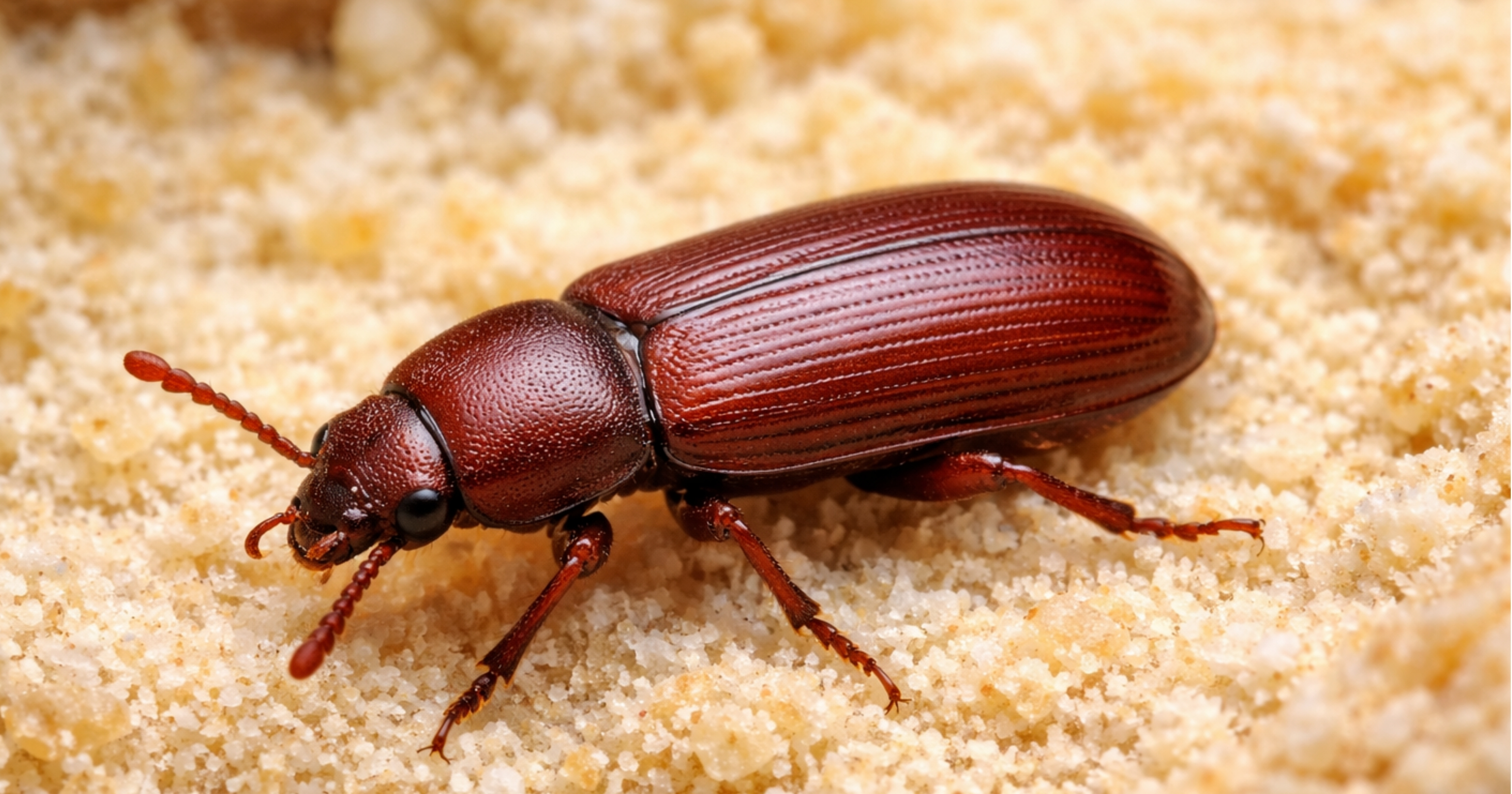
Small, flat, and easy to overlook, flour beetles are among the most persistent pantry and stored-food pests in the world. Their real strength is not size. It is their ability to thrive in processed dry foods, reproduce continuously in warm conditions, and contaminate food with defensive chemicals that affect smell and taste.
“Flour beetle” usually refers to two very similar beetles in the genus Tribolium:
Both are classic stored-product pests, meaning they attack food after harvest, during storage, transport, processing, or in cupboards and pantries. They are especially associated with milled, broken, or processed food products rather than healthy intact grain kernels. UF/IFAS lists them as major pests of flour, cereals, meal, crackers, beans, spices, pasta, cake mix, dried pet food, chocolate, nuts, and seeds. The University of Minnesota likewise lists them as common pantry pests of dried foods.
These two species are extremely alike, which is why they are often lumped together on pest-control pages. That is reasonable for practical household guidance, but biologically they are not identical.
UF/IFAS notes these main differences:
For most home infestations, both species behave similarly enough that the treatment logic is nearly the same. But from a spread point of view, the red flour beetle can sometimes disperse more easily because it is capable of flight.
Adult flour beetles are typically:
The larvae are slender, pale yellowish to cream, and have two dark pointed projections at the tail end. UF/IFAS describes these projections clearly for both species.
Flour beetles are found worldwide and are common in:
The University of Minnesota notes that red flour beetles are common in homes, while the confused flour beetle is often associated with flour mills.
Flour beetles are not limited to flour alone. They can infest a wide range of dry foods, including:
That broad diet is one reason they are such successful pests. They are not specialists that depend on one rare commodity. They can survive in many common stored foods.
This is one of the biggest facts people miss.
Flour beetles are best understood as secondary stored-product pests. That means they are especially good at attacking broken grain, flour, meal, dust, and damaged or processed food material, rather than sound, intact whole kernels. The pantry pest guidance from Minnesota reflects this clearly by separating flour beetles from true grain weevils, which develop inside whole kernels.
If you find flour beetles, the problem is often not just “beetles appeared.” The real issue is usually one of these:
This is why they often thrive in places that look “mostly clean” but still have hidden product dust or older stock. That is exactly the kind of environment these beetles exploit.
UF/IFAS reports that the life cycle of both red and confused flour beetles can take about 40 to 90 days, depending on conditions, and adults can live for up to three years. It also notes that in warm areas they can breed throughout the year, and all life stages may be present in infested products at the same time.
That combination is powerful:
So even a small infestation can quietly become a persistent one if the source is not removed.
The lesser-known advantage that makes flour beetles especially successful is chemical contamination and defence through quinones. Scientific studies on Tribolium castaneum and related flour beetles show that they produce benzoquinone-based defensive secretions, including compounds such as methyl- and ethyl-benzoquinone. These chemicals help defend the beetles and also affect the food around them. Research shows these secretions can have antimicrobial and antifungal effects, and in high enough concentrations can make infested food develop a characteristic foul odour and taste.
This means flour beetles do not just eat food. They can also ruin food.
Their special power is not physical destruction like termites. It is the ability to persist in food environments and chemically contaminate them, making products unfit even when the visible damage seems small.
That makes them disproportionately important as pantry and food-storage pests.
Research on Tribolium castaneum shows that these beetles also use chemical cues, including aggregation pheromones, to influence crowding and behaviour. At lower concentrations, some of these chemical signals can support aggregation, while at higher concentrations defensive quinones can become repellent or even harmful to the beetles themselves.
In plain language
They are not random little beetles wandering through flour. They are chemically tuned insects that use their environment and one another's signals to survive in crowded food patches.
Flour beetles succeed because they combine several advantages:
That makes them more than a simple pantry nuisance. They are highly adapted stored-food survivors.
Common warning signs include:
In homes, they create a persistent pantry infestation. In food businesses, mills, warehouses, and storage sites, they become a quality-control and contamination issue.
Because they can taint products chemically as well as physically, a flour beetle problem is not just about visible insects. It is about food quality, food loss, and reputation.
The red flour beetle and confused flour beetle are small insects with an outsized impact. Their real power is not in chewing through large amounts of food, but in their ability to live inside processed dry goods, reproduce steadily, hide in residues, and spoil food chemically as well as physically. That is what makes flour beetles such stubborn and costly pantry pests.
Next: how we treat pantry pests, pantry guarantees, pantry pest identification guide, Rice weevil / grain weevil guide. Book pantry pest control in Cape Town · Pantry pests Cape Town hub. Read pantry pest treatment safety.
Tribolium — discard and seal on your quoted pantry footprint; red vs confused matters most for flight-based spread context.
Beetles in multiple packets? Use get a quote for cupboard-led treatment.
We treat cupboards and harbourages on your quoted scope, with discard-and-seal cooperation—national pantry methodology; your agreement prevails.
Rice weevil / grain weevil guide, How we treat pantry pests, Pantry guarantees, Pantry pest control by area, Pantry pest identification guide. Hub: pantry pests.