Pest guide · wood borer
National wood borer methodology: wood borer hub, how we treat wood borer, wood borer guarantees. True Lyctus powderpost: Lyctus powderpost guide. Common furniture beetle: Anobium punctatum guide. Identification: wood borer identification.
The bostrichid horned powderpost beetle is one of the most misunderstood wood borers because people often lump it together with Lyctus powderpost beetles, even though the biology is importantly different. In pest literature, bostrichids are often called false powderpost beetles or auger beetles. One of the clearest differences is that adult bostrichids bore directly into wood to prepare egg tunnels, while Lyctus beetles usually lay eggs in exposed pores or cracks instead.
Its real strength is not simply that it bores into timber. Its supremacy lies in adult-led invasion: unlike many other wood borers where the larva is the only true penetrating stage, bostrichids use the adult female as a drilling specialist, turning the adult into an active coloniser of wood rather than only a breeder looking for a surface opening.
A bostrichid powderpost beetle is a wood-boring beetle in the family Bostrichidae. In practical timber-pest language, these are often called false powderpost beetles or auger beetles. USDA Forest Service material notes that, in Australia, they are called auger beetles because of the neat, drill-like holes the adults bore into wood.
For a pest guide, the most important truth is this: this beetle is not just a larva that happens to emerge later. In bostrichids, the adult female is already a capable wood-borer, and that changes the whole story of infestation.
Bostrichid powderpost beetles are usually identified by a mix of body shape, exit holes, frass behaviour, and damage pattern. UC IPM's wood-boring beetle guide notes that false powderpost beetles typically make larger holes than Lyctus beetles, and that their frass is harder to dislodge from the hole. The same guide even suggests a practical distinction: with bostrichids, the entire point of a click-type ballpoint pen usually fits into the exit hole, whereas Lyctus holes are smaller.
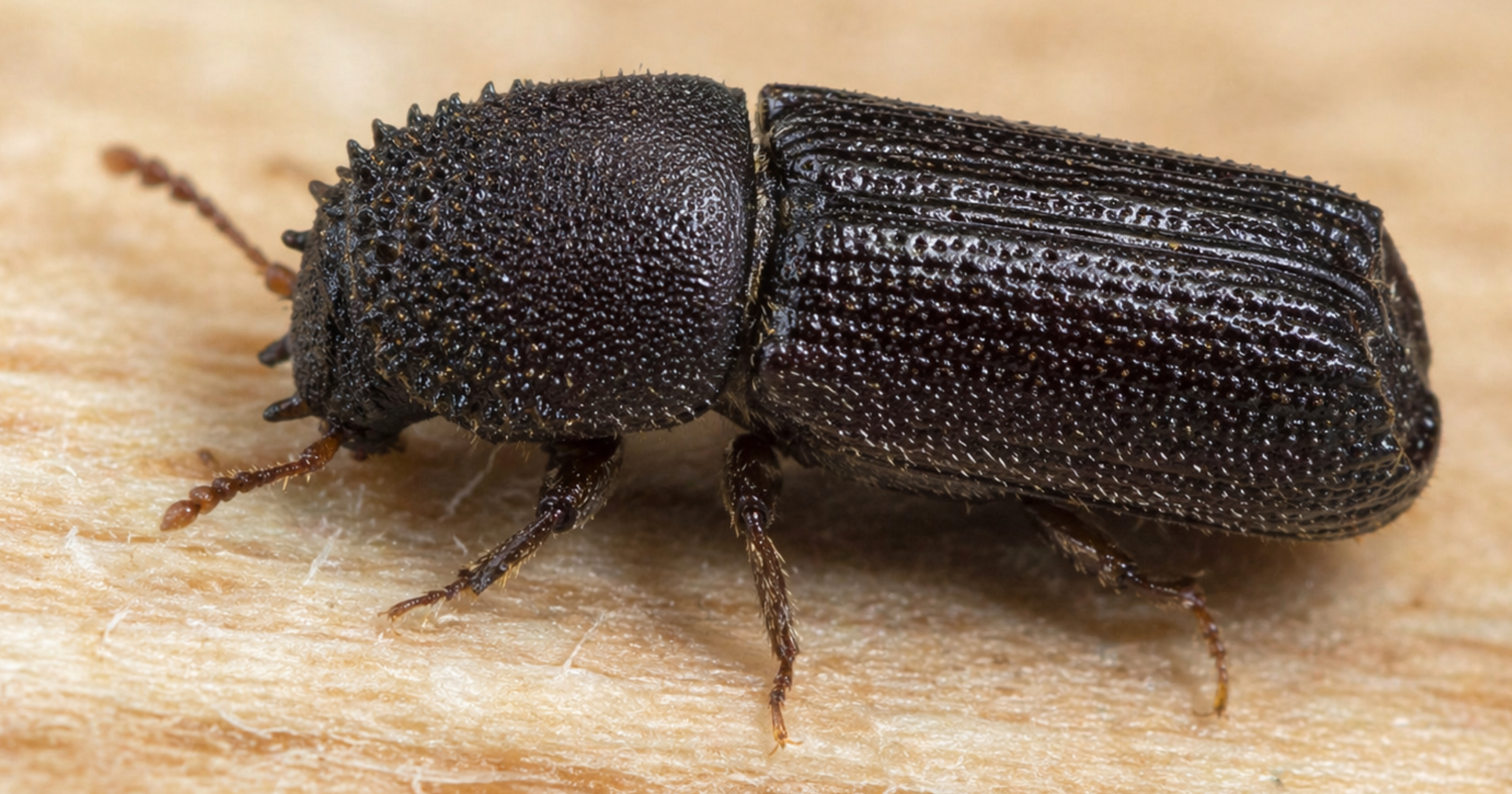
Another common identification point is body shape. Pest management references describe adult bostrichids as more hooded or hump-backed, with the head angled downward and not easily visible from above. Some species also show roughened areas or horn-like structures on the thorax or body, which is part of why “horned” is used in common identification language.
This beetle is serious because it does not rely only on pre-existing pores or convenient surface openings. USDA Forest Service guidance states that bostrichids differ from lyctids because the adult beetles bore into wood and prepare egg tunnels instead of simply laying eggs in surface pores. That means the insect brings its own entry strategy.
That makes these beetles especially deceptive. With Lyctus beetles, exposed pores and susceptible sapwood are central to infestation. With bostrichids, the female's own drilling behaviour becomes part of the invasion system. In plain language, this beetle is not just waiting for the right opening — it may make its own.
Most people think the biggest issue is simply that it is another “powderpost beetle.” That is partly true, but the deeper advantage is this: its special power is adult drilling colonisation.
The bostrichid's hidden advantage is that the adult female is itself a wood-boring invasion tool. USDA Forest Service material says clearly that bostrichids differ from lyctids because the adult beetles bore into the wood, preparing egg tunnels.
Many wood borers depend mainly on larvae to do the deep destructive work. A bostrichid adds another level: the adult female actively drills the first access route.
This is the real “special power.” Its hidden advantage is not just internal feeding. It is the ability to begin the attack with an adult boring phase, which makes the species especially formidable and biologically elegant. That is what separates bostrichids from the more familiar Lyctus story — an inference directly supported by the documented egg-tunnel behaviour.
One of the most useful and least appreciated traits of bostrichid powderpost beetles is the nature of their frass. UC IPM notes that, unlike the silky talcum-like frass of Lyctus beetles, false powderpost beetle frass is difficult to dislodge from the hole. Other pest references describe it as more meal-like and tightly packed in holes and galleries.
This matters because it means the damage does not always announce itself with loose piles of obvious powder. In many cases, the beetle is effectively plugging its own tracks. That makes casual inspection less reliable and is one reason bostrichid infestations can be misread or confused with other borers. This is an inference supported by the documented packed-frass habit.
Bostrichid horned powderpost beetles succeed because they combine:
That combination makes them less like simple powder-makers and more like auger-style timber invaders. That is what makes them so effective — an inference based on the biology above.
A surprisingly important fact is that some authoritative material notes confusion in the phrase “powderpost beetle” itself. One Forest Products Laboratory document points out that more than one beetle family gets called “powderpost beetles,” and that nutritional requirements differ between them. That means a correct ID is not just a nice extra — it changes how the infestation should be understood.
Verminator aligns treatment with confirmed borer group and your quoted programme — injection, heat, or integrated timber work. This page is educational; pen-point hole checks and frass behaviour still need professional context on site.
The bostrichid horned powderpost beetle is one of the most deceptive wood borers because it breaks the pattern many people assume. Its real supremacy lies in drill-led invasion. Instead of relying only on larvae to do the important penetration work, it uses the adult female as the opening tool, turning wood entry into a deliberate first-stage act of colonisation. That is what makes it so different from Lyctus beetles — and so easy to misunderstand if all “powderpost beetles” are treated as the same.
Larger holes with packed frass vs silky Lyctus flour — species logic drives scope; book an inspection when in doubt.
Structural or high-value timber? Use get a quote.
We separate false powderpost (Bostrichidae) from Lyctus and furniture beetle, then match injection, heat, or remedial scope to your quote.
Powderpost beetle (Lyctus) guide · Common furniture beetle guide · Wood borer identification guide · How we treat wood borer · Wood borer treatment safety. Book wood borer control in Cape Town.