Pest guide · wood borer
National wood borer methodology: wood borer hub, how we treat wood borer, wood borer guarantees. Identification: wood borer identification. Lyctus hardwood powderpost: powderpost beetle (Lyctus) guide. False powderpost (Bostrichidae): bostrichid horned powderpost guide. Termite contrast: termite identification.
The common furniture beetle is one of the most deceptive timber pests because the real damage is done quietly, out of sight, from inside the wood. In most pest and conservation references, “common furniture beetle” means Anobium punctatum, one of the classic insects behind what people loosely call woodworm. The adult beetle is only a few millimetres long, but the larval stage can live inside timber for years.
Its real strength is not speed, size, or aggression. Its supremacy lies in long-duration hidden feeding: the larva can spend 3 to 5 years tunnelling inside seasoned timber before the adult ever appears, which is why people often notice the problem late.
A common furniture beetle is a wood-boring beetle whose larval stage feeds inside timber. The Natural History Museum states that it attacks seasoned sapwood, not live wood, and usually avoids heartwood. English Heritage similarly describes the larvae as living their lives inside tunnels in wood, enlarging them as they grow.
For a pest guide, the most important truth is this: the pest people call “woodworm” is not a worm at all. It is usually the larva of a beetle, and in this case, that larva is the stage responsible for almost all the damage.
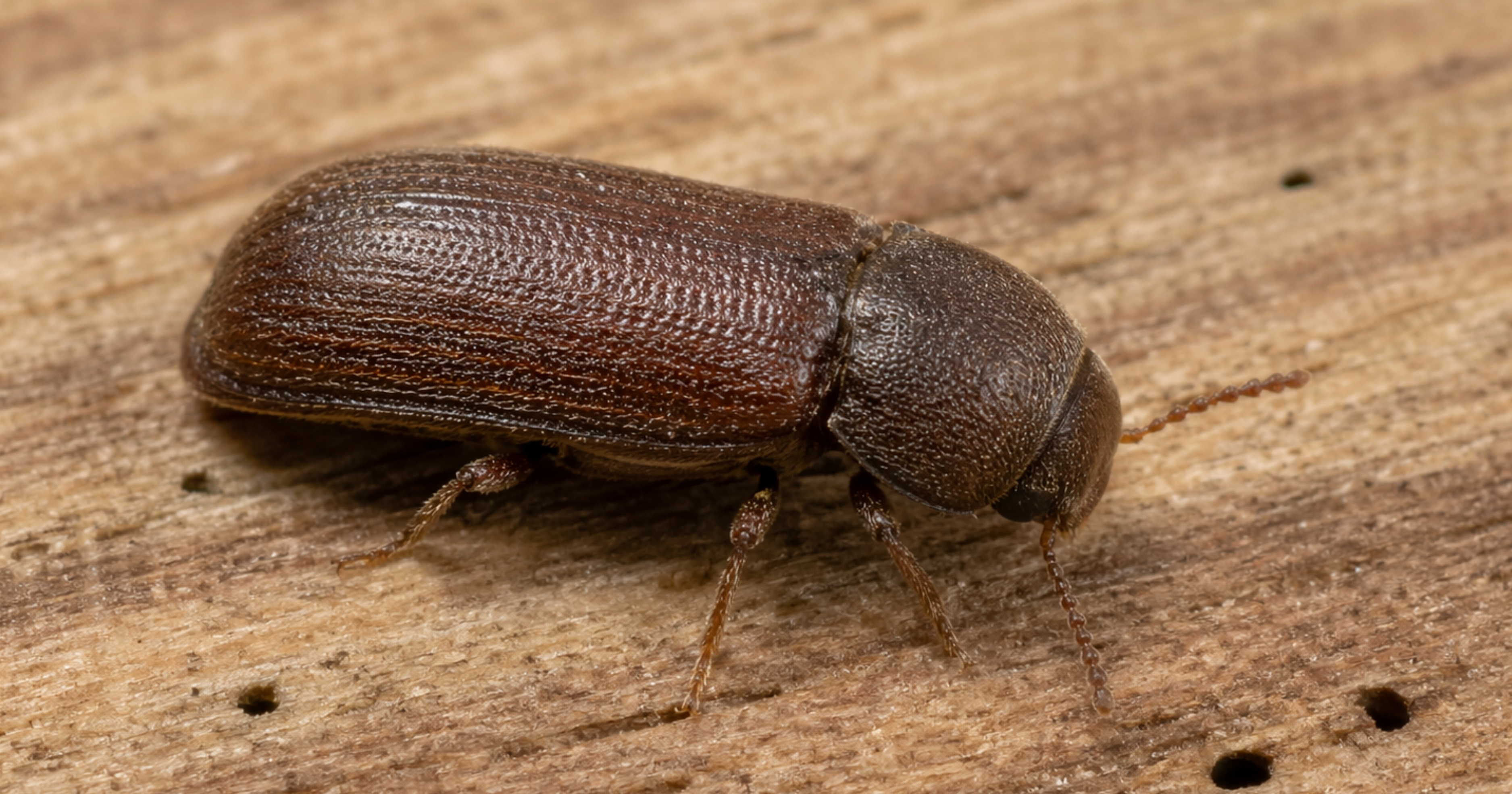
Common furniture beetles are usually identified more by their signs in wood than by seeing the insects themselves. The adult beetle is typically about 3–4 mm long, brown, and hump-backed in profile, with the head largely hidden from above by the pronotum. Exit holes are small and round, generally around 1–1.5 mm wide.
This beetle is a serious pest because it can remain concealed for years while its larvae gradually weaken timber from within. Natural History Museum and English Heritage both describe a long developmental period in wood, and forestry and building references warn that severe infestations can eventually cause serious weakening in structural timber if conditions remain favourable.
People often underestimate it because the adults are small and short-lived. But the adult is only the visible end of a much longer internal process. By the time fresh emergence holes appear, the larva may already have spent years eating the wood.
Most people think the biggest issue is simply that it “eats wood.” That is true, but the deeper advantage is this: its special power is delayed, concealed colonisation.
The common furniture beetle's hidden advantage is that almost the entire destructive phase happens inside seasoned timber, slowly and silently. English Heritage notes that the eggs are laid in cracks or end grain, the larvae tunnel into the wood, and they live their whole life inside those enlarging galleries until pupation.
A pest that lives on the surface is easier to detect. A pest that lives inside the material can keep feeding while escaping notice.
This is the real “special power.” Its hidden advantage is not brute force. It is the ability to turn timber into a concealed feeding chamber for years at a time. That is what makes this beetle so deceptive and so persistent — an inference directly supported by the documented life cycle and internal larval feeding habit.
One of the least appreciated facts about Anobium punctatum is that it is not just a random wood eater. The Natural History Museum states that it attacks seasoned sapwood, not live or fresh wood, and usually avoids heartwood. English Heritage also notes that eggs and young larvae do not survive when the wood is too dry, specifically below about 12% moisture content, or when relative humidity is too low.
That means the beetle's strength is not only boring into timber, but finding the right timber condition: suitable sapwood, enough moisture, and the right environment for larval survival. In other words, it is not merely destructive; it is biologically tuned to exploit vulnerable timber.
The common furniture beetle succeeds because it combines:
That combination makes it less like a surface pest and more like a slow internal occupier of timber. That is what makes it so effective — an inference based on the biology above.
A surprisingly important fact is that the common furniture beetle is often associated with sapwood vulnerability and moisture conditions, not just age. Old timber may be attacked because it has remained untreated or favourable for long periods, but age alone is not the magic factor. The species is exploiting the right wood zone and climate conditions, not simply “oldness.”
Verminator treats confirmed wood borer on your quoted scope — structural injection, heat for movables, and integrated timber-floor programmes per assessment. This page is educational context; hole age, moisture, and extent still need a site inspection before we commit a programme class on paperwork.
The common furniture beetle is one of the most deceptive timber pests because it does not need to advertise its presence. Its real supremacy lies in hidden endurance. It can turn suitable sapwood into a long-term feeding chamber, remain protected through most of its life, and leave only a tiny exit hole as the visible clue to years of internal damage. That is what makes it so easy to underestimate — and so important to identify properly.
Exit holes, frass type, and timber zone (sapwood vs heartwood) drive species logic — book an inspection when signs appear.
Structural timber or valued movables? Use get a quote.
We confirm wood borer vs other timber pests, then match injection, heat, or integrated floor programmes to your quoted scope.
Wood borer identification guide · Powderpost beetle (Lyctus) guide · Bostrichid horned powderpost guide · How we treat wood borer · Wood borer guarantees · Wood borer injection · Wood borer treatment safety. Book wood borer control in Cape Town.