Pest guide · wood borer
National wood borer methodology: wood borer hub, how we treat wood borer, wood borer guarantees. Seasoned softwood / woodworm context: common furniture beetle guide. False powderpost (Bostrichidae): bostrichid horned powderpost guide. Identification: wood borer identification.
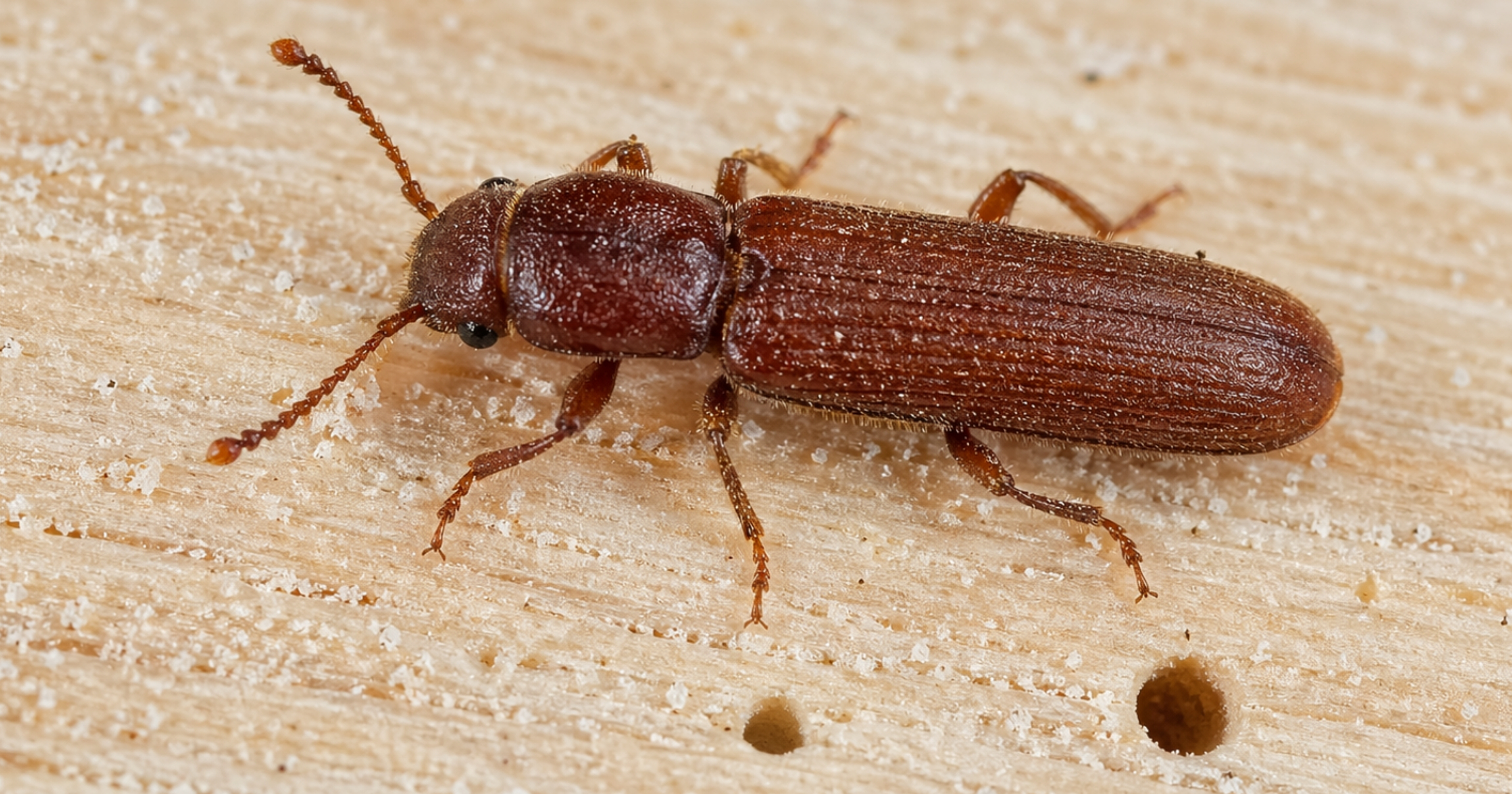
The Lyctus powderpost beetle is one of the most deceptive timber pests because it can turn the inside of suitable hardwood into a flour-like powder while the outer surface still looks fairly intact. In pest and timber references, the term true powderpost beetle refers to the lyctids, including species in the genus Lyctus. These beetles are especially important because they attack hardwood sapwood and can reinfest suitable timber repeatedly if conditions allow.
Its real strength is not size or speed. Its supremacy lies in nutrient-targeted hidden feeding: Lyctus larvae are especially associated with the starch-rich sapwood of hardwoods, which lets them exploit certain timbers very effectively while leaving other wood types largely untouched.
A Lyctus powderpost beetle is a wood-boring beetle in the true powderpost group whose larvae develop inside hardwood sapwood. Forest Service and extension sources state that lyctids attack the sapwood of dead hardwoods, especially dried and cured lumber, and that they feed predominantly on the starch in these woods. Commonly affected materials include flooring, cabinets, furniture, trim, plywood, tool handles, and other hardwood articles.
For a pest guide, the most important truth is this: a Lyctus powderpost beetle is not a general “wood eater.” It is a specialist hardwood sapwood borer. That distinction matters because it explains why one timber item may be heavily attacked while another nearby may be left alone.
Lyctus powderpost beetles are usually identified more by their signs in timber than by seeing the adults. Purdue notes that powderpost beetles are small, usually about 1/12 to 1/5 inch long, often reddish-brown to nearly black, and that they leave characteristic exit holes. Forest and timber references describe the damage as being associated with fine, powdery frass and small round holes in suitable hardwoods.
This beetle is a serious pest because it can quietly destroy the usable sapwood portion of hardwood from the inside out. Forest Service sources warn that true powderpost beetles can attack dried hardwood products and that several generations can reinfest the same wood if the timber remains suitable. Purdue likewise notes that powderpost beetles are second only to termites as destroyers of seasoned wood in buildings and furniture in many settings.
People often underestimate Lyctus beetles because the first visible signs may only appear after the timber has already been installed in a building or turned into furniture. Timber can be infested earlier in storage or processing, and the evidence may only become obvious later when adults emerge and frass starts appearing.
Most people think the biggest issue is simply that it bores into wood. That is true, but the deeper advantage is this: its special power is nutrient targeting.
The Lyctus powderpost beetle's hidden advantage is that it is not randomly tunnelling through any timber it encounters. It is especially adapted to exploit starch-rich hardwood sapwood. Forest Service and wood references state that true powderpost beetles attack sapwood of hardwoods almost exclusively, and that starch content is central to their development.
A general feeder has to survive on many materials. A Lyctus beetle is tuned to the most nutritionally suitable zone of certain hardwoods.
This is the real “special power.” Its hidden advantage is not just boring. It is the ability to locate and exploit the best nutritional part of hardwood, which makes the infestation efficient, selective, and surprisingly destructive. That is what makes Lyctus beetles so formidable — an inference directly supported by the documented importance of sapwood and starch in their biology.
One of the least appreciated facts about Lyctus beetles is that the problem does not always end with one generation. Forest Service sources state that several generations can reinfest the same wood, especially if enough sapwood and starch remain. Purdue also notes that finished or painted wood is much less likely to be reinfested because females lay eggs in exposed wood pores.
That means the beetle's strength is not only hidden development, but the ability to turn a suitable exposed hardwood article into a repeat breeding site. In practical terms, unfinished sapwood can become both food source and nursery again and again.
Lyctus powderpost beetles succeed because they combine:
That combination makes them less like random borers and more like precision exploiters of vulnerable hardwood sapwood. That is what makes them so effective — an inference based on the biology above.
A surprisingly important fact is that Lyctus infestations often begin before the wood reaches the customer. Infestation can occur in lumber, stored wood, or manufactured items before installation, and only later become visible when adults emerge. That is one reason outbreaks in finished spaces can seem mysterious even though the real origin may lie earlier in the timber's history.
Verminator matches treatment to confirmed borer type and quoted scope — injection, heat, or integrated timber programmes. This page is educational; species confirmation and starch/sapwood risk still belong in an on-site inspection.
The Lyctus powderpost beetle is one of the most deceptive hardwood pests because it does not attack timber randomly. Its real supremacy lies in selective internal exploitation. It targets the starch-rich sapwood of hardwoods, develops quietly inside the wood, and can leave behind a shell of timber and a mass of fine powder. That is what makes it so easy to miss at first — and so costly to ignore once it is established.
Fine flour-like frass under oak, ash, or similar hardwoods usually triggers a lyctid check — book an inspection early.
Flooring or built-ins affected? Use get a quote.
We separate Lyctus powderpost from furniture beetle and other borers, then align injection, heat, or remedial scope with your quote.
Common furniture beetle guide · Bostrichid horned powderpost guide · Wood borer identification guide · How we treat wood borer · Wood borer guarantees · Wood borer treatment safety. Book wood borer control in Cape Town.