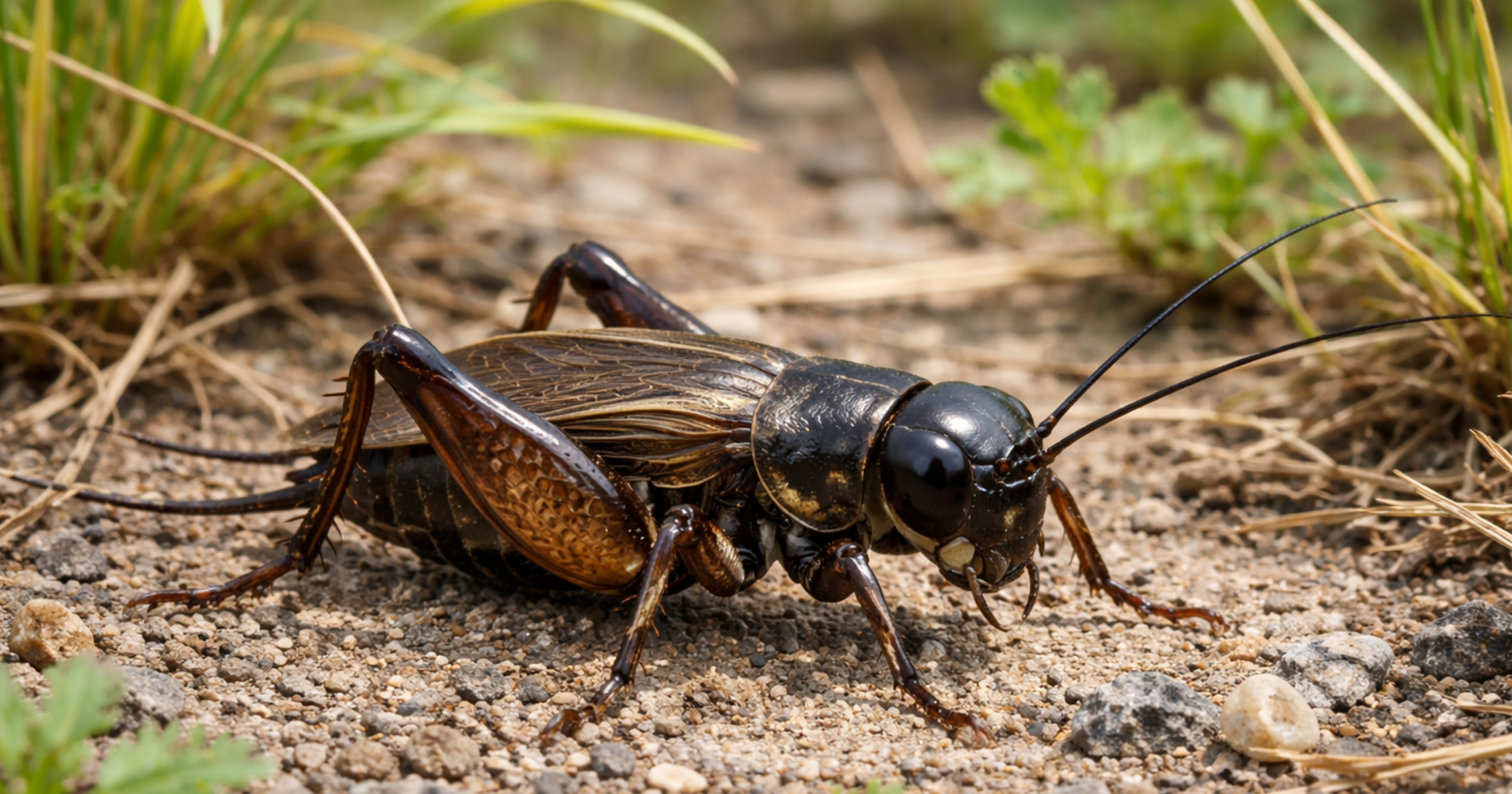
Pest guide · cricket family
National cricket methodology: cricket control hub, how we treat crickets, cricket guarantees, cricket control by area, House cricket pest guide. Identification: cricket identification.
Gryllus spp. (field cricket group)
The field cricket is one of the most familiar night-singing insects, but that familiar sound hides a remarkably effective survivor. Field crickets in the genus Gryllus are ground-dwelling, dark-bodied crickets that thrive in open, disturbed habitats. Their real strength is not just jumping or chirping. It is a combination of burrow use, temperature-linked activity, and highly effective acoustic signalling that lets them survive, attract mates, and hold ground in exposed environments.
Field crickets are true crickets in the family Gryllidae, and many species in the genus Gryllus are commonly called field crickets. Extension sources describe them as generally large, dark crickets found on the ground, especially in fields, lawns, open disturbed ground, and around buildings.
For a South African pest guide, it is better to talk about field crickets as a group, while noting that Gryllus bimaculatus is one especially relevant species in this region. GBIF lists it as naturally widespread from the tip of South Africa northward, and southern African fauna resources confirm the genus Gryllus is present in the region.
Field crickets are usually:
Extension descriptions place them in the 15 to 31 mm size range, with the typical field-cricket look being a dark, heavy-bodied insect with strong hind legs for jumping.
What to look for
This is one of the most important truths about field crickets.
Many field crickets use burrows or sheltered ground refuges, and research on Gryllus campestris shows that burrow-centred life is a major part of their behaviour. Studies of wild field crickets recorded repeated movement in and out of burrows, time spent at the entrance, fast retreat into burrows to escape danger, and calling associated with these fixed ground shelters.
That is why people often hear a cricket very clearly but struggle to find it. The insect may be singing from the mouth of a refuge and vanish the moment it senses disturbance.
Field crickets are characteristic of open habitats. UF/IFAS describes them as typical of fields and other open areas, and house-invading guidance notes that species in Gryllus are often associated with lawns, mulch, weedy borders, foundations, and disturbed ground near buildings.
They are especially likely where there is:
Field crickets are not usually in the same pest category as cockroaches or termites, but they do matter in certain settings.
Missouri Extension's house-invading cricket guidance notes that field crickets can become nuisance pests when they gather around buildings and enter indoors. Their main problems are:
So the real issue is often nuisance pressure, especially where outdoor populations build up and spill toward lights, entrances, garages, storage areas, and foundations.
Most people think the field cricket's main power is the chirp.
That is only the surface.
Its deeper advantage is the combination of burrow anchoring and acoustic broadcasting.
Research on field cricket burrow behaviour shows that the burrow is not just a hiding hole. It acts as a secure base for feeding, escape, waiting, and mating behaviour. At the same time, the male's song lets him advertise over distance without wandering constantly in the open.
That gives the cricket a powerful survival formula:
The field cricket's lesser-known strength is not jumping.
It is the ability to turn a tiny patch of ground into a defended communication base. A burrow or refuge gives safety, and the song extends the insect's reach far beyond that shelter. That combination makes field crickets extremely efficient in open, risky habitats. This is an inference directly supported by the burrow-behaviour and stridulation literature.
One of the most overlooked facts about crickets is that their calling is strongly tied to temperature. Research summaries on cricket stridulation show that the rate of calling increases as environmental temperature rises. That means the field cricket's sound is not random background noise — it is tightly linked to physiology and environmental conditions.
This matters because it helps explain why field crickets can seem much louder or more active on warm evenings than on cool ones. Their signalling system is deeply tied to heat and metabolic performance.
Field crickets are difficult because they are often supported by the landscape around the building, not just by the building itself. Lawns, weed edges, mulch, debris, foundation gaps, and lighting can all help sustain populations near structures. Once concentrated, they may move indoors or gather in nuisance numbers.
Their use of small ground refuges also makes them harder to locate individually than people expect. A noisy cricket may be occupying a very specific crack, burrow, or concealed edge habitat.
One of the least appreciated truths about field crickets is that the burrow itself can shape the animal's success. Wild behavioural studies show the burrow is central to daily life, influencing feeding, escape, time allocation, and exposure to danger. So the cricket's power is not only in its body — it is also in its use of microhabitat.
If you want one accurate answer, it is this:
It combines shelter with broadcast.
Many insects hide well. Many insects make sound. Many insects jump. But field crickets stand out because they combine:
That is what makes them so successful in fields, lawns, and foundation-edge environments.
The field cricket is one of the best examples of how a simple-looking animal can be brilliantly engineered for open ground survival. Gryllus field crickets succeed not because they are large or dangerous, but because they combine shelter, sound, warmth-linked activity, and smart use of disturbed habitats. That is what makes them so familiar on summer nights — and so hard to ignore.
Next: how we treat crickets, cricket guarantees, house cricket pest guide, cricket identification guide. Book a get a quote. Read cricket treatment safety.
Gryllus — burrows vs wandering, temperature and song, lawns and foundation edges vs structural pests.
Noise at the lawn line and crickets at the garage door? Book through our quote flow for perimeter and lighting-aware programmes.
We treat quoted entry and perimeter zones and pair chemistry with sealing and lighting advice—same cricket programme logic as house-invading pressure.
House cricket pest guide, How we treat crickets, Cricket guarantees, Cricket control by area, Cricket identification guide. Hub: cricket control.