Pest guide · cricket family
National cricket methodology: cricket control hub, how we treat crickets, cricket guarantees, cricket control by area, Field cricket pest guide. Identification: cricket identification.
Acheta domesticus
The house cricket is one of the most familiar chirping insects in buildings, but it is often misunderstood. Acheta domesticus is not just a harmless background sound of summer, and it is not usually a dangerous pest either. Its real strength is a combination of warmth-seeking behaviour, omnivorous flexibility, attraction to artificial light, and the ability to survive around human structures where shelter and microclimate work in its favour.
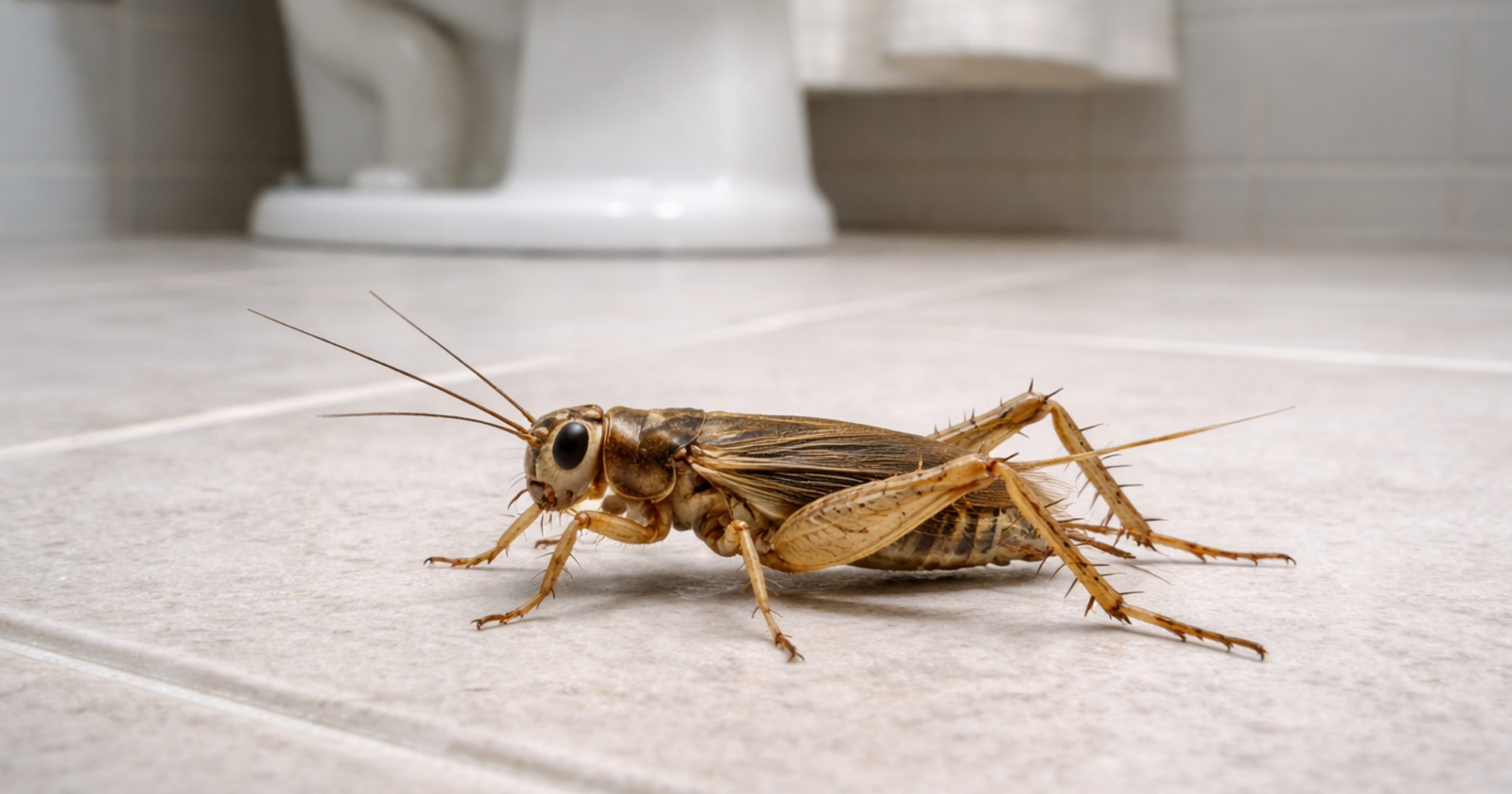
The house cricket, Acheta domesticus, is a species of cricket long associated with human buildings and warm sheltered spaces. KwaZulu-Natal Health describes adults as about 19 mm long, light yellowish-brown, with three dark bands on the head and long thin antennae. Missouri Extension places house crickets among the crickets that commonly invade homes and are usually considered nuisance pests because of their presence.
House crickets are usually light brown to tan, with very long antennae and strong hind legs for jumping. A particularly useful field mark is the three dark bands on the head, noted by KwaZulu-Natal Health. Females also have a long, needle-like ovipositor projecting from the rear, which people often mistake for a stinger, but it is an egg-laying structure, not a weapon. The general description of the female ovipositor is consistent with standard species descriptions of Acheta domesticus.
What to look for
House crickets do especially well where buildings provide warmth, shelter, and stable hiding places. Missouri Extension notes that crickets often remain in basements, crawl spaces, and other sheltered areas and are usually regarded mainly as nuisance invaders. Pest guidance also consistently notes that house crickets are attracted to lights at night, which helps explain why they gather near doors, windows, garages, patios, and lit exterior walls before moving indoors.
Once indoors, house crickets tend to settle in warm, dark, and protected spaces. Public-health guidance and pest references commonly place them in basements, crawl spaces, utility zones, and similar sheltered areas. In practical terms, they are often found near:
House crickets are usually classified first as nuisance pests. The main complaints are their chirping, their sudden jumping indoors, and their attraction to lit areas. Missouri Extension explicitly says house-invading crickets are “usually considered a nuisance only by virtue of their presence.” That said, the species is also an omnivore, and research notes that A. domesticus is a non-specialized feeder recorded consuming a wide range of plant and animal matter. That broader diet helps explain why they can persist around human spaces rather than dying off quickly once indoors.
Most people think the house cricket's main advantage is its chirping or jumping.
That is not the real reason it succeeds.
Its deeper advantage is omnivorous flexibility. A 2020 open-access study describes Acheta domesticus as a non-specialized omnivore, and notes that in natural conditions it has been recorded attacking crops, vegetables, and also feeding on animal matter. That means the house cricket is not locked into one narrow food source.
A species with a narrow diet is easier to starve out. A cricket that can feed broadly on plant material, organic scraps, and animal-derived matter has a much better chance of surviving around human structures. This flexibility helps it persist in garages, store rooms, basements, and cluttered spaces where a more specialized insect would struggle. That is an inference supported by the documented omnivory of A. domesticus.
The house cricket's hidden strength is not just noise.
It is the ability to live off opportunity:
That makes it one of the most adaptable nuisance insects around buildings.
Research on food choice in house crickets found that diet composition and social environment affect feeding behaviour. In simple terms, this species adjusts its feeding depending on conditions around it. That matters because it suggests a cricket that is not just flexible in what it eats, but also responsive to crowding and food context.
A related, practical point is that house crickets are also known for cannibalism under some conditions, which is part of the reason they can keep functioning even when ideal food is limited. Standard species summaries mention that they may consume dead members of their own species.
House crickets are difficult mainly because they exploit a building-edge lifestyle so well. Exterior lights attract them, small gaps let them enter, and sheltered indoor areas let them stay. Their omnivorous feeding and tolerance of varied conditions make them more persistent than people expect from a “simple” cricket. That overall explanation is an inference supported by their documented attraction to lights, nuisance invasion of structures, and broad diet.
One of the least appreciated facts about the house cricket is that it is not only a nuisance pest — it has also become globally important as a feeder insect and edible insect species. Reviews and summaries note that between the late 20th century and recent years it became one of the most widely used crickets in pet feeding and insect farming. That does not change its nuisance status in buildings, but it shows how biologically and commercially adaptable the species is.
If you want one accurate answer, it is this:
It can turn a small opportunity into a survivable habitat.
Many insects enter houses by accident. Many insects need one very specific food. Many insects fail once they get indoors. But the house cricket stands out because it combines:
That is what makes it such a successful nuisance invader.
The house cricket is a perfect example of a pest that succeeds not through brute force, but through adaptability. Acheta domesticus is small, familiar, and often underestimated, yet it combines warmth-seeking behaviour, light attraction, shelter use, and broad feeding in a way that makes it one of the most persistent nuisance insects around buildings. That is what makes it so ordinary — and so effective.
Next: how we treat crickets, cricket guarantees, cricket identification guide. Book a get a quote. Read cricket treatment safety.
Acheta domesticus — head bands vs field cricket darkness, ovipositor vs sting, omnivory vs plant-only myths.
Lights on the patio and chirping in the lounge? Book through our quote flow for entry-point and lighting-aware programmes.
We treat quoted entry and perimeter zones and pair chemistry with sealing and lighting advice—standard cricket programme logic.
How we treat crickets, Cricket guarantees, Cricket control by area, Field cricket pest guide, Cricket identification guide. Hub: cricket control.