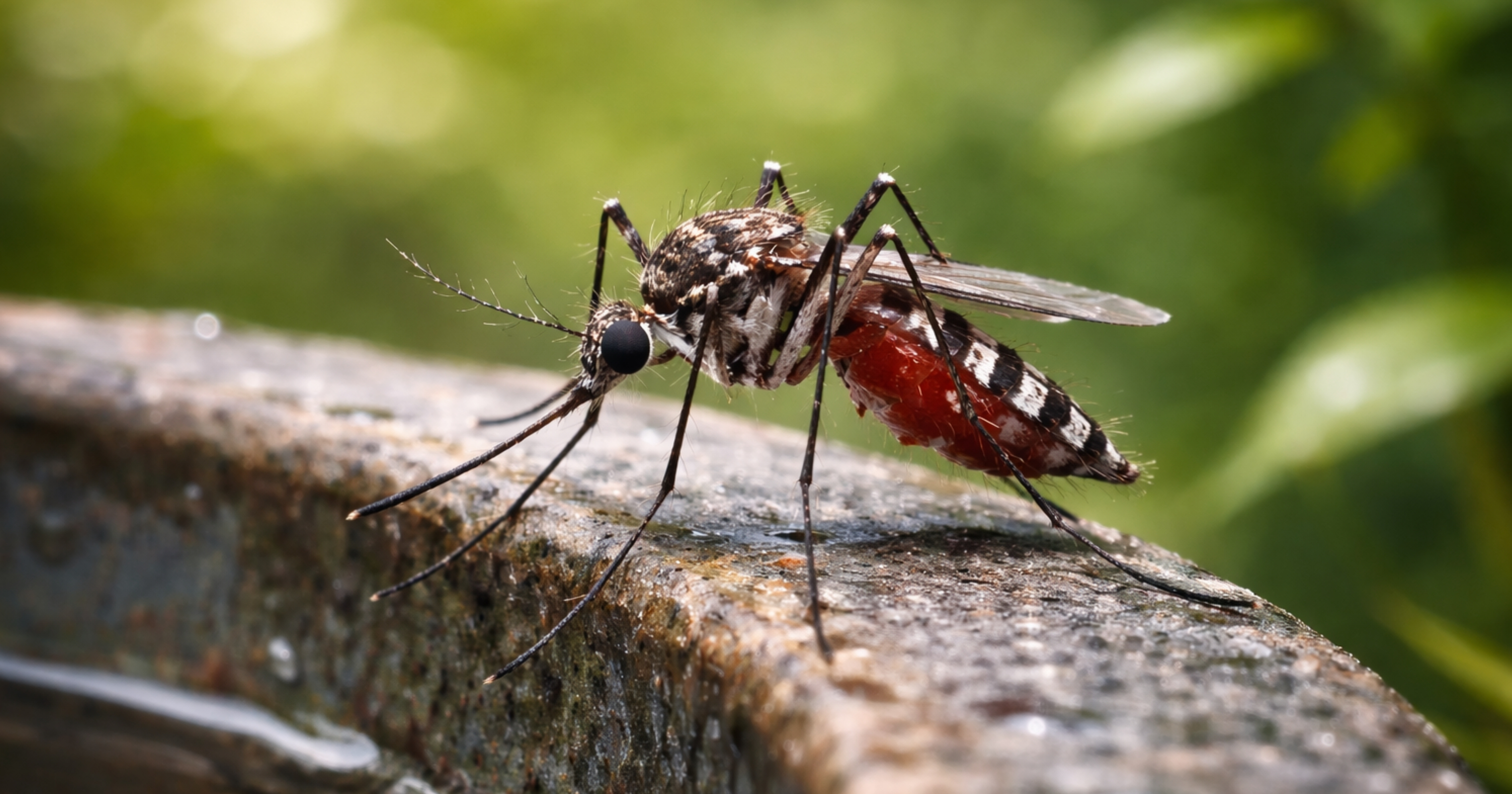
Pest guide · mosquitoes
National mosquito methodology: mosquito control hub, how we treat mosquitoes, mosquito guarantees, mosquito control by area. Identification: mosquito identification. See also: Culex house mosquito guide, Anopheles malaria mosquito guide.
Aedes aegypti, Aedes albopictus, and related container-breeding species
The Aedes container mosquito is one of the most dangerous and successful urban insects in the world. Its power does not come from size or strength. It comes from an extraordinary ability to exploit tiny water-holding containers near people, combined with eggs that can survive drying out for months. That combination makes Aedes one of the most efficient urban mosquitoes on earth.
In public-facing pest content, “Aedes container mosquito” usually means Aedes aegypti and often also Aedes albopictus. These mosquitoes are highly adapted to human environments and thrive in suburban and urban areas, especially where there are small water-holding containers such as buckets, flowerpots, saucers, bowls, vases, tyres, and other artificial sites that collect water.
They matter because they are important disease vectors. The World Health Organization states that dengue is transmitted to humans through infected female mosquitoes, primarily Aedes aegypti, and that other Aedes species can also act as vectors. These mosquitoes are also associated with the transmission of chikungunya, Zika, and yellow fever.
Aedes mosquitoes are generally small, dark mosquitoes with a more refined, sharper look than the plain brown “house mosquito” type many people associate with Culex. In practical pest-control communication, they are best identified not just by appearance, but by behaviour: they are closely associated with people, homes, small containers, and repeated local biting activity near dwellings. The CDC notes that these mosquitoes prefer to bite people and live both indoors and outdoors near people.
What to look for
This is one of the most important truths about them: they do not need large ponds, marshes, or dirty drains to succeed.
The CDC states that adult female Aedes mosquitoes lay eggs on the inner walls of containers with water, above the waterline, and that even bowls, cups, fountains, tyres, barrels, vases, and similar objects can serve as a mosquito nursery. It also notes that these mosquitoes need only a small amount of water to lay eggs.
That is why this group is called container mosquitoes. They are specialists in small, scattered, human-made water habitats rather than large natural water bodies. Their favourite breeding sites are often ordinary domestic items people barely notice.
These mosquitoes are not just annoying biters. They are medically important. WHO identifies Aedes aegypti as the primary mosquito vector of dengue, and notes that Aedes albopictus and other Aedes mosquitoes can also contribute. WHO also notes that dengue is now a major global problem and is closely associated with urban and semi-urban environments.
They are also especially important because they are so closely linked to human behaviour and urban living. WHO specifically connects dengue risk with urbanization, water storage practices, and local environmental conditions, while public-health guidance emphasizes removing artificial water-holding habitats around homes.
Most people think the mosquito's main power is the bite.
That is only the visible part.
The real special power — the one that makes Aedes so formidable — is its desiccation-resistant egg. The CDC states that Aedes eggs are laid above the waterline, stick to the container wall “like glue,” and can survive drying out for up to 8 months. California public-health guidance likewise highlights that Aedes aegypti and Aedes albopictus lay desiccation-resistant eggs in artificial, cryptic water sources.
This means the mosquito does not need permanent standing water in the ordinary sense. A container can dry out, be forgotten, and then later fill again with rainwater or household water. When that happens, the eggs can hatch and the cycle starts again. That is a far more sophisticated survival strategy than most people realise. It allows the mosquito to turn temporary, neglected, and intermittent water sources into reliable nurseries.
If one trait makes this insect exceptional, it is this:
Aedes mosquitoes can place drought-resistant eggs just above the waterline in tiny containers near humans, then wait for the next refill.
That single ability gives them a huge advantage in towns, suburbs, and homes.
Another powerful but often overlooked truth is how closely Aedes mosquitoes are adapted to living around people. California public-health guidance describes Aedes aegypti and Aedes albopictus as highly adapted to humans and thriving in urban and suburban environments. The CDC also notes that these mosquitoes prefer to bite people and live both indoors and outdoors near people.
That means their success is not accidental. They are not merely wild insects wandering into town. They are insects that have become extremely good at using the microhabitats of daily human life — water storage, decorative containers, plant saucers, buckets, tyres, and shaded domestic spaces.
Aedes mosquitoes are difficult because they exploit many small, hidden, scattered breeding sites rather than one obvious source. Public-health guidance specifically notes that they lay eggs in artificial, cryptic water sources, which means a property can support a population without having any dramatic standing-water feature.
They are also hard to manage because their eggs survive drying, and because the mosquitoes are closely tied to human environments and habits. If water-holding items are repeatedly refilled, neglected, or exposed to rain, the breeding cycle restarts very easily.
One of the least appreciated facts about Aedes mosquitoes is that they do not simply lay eggs into open water in the usual sense. They place them above the waterline on container walls. That makes their strategy far more clever than many people realise, because it allows the eggs to remain in place waiting for future flooding or refilling.
If you want one accurate answer, it is this:
It turns tiny, temporary water containers into long-term breeding infrastructure.
Many insects need stable habitat. Many mosquitoes need larger or more obvious water bodies. But Aedes stands out because it combines:
That is what makes this mosquito so successful.
The Aedes container mosquito is one of the best examples of how a small insect can become a major pest by being exquisitely adapted to human life. It does not need swamps, wetlands, or large water bodies. It needs small containers, human proximity, and the remarkable resilience of its eggs. That is why it remains such an important household and public-health pest worldwide.
Next: how we treat mosquitoes, mosquito guarantees, mosquito identification guide, Culex house mosquito guide, Anopheles malaria mosquito guide. Book mosquito control in Cape Town · Mosquito Control Cape Town hub. Read mosquito treatment safety.
Aedes — empty, cover, or treat every small container on your quoted footprint; vector disease risk varies by region and species.
Saucers, tyres, or cryptic water? Use get a quote for a survey-led programme.
We map breeding sites first, then larvicide and adult pressure on your quoted scope—national mosquito methodology and guarantee framing.
Culex house mosquito guide, Anopheles malaria mosquito guide, How we treat mosquitoes, Mosquito guarantees, Mosquito control by area, Mosquito identification guide. Hub: mosquito control.