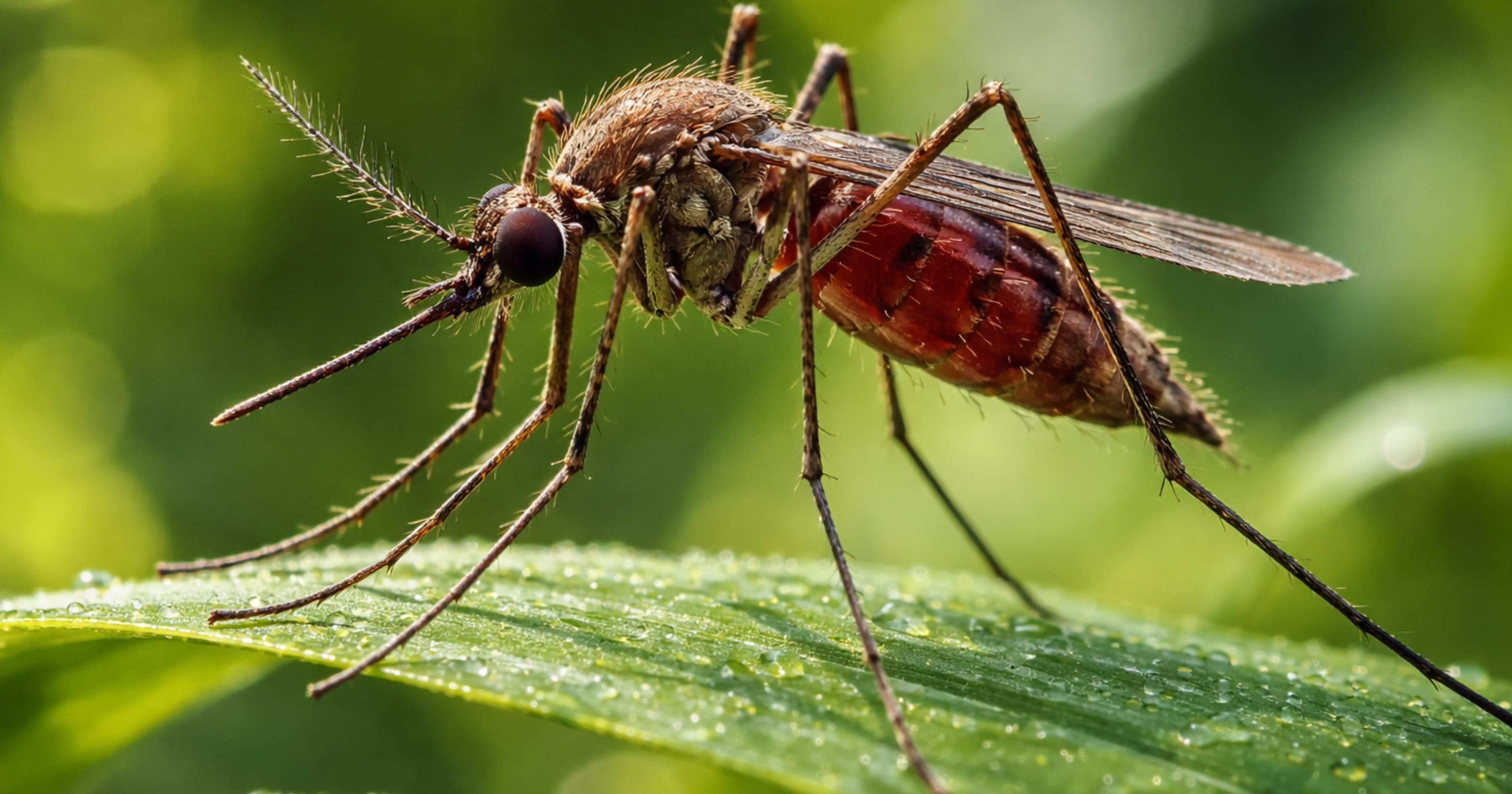
Pest guide · mosquitoes
National mosquito methodology: mosquito control hub, how we treat mosquitoes, mosquito guarantees, mosquito control by area. Identification: mosquito identification. See also: Culex house mosquito guide.
Anopheles spp. — malaria vectors where parasite, vector, and human contact align (area- and species-specific)
The malaria mosquito is one of the most important disease vectors in human history. Its power does not come from aggression or numbers alone. It comes from a combination of water-based breeding, female blood-feeding, and a body design and behaviour pattern that make it highly effective at transmitting parasites. One of its most overlooked advantages is that its early life stages are built specifically for life at the water surface, while the adult female is the stage that links aquatic habitats to human disease.
Anopheles mosquitoes are the mosquito group best known for malaria transmission. WHO describes malaria as a life-threatening disease caused by parasites that are transmitted to people through the bites of infected female Anopheles mosquitoes. CDC materials say the same: malaria is spread by the bite of an infective female Anopheles mosquito.
This matters because not every mosquito is a malaria mosquito, and not every mosquito breeding site is equally relevant to malaria risk. “Anopheles” is not just another name for “mosquito.” It refers to a biologically important group with distinctive life stages and a unique place in medical entomology.
For a public-facing pest guide, the most useful identification facts are these:
What to look for
CDC states that female Anopheles lay eggs directly on water, and that larvae and pupae develop in water. CDC's malaria reference also notes that Anopheles larvae have been found in a wide range of aquatic habitats, including fresh- or salt-water marshes, mangrove swamps, rice fields, grassy ditches, and the edges of streams.
That is one of the major differences between Anopheles and the classic “container mosquito” story. While some mosquitoes are specialists in buckets, tyres, and flowerpots, Anopheles is more strongly associated with open aquatic habitats and water surfaces. The exact habitats vary by species, but the basic rule is that their immature stages are truly aquatic.
Anopheles mosquitoes matter primarily because of malaria transmission. WHO describes malaria as preventable and curable, but still life-threatening, and spread by some types of mosquitoes. The relevant vector connection is specific: infected female Anopheles mosquitoes transmit the parasite to people.
This is what makes Anopheles different from a simple nuisance biter. Its importance is not mainly the irritation of bites. Its importance is that it can act as the bridge between the malaria parasite and the human bloodstream.
Most people think the malaria mosquito's greatest power is simply that it bites.
That is only the visible part.
Its more interesting biological advantage is the way its immature stages are adapted to the water surface itself. CDC's PHIL notes that Anopheles larvae have palmate hairs that help them remain parallel to the water surface, and CDC training material emphasizes that malaria-mosquito larvae lie parallel to the surface and lack the typical air tube seen in many other mosquito larvae.
This is not a trivial detail. It means Anopheles larvae are highly specialized for a particular style of aquatic life. Their whole posture at the surface is different. They are not just “mosquito babies in water.” They are structurally adapted for surface feeding and breathing in a way that helps define the group.
If one lesser-known trait makes Anopheles remarkable, it is this:
Its larvae are engineered to live flat against the water surface.
That feature, together with eggs laid directly on water and the female's blood-feeding cycle, makes the genus biologically distinctive and highly successful.
This is one of the biggest differences from Aedes. CDC states that female Anopheles lay eggs directly on water. A malariology reference also notes that Anopheles eggs are laid singly on water and are unique in having floats on either side, but are not resistant to drying. That means their strength is not drought endurance, but fast, direct exploitation of suitable water surfaces.
That may sound like a weakness compared with drought-resistant container mosquitoes, but it is actually a different strategy: Anopheles is optimized for real aquatic habitat, not for waiting months on the wall of a dry container.
Anopheles mosquitoes are difficult because they are tied to real aquatic habitats, and because their importance is regional and species-dependent. Some vector species thrive in wetlands, some around agricultural water, and some in altered human landscapes. CDC's malaria reference shows just how broad Anopheles breeding habitats can be.
They are also difficult because malaria transmission depends on more than mosquito presence alone. The mosquito must be the right kind, must bite, and must be infected with the parasite. That is why malaria control is both an entomology problem and a public-health problem.
One of the least appreciated facts about Anopheles is that its larval posture is so distinctive that it can help identify the group even before adulthood. The CDC specifically notes the palmate hairs and the parallel floating position of Anopheles larvae. That is a real anatomical clue, not just a textbook curiosity.
If you want one accurate answer, it is this:
It connects water, blood, and parasite transmission with extraordinary efficiency.
Many insects live in water. Many insects bite. But Anopheles stands out because it combines:
That is what makes the malaria mosquito so important.
The Anopheles malaria mosquito is powerful not because it is flashy, but because its biology is so efficient. It begins life on water, grows through a surface-adapted larval stage, and in the female adult stage becomes one of the most important parasite vectors in human history. That is what makes Anopheles not just another mosquito, but one of the most consequential insects on earth.
Next: how we treat mosquitoes, mosquito guarantees, mosquito identification guide, Culex house mosquito guide. Book mosquito control in Cape Town · Mosquito Control Cape Town hub. Read mosquito treatment safety.
Anopheles — malaria risk is area- and species-specific; larvicides and property surveys follow your quoted breeding-site scope. Follow national malaria prevention guidance in endemic areas.
Open water or wet margins on your property? Use get a quote for survey-led control.
We map breeding sites first, then larvicide and adult pressure on your quoted scope—national mosquito methodology and guarantee framing.
Culex house mosquito guide, How we treat mosquitoes, Mosquito guarantees, Mosquito control by area, Mosquito identification guide. Hub: mosquito control.