Pest guide · pantry pests
National pantry methodology: pantry pest hub, how we treat pantry pests, pantry guarantees, pantry pest control by area. Identification: pantry pest identification. See also: Flour beetle guide, Rice weevil / grain weevil guide.
Plodia interpunctella — Pyralidae; stored-product pest (extension framing)
The Indian meal moth is one of the world's most persistent stored-product pests. It is not dangerous in the way people sometimes fear, but it is exceptionally good at getting into food, surviving unnoticed, and spreading through dry goods. Its real strength is not the adult moth you see flying in the kitchen. The real power of this insect lies in its larval stage, silk production, broad diet, and ability to pause development until conditions improve.
The Indian meal moth, Plodia interpunctella, is a moth in the family Pyralidae and is one of the most economically important pests of stored food products worldwide. It commonly infests grain products, cereals, flour, nuts, seeds, dried fruit, spices, chocolate, pet food, and bird seed. In homes, it is often called a pantry moth.
This is important because many people think pantry moths only attack flour or grain. That is not true. Indian meal moth larvae can develop in a very wide range of dry stored foods.
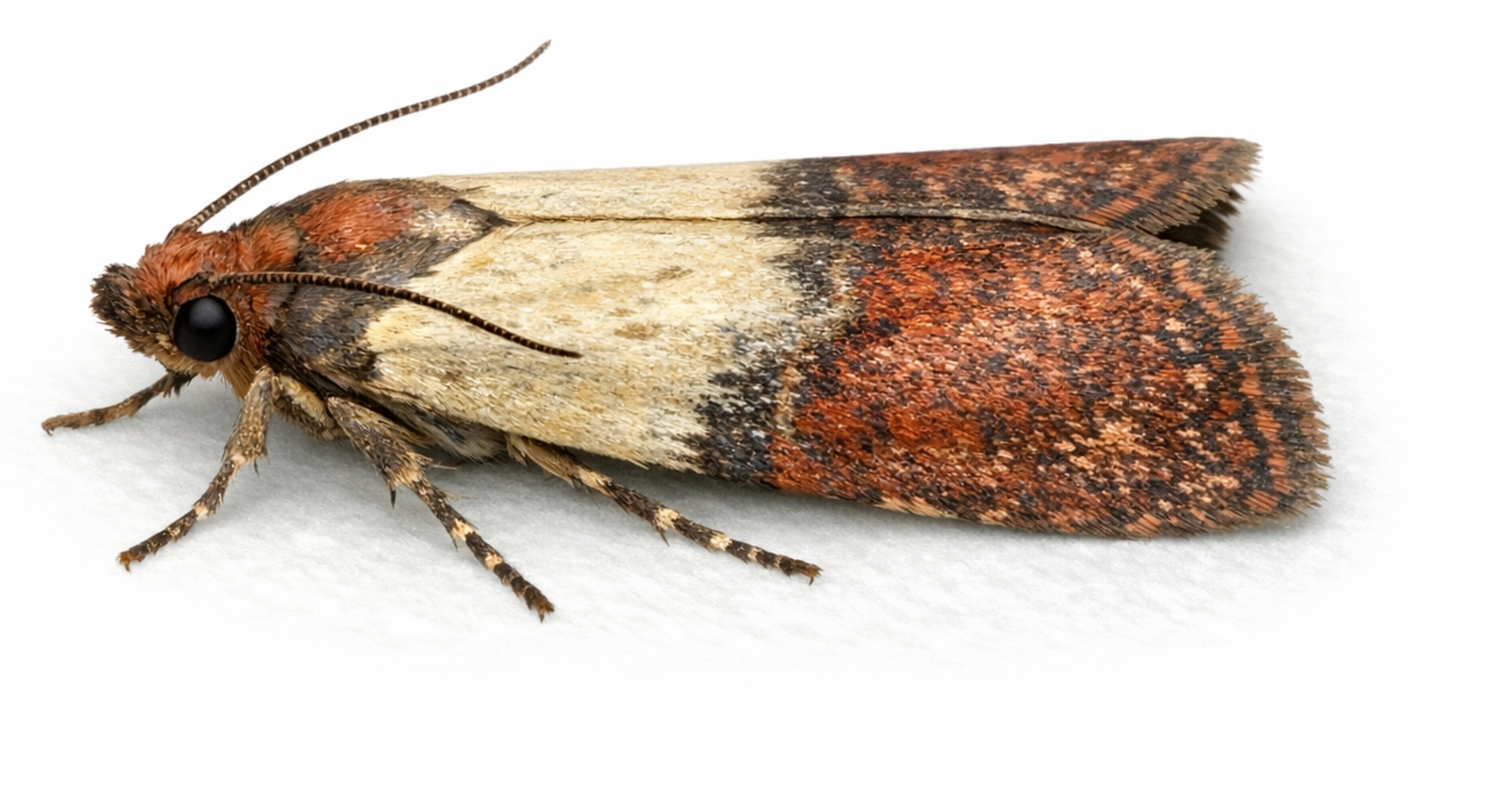
Adult Indian meal moths are fairly distinctive once you know what to look for. The front part of the forewing is pale grey, while the outer part is darker reddish-brown or coppery. Adults are small, but their two-toned wings are one of the best clues. Larvae are creamy white to yellowish or pinkish caterpillars with brown heads.
One of the most confusing things for homeowners is that the larvae often leave the food before pupating. So people may see worms on walls or ceilings and not realise the source is a packet of food in the pantry.
Indian meal moth infestations usually begin when eggs or very small larvae arrive inside packaged food. The insects do not need an obviously torn bag to get in. They often come home from the shop already inside the product. University extension sources specifically note that unopened or newly purchased products can already contain the infestation.
That is why a perfectly clean kitchen can still get pantry moths.
The main damage is caused by the larvae, not the adults. Larvae feed directly on stored food and spin silk through it. This silk mats particles together, causes clumping, and contaminates food with webbing, cast skins, and frass. Purdue and other extension sources note that the webbing is one of the most characteristic signs of infestation.
Most people think its main strength is simply “it lays eggs in food.”
That is not the most interesting part.
Its real hidden advantage is a combination of silk-based habitat engineering and developmental flexibility.
Indian meal moth larvae spin silk as they feed. That webbing is not just a nuisance to us. It helps create a more stable feeding environment around the larva, binds food particles together, and can make the infestation harder to detect early. In practical terms, the larva is not only eating the product — it is modifying the food environment while it lives in it.
A major overlooked advantage of this species is its ability to enter diapause, a paused developmental state. Research on Plodia interpunctella describes it as one of the more cold-hardy stored-product pests, with diapausing larvae able to spend six months or more in that state under some conditions.
That matters a lot.
It means this insect is not just fast. It is also patient. When conditions are poor, some larvae can effectively wait, then resume development later. That makes infestations more resilient than people expect.
If you want the single best answer, it is this:
The Indian meal moth is powerful because its larvae can both engineer their feeding space with silk and survive unfavourable periods by delaying development.
That combination is a big reason it remains such a supreme pantry pest.
Indian meal moth is also biologically impressive because reproduction depends heavily on sex pheromones, and this system is so reliable that pheromone traps are widely used to monitor adult males. Pheromone-based mating disruption is also being studied and used in commercial settings.
That tells you something important about the insect: its mating system is chemically sophisticated and predictable enough to manipulate. That is one reason pheromone traps work well for detection.
Indian meal moth does well because it combines several advantages:
That is why infestations can feel mysterious. The visible moth is often only the tip of the problem.
It is not the strongest insect.
It is not the fastest insect.
It is not the biggest insect.
What makes it exceptional is adaptability.
It can exploit many foods, reproduce in small hidden sources, protect its larvae with silk, disperse within a room by wandering before pupation, and survive poor conditions by delaying development. That is a very powerful set of traits for a stored-product pest.
The Indian meal moth is one of the most successful food-storage pests in the world because it does not rely on one trick. It uses hidden larvae, silk webbing, broad food tolerance, chemical communication, and developmental patience. That is what makes it so persistent — and why the visible moth is only a small part of the real story.
Next: how we treat pantry pests, pantry guarantees, pantry pest identification guide, Flour beetle guide, Rice weevil / grain weevil guide. Book pantry pest control in Cape Town · Pantry pests Cape Town hub. Read pantry pest treatment safety.
Plodia interpunctella — discard webbed and suspect product, clean thoroughly, seal new stock; cupboard treatment stays on your quoted scope.
Moths after a clean-out? Use get a quote for source tracing and residual treatment.
The problem is usually deeper than the one moth you noticed. A proper inspection helps identify the source, the spread, and the conditions allowing the infestation to continue. Get a professional assessment and stop the cycle properly.
Flour beetle guide · Rice weevil / grain weevil guide · How we treat pantry pests, Pantry guarantees, Pantry pest control by area, Pantry pest identification guide. Hub: pantry pests.