Pest guide · rodents
National rodent methodology: rodent control hub, how we treat rodents, rodent guarantees, rodent control by area, entry points & exclusion. Identification: rodent identification.
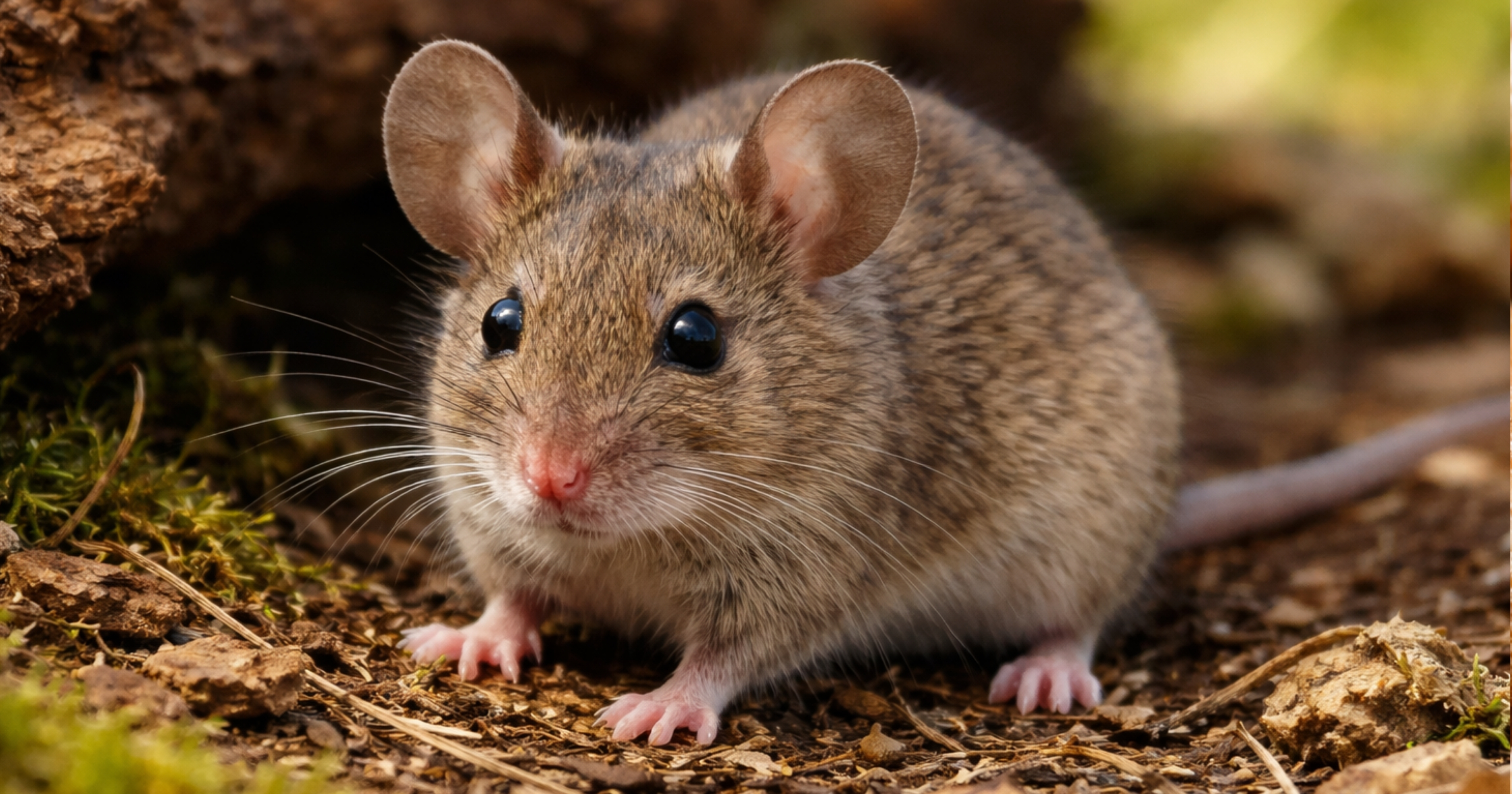
Mus musculus
Small, quiet, and often underestimated, the house mouse is one of the world's most successful pest mammals. Its real power is not size. It is its ability to live close to people, squeeze into tiny spaces, reproduce rapidly, learn routes quickly, and survive on surprisingly little food and water. That combination makes it one of the most persistent indoor pests on earth.
The house mouse is Mus musculus, a small rodent that has become one of the most widespread mammals in the world because of its close association with human buildings, stored food, and shelter. The University of California Integrated Pest Management (UC IPM) programme describes it as a highly adaptable animal found in and around homes, businesses, farms, and many other human environments.
This is important for a pest page because the house mouse is not just a “wild mouse that came indoors.” It is one of the classic commensal rodents — a species that thrives specifically by living alongside people.
House mice succeed because they combine several advantages at once:
That is why a mouse problem can start quietly and then suddenly seem much bigger than expected.
A house mouse is much smaller and finer-built than a rat.
House mice live wherever people provide three things: food, shelter, and access.
They are especially common in:
Unlike Norway rats, house mice usually do not need large burrow systems to become established indoors. They can nest in tiny protected spaces close to a food source.
Most people think the mouse's biggest strength is reproduction.
That is true, but it is not the whole story.
The more interesting biological advantage is this: the house mouse can survive and operate in extremely small territories. UC IPM notes that house mice usually travel only short distances from their nest when food and shelter are nearby. In other words, they do not need a large territory to survive. A mouse can live its whole life in a very small zone if that zone gives it warmth, nesting material, and reliable food.
This gives the species a huge advantage over larger rodents.
A house mouse does not need much:
That means a building can support a mouse population in places people barely notice — behind kickplates, inside cupboards, above ceilings, in appliance voids, or inside stock clutter.
Its special power is micro-living.
The house mouse is supreme not because it is strong, but because it can turn tiny overlooked spaces into full survival zones. That makes it brilliantly suited to human buildings.
This is one of the most important facts people miss.
House mice can survive with very little free water, and in many situations they obtain enough moisture directly from their food. That is one reason they can persist in dry indoor spaces where people assume animals would need a visible water source.
People often remove a dripping tap and assume the mouse issue will disappear. That may help, but it does not automatically solve the problem if food remains available.
UC IPM states that when resources are stable, house mice can reproduce throughout the year. A single female may produce 5 to 10 litters a year, often with around 5 or 6 pups per litter.
That does not mean every mouse problem instantly explodes, but it does mean one small infestation can build fast if:
House mice do not just eat food. They also contaminate it.
Rodent contamination happens through droppings, urine, hair, gnawing, and movement across food-contact surfaces. CDC materials also note that mouse allergens, especially in urine, can contribute to asthma problems in some indoor environments.
CDC's recent reporting also notes that the house mouse is the usual carrier of lymphocytic choriomeningitis virus (LCMV), a rodent-borne virus with global distribution.
So the issue is not just nuisance. It can also be:
House mice are difficult because they combine:
This means control often fails when people focus on only one part of the problem, such as catching visible mice, while ignoring entry points, food spillages, stock clutter, nesting material, and hidden harbourage zones.
They usually do not.
House mice are just very good at staying unnoticed. Because they can live in tiny spaces and move short distances, they may be present for some time before people see one in the open. By the time daytime sightings happen, conditions inside the building may already be supporting them well.
The house mouse is one of the most underestimated pests in the world. It is not dominant because it is powerful in the obvious sense. It is dominant because it is small enough to be overlooked, flexible enough to live almost anywhere, and efficient enough to survive on very little. That is what makes it such a stubborn pest in homes and businesses alike.
Next: how we treat rodents, rodent guarantees, rodent identification guide. Book rodent control in Cape Town · Rodents Cape Town hub. Read rodent treatment safety.
Mus musculus — inspection-led control, proofing, and attractant reduction on your quoted scope; disease and allergen risk varies by site and exposure.
Droppings or gnawing in food areas? Use get a quote for a species-aware programme.
We inspect for species and routes, reduce populations on agreed scope, then seal and advise so mice do not return — national rodent methodology; your quote prevails.
How we treat rodents, Rodent guarantees, Rodent control by area, Entry points & exclusion, Rodent identification guide. Hub: rodent control.