Pest guide · rodents
National rodent methodology: rodent control hub, how we treat rodents, rodent guarantees, rodent control by area, entry points & exclusion. Identification: rodent identification.
Rattus rattus
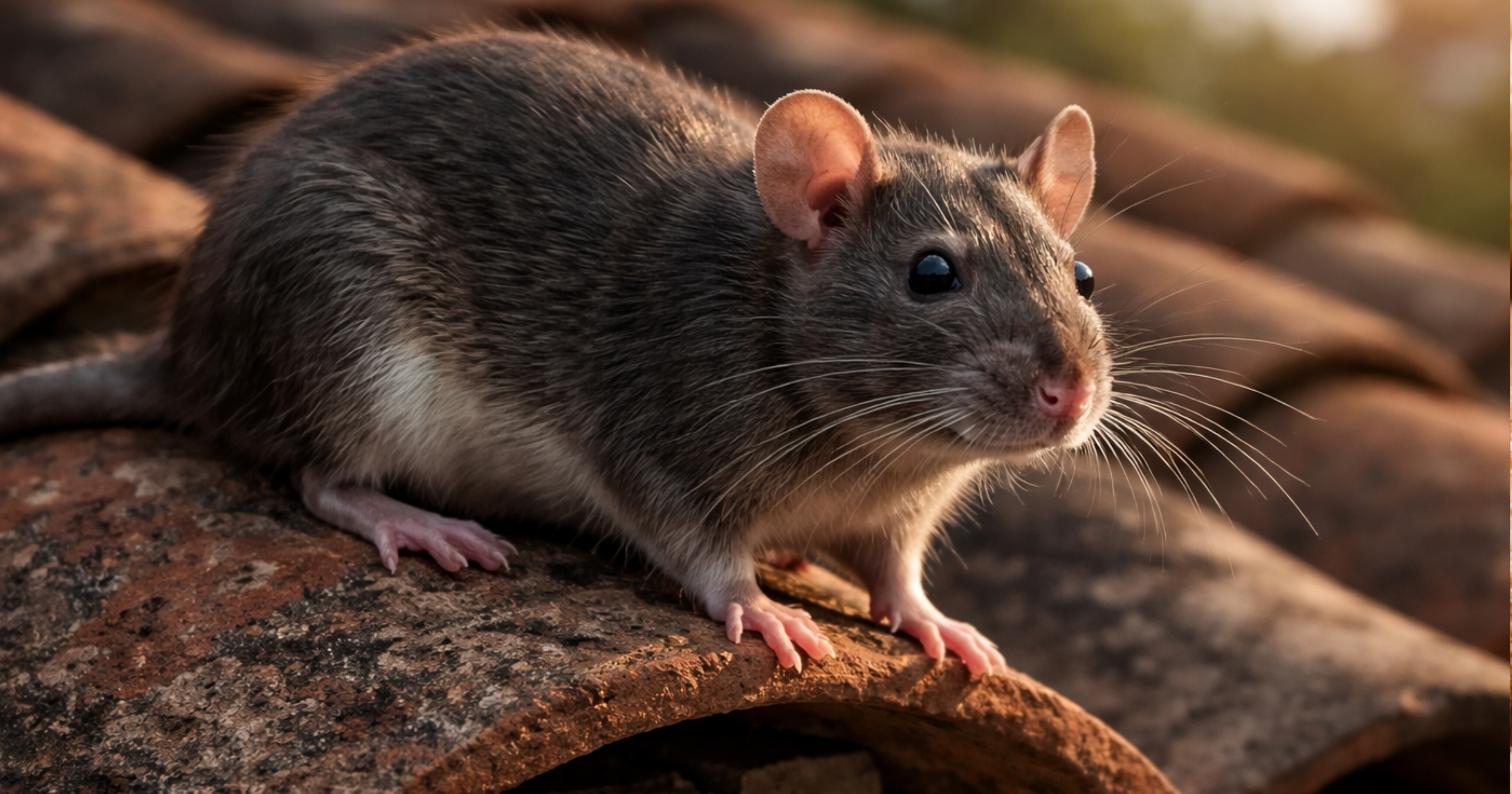
The roof rat is Rattus rattus, also called the black rat or ship rat. It is one of the main commensal rat species associated with people, buildings, stored food, and urban environments. Unlike the heavier Norway rat, the roof rat is typically slender, agile, and strongly associated with elevated spaces such as ceilings, rafters, trees, and upper parts of structures.
A roof rat is a light-built, climbing rat that thrives where it can move above ground. UC IPM describes it as slimmer than a Norway rat, with a more pointed muzzle, larger ears, and a tail longer than the combined head-and-body length. That tail detail is one of the clearest identification clues.
A roof rat usually looks:
This species is strongly associated with elevated harbourage. UC IPM and the Internet Center for Wildlife Damage Management (ICWDM) both note that roof rats commonly live in attics, roofs, upper building levels, trees, dense vines, and palms. In agricultural settings, UC IPM also notes that they may build nests in trees, while in some hot conditions they may use ground debris or shallow burrows near trees.
That is one of the biggest truths people get wrong: roof rats are not only “roof” animals in a strict sense, but they are much more arboreal and elevated in habit than Norway rats.
Roof rats matter because they combine:
CDC states that rats and mice together are associated worldwide with dozens of diseases transmissible directly or indirectly to humans. That is why roof rat activity is never just a nuisance issue.
Most people think the roof rat's biggest strength is simply that it can climb.
That is true, but the deeper advantage is three-dimensional movement.
Roof rats are exceptionally good at using vertical space. Their slender build, long tail, and climbing ability allow them to live and travel in places that are harder for heavier rodents to exploit efficiently, including rafters, cables, beams, vines, branches, and roof voids. That lets them turn the upper parts of a property into a protected highway system.
A Norway rat is often a ground-and-burrow problem.
A roof rat is often a height problem.
That changes everything:
Its hidden advantage is not just climbing. It is the ability to own the aerial layer of a property. That makes the roof rat especially successful in buildings, orchards, palms, and cluttered urban landscapes. This is an inference from its documented arboreal and elevated nesting habits.
Rodent behaviour reviews note that commensal rats often rely on familiar routes and show caution around changes in their environment. For roof rats, this becomes especially important because those routes may be overhead, concealed, and repeated night after night. That helps explain why an infestation can continue while people see very little direct movement at ground level.
Roof rats are difficult because they combine:
This means poor control often fails when people treat them like ground rats. The real challenge is that they often occupy places people do not inspect well.
CDC materials note that roof rats, like other commensal rats, are associated with the transmission of numerous zoonotic diseases, and rats in urban settings are a recognized public-health concern because of contamination and exposure risk.
The roof rat is one of the most elegant and troublesome pest rodents in the world. It is not formidable because it is the biggest rat. It is formidable because it is light, agile, elevated, and hidden. Its real advantage is that it can turn height into safety, movement, and survival — and that makes it a very different pest from the heavier, ground-driven Norway rat.
Next: how we treat rodents, rodent guarantees, rodent identification guide. Compare Norway rat guide · House mouse guide. Book rodent control in Cape Town. Read rodent treatment safety.
Rattus rattus — elevated harbourage, proofing at rooflines and vegetation, and programmes that match overhead travel; your quoted scope prevails.
Scratching overhead or fruit damage? Use get a quote for inspection-led control.
We inspect high routes and entry first, then align trapping and secured baiting with proofing on your quoted scope — national rodent methodology; your quote prevails.
Norway rat pest guide, House mouse pest guide, How we treat rodents, Rodent guarantees, Rodent control by area, Entry points & exclusion, Rodent identification guide. Hub: rodent control.