Pest guide · wasps
Social wasps: paper wasp guide, yellowjacket / hornet-type guide. Hub: wasps, wasp identification.
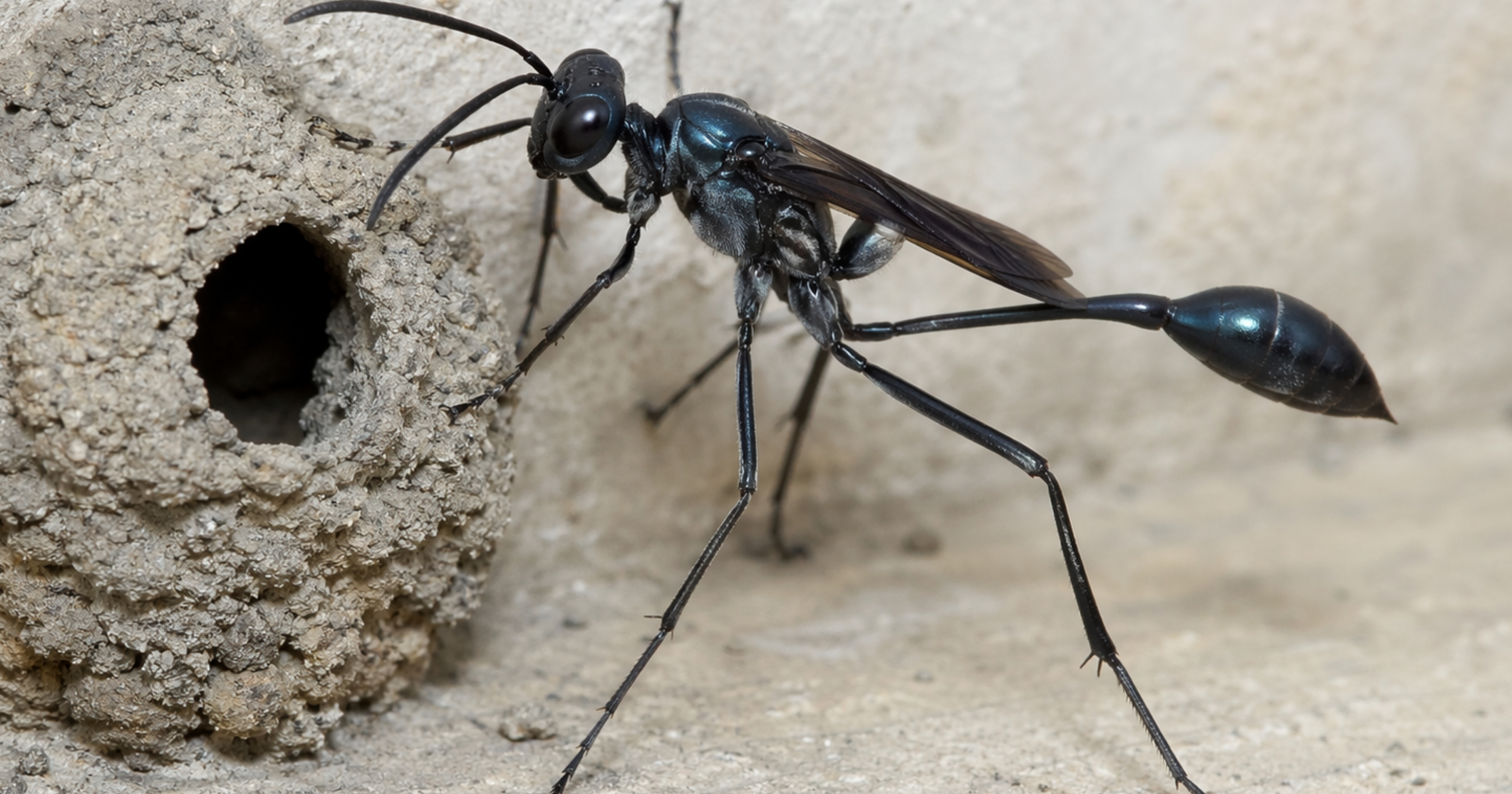
Mud daubers are among the most misunderstood wasps because people often assume that any wasp with a nest near a home must be highly aggressive. In reality, mud daubers are solitary wasps, not large social colony wasps like yellowjackets or hornet-type wasps. Extension sources describe them as slender wasps with very narrow waists that build nests out of mud, and they are generally considered non-aggressive toward people.
Their real strength is not swarming or mass defence. Their real power is the ability to act as a precision spider hunter, building individual mud chambers and stocking each one with paralysed prey for a developing larva.
A mud dauber is a solitary hunting wasp that builds nests from mud rather than paper. University of Maryland Extension notes that common mud daubers include the black and yellow mud dauber, blue mud dauber, and organ pipe mud daubers, and that they are typically dark or metallic with a long, thread-like waist. Purdue's public health entomology materials likewise place mud daubers among solitary wasps rather than social wasps.
For a pest guide, that distinction is the most important one to make clearly: a mud dauber is not a swarm-forming social nest defender. It is a lone female builder and hunter, provisioning her own nest cell by cell.
Mud daubers are usually identified by a combination of body shape and nest type. University of Maryland Extension describes them as long-bodied wasps with a very thin waist, often black, blue-black, metallic, or black-and-yellow depending on species. Their nests are made of mud and may appear as smooth clumps, organ-pipe tubes, or attached mud cells on sheltered surfaces.
Unlike paper wasps or hornet-type wasps, their nests are not papery combs. A mud dauber nest is built from collected wet mud, shaped into sealed chambers, usually on protected structures such as walls, ceilings, under eaves, garages, sheds, barns, bridges, and other sheltered spaces.
Mud daubers are usually more of a nuisance pest than a dangerous one. Their main issue around homes and buildings is the unsightly mud nests they leave on walls, ceilings, equipment, and sheltered structures. University of Maryland Extension states plainly that mud daubers are not aggressive, and Purdue notes that solitary wasps almost never sting in defence of the nest.
That said, they matter because they repeatedly choose sheltered man-made structures as nesting surfaces. In rare cases, mud-dauber nesting in equipment openings has caused serious problems; one widely cited aviation incident involved a pitot tube blockage attributed to mud-dauber nesting.
So the important truth is this: mud daubers are usually low-aggression structural nuisance wasps, not high-risk swarm attackers.
Most people think the biggest difference is simply that mud daubers build with mud. That is true, but the deeper advantage is this: their special power is precision prey storage.
Mud daubers do not just catch prey and eat it immediately. Female mud daubers hunt spiders, sting them, and paralyse rather than kill them outright, then place them inside a sealed mud chamber as living food for the larva. Multiple sources describe mud daubers stocking each nest cell with several spiders before laying an egg and sealing the chamber.
A predator that kills prey immediately has to hunt again and again. A mud dauber creates a sealed pantry of fresh prey.
This is the real “special power.” Its hidden advantage is not just mud-building. It is the ability to turn paralysis into biological refrigeration, keeping prey available for the larva in a sealed chamber. That is what makes the mud dauber such an elegant hunter — an inference based on the documented behaviour of paralysing and storing spiders in nest cells.
One of the most interesting and least appreciated mud-dauber traits is that they can remove significant numbers of spiders from an area. UC ANR notes that mud daubers prey on spiders, including black widows, and may stock each cell with many spiders; with multiple cells per nest, the total number of spiders taken can be substantial. University of Maryland also notes that the adults collect spiders to feed their young.
This matters because it means mud daubers are not just nuisance nest builders. They are active natural control agents of spiders, especially around structures. That does not make every mud nest welcome, but it does make the biology far more interesting than most people realise.
Mud daubers succeed because they combine:
That combination makes them less like “angry house wasps” and more like specialised architectural hunters. That is what makes them so distinctive — an inference based on the biology above.
A surprisingly important fact is that adult mud daubers and their larvae live very different food lives. Adults often feed on nectar and other liquid foods, while the larvae are raised on stored spiders. Maryland Extension notes adults may act as pollinators while feeding on nectar, even as they collect spiders for their offspring. That means the same insect functions both as a flower visitor and a spider-hunting predator during its life cycle.
Verminator can remove or treat mud nests where they conflict with your quoted scope (e.g. equipment openings, high-visibility facades). Solitary wasp biology still means lower sting urgency than social nests — your assessment and quote govern what we do. This page is educational context, not equipment-specific maintenance advice.
The mud dauber is one of the most remarkable wasps because it is not built around swarming or intimidation. Its real supremacy lies in engineering and precision. It can turn wet mud into a nursery, turn spiders into stored fresh prey, and raise its young in sealed chambers with extraordinary efficiency. That is what makes it such a successful hunter — and such a misunderstood visitor around buildings.
Solitary mud nests, spider provisioning, low nest-defence sting risk — treatment only where the site needs it.
Mud on critical equipment or heavy buildup? Use get a quote.
We assess solitary vs social wasps, then treat or remove mud nests on your agreed scope — social yellowjacket voids are a different job profile.
Paper wasp guide · Yellowjacket / hornet-type guide · Wasp identification guide · How we treat wasps · Wasp treatment safety. Book wasp control in Cape Town.