Pest guide · wasps
National wasp methodology: wasp hub, how we treat wasps, wasp guarantees, wasp control by area. Open-comb context: paper wasp guide. Solitary mud nests: mud dauber guide.
Yellowjacket and hornet-type wasps are among the most misunderstood stinging pests because people often mix several different wasps together under one name. In strict biological terms, yellowjackets are social wasps in the genera Vespula and Dolichovespula, while true hornets belong to the genus Vespa. In South Africa, the best-known yellowjacket-type pest is the German wasp, Vespula germanica, an invasive social wasp that has become a serious concern in parts of the Western Cape, especially around Cape Town.
Their real strength is not simply the sting. Their real power is that they are fortress-building social hunters: they create enclosed paper colonies, raise a coordinated workforce, defend the nest fiercely, and switch food strategies as the colony grows through the season.
A yellowjacket is a social paper wasp that lives in a colony founded by a queen and expanded by sterile female workers. UC IPM describes yellowjackets as species in Vespula and Dolichovespula — medium-sized wasps with a short narrow waist that build enclosed paper nests. University of Maryland Extension describes the same social system: one queen starts the colony in spring, workers take over nest building and foraging, and the colony reaches peak size by late summer or early autumn.
For a South African pest page, the key point is this: when people say “yellowjacket” or “hornet-type wasp,” they usually mean an enclosed-nest social wasp that is more defensive and more colony-driven than an open-comb paper wasp. In Cape Town, official city communications specifically identify the German wasp as one of the invasive alien wasps being actively targeted.
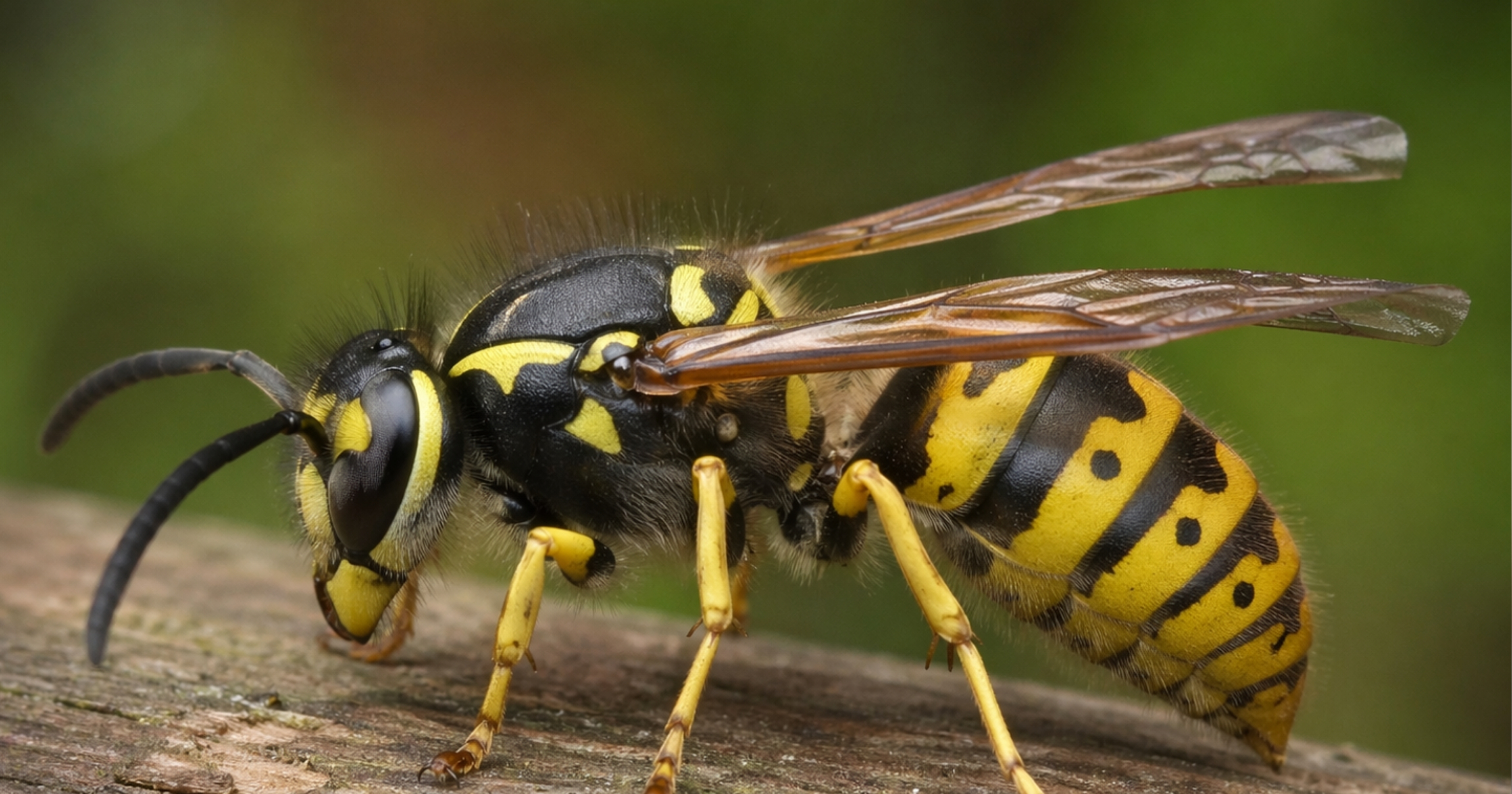
Yellowjacket / hornet-type wasps are usually identified by a mix of body shape, nesting style, and behaviour rather than colour alone. UC IPM notes that yellowjackets tend to be medium-sized, black with bright yellow markings, with a very short narrow waist. Their nests are made from wood fibres mixed with saliva and consist of multiple layers of comb enclosed by an outer paper envelope.
They are easy to confuse with paper wasps, but the nest helps greatly. Paper wasps make an open umbrella-like comb with exposed cells, while yellowjackets and hornet-type wasps build a more enclosed nest, often with a single entrance. Some species nest underground, while others use wall voids, roofs, cavities, shrubs, or trees depending on the species.
These wasps are serious pests because they combine social organisation, repeated stinging ability, and aggressive nest defence. UC IPM notes that colonies may range from about 1,500 to 15,000 individuals, depending on species, and that stingers are not barbed, so workers can sting repeatedly.
They also become more troublesome because their diet changes through the season. Adults consume liquids and are drawn to nectar, fruit juices, sap, honeydew, and sweet foods, while workers hunt insects and scavenge protein to feed the larvae. Later in the season, when colony growth slows and sugar demand rises, they become especially attracted to human food and drink. That is why they often seem “suddenly worse” in late summer.
This is why they are underestimated. People often think of them as random angry wasps, but biologically they are expanding seasonal colonies with changing nutritional demands. That makes their behaviour much more strategic than it appears.
Most people think the biggest difference is the sting. That is true, but the deeper advantage is this: their special power is enclosed social architecture.
Yellowjacket and hornet-type wasps do not just build a nest. They build a layered paper fortress. Extension sources describe their nests as multiple comb layers surrounded by a paper envelope, often hidden in sheltered cavities or underground spaces. That outer envelope is not just packaging — it turns the colony into a protected, centralised system for brood rearing, defence, and workforce coordination.
An open-comb paper wasp nest is more exposed. A yellowjacket or hornet-type colony is more shielded. That means:
This is the real “special power.” Its hidden advantage is not merely venom. It is the ability to convert chewed wood and saliva into a defensive, expandable colony shell that protects the queen, brood, and workers while allowing the colony to scale up dramatically. That is what makes these wasps so biologically effective and so difficult when they establish near people — an inference based directly on the documented nest structure and colony behaviour.
One of the least-known facts about social wasps is that the larvae are not just passive mouths waiting for food. University of Maryland Extension notes that adult wasps feed on sugary liquids and on nutritional liquids produced by their young. NC State likewise explains that workers bring prey to the larvae, and the larvae in return produce a nutritional syrup that adults consume.
This is a remarkable biological system. The adults hunt protein for the brood, and the brood helps nourish the adults. That means the nest is not simply a place where food is stored — it is a living nutrient-processing system. That is one reason these colonies can sustain such active, aggressive foraging and defence.
Yellowjacket / hornet-type wasps succeed because they combine:
That combination makes them less like “random flying wasps” and more like seasonal aerial or subterranean hunting societies. That is what makes them so effective — an inference based on the biology above.
In South Africa, the German wasp (Vespula germanica) is not just a nuisance insect. It is an invasive alien wasp being actively targeted in Cape Town, and research from the southern tip of South Africa shows that its spread is shaped by habitat and moisture conditions rather than simple unrestricted expansion. That matters because it shows this is not just a garden annoyance — it is a monitored invasive social pest with real ecological and urban significance.
Verminator treats wasp nests on the quoted scope — timing, access, and wasps-vs-bees identification matter. Do not block cavity entrances or disturb active colonies yourself. This guide is educational context, not DIY nest removal instructions.
The yellowjacket / hornet-type wasp is one of the most formidable social stinging pests because it is not just an insect with venom. It is a colony organism. Its real supremacy lies in fortress-building, workforce coordination, repeated defence, and a hidden nutrient system between adults and larvae. That is what makes it so effective in nature — and so dangerous to underestimate around homes, structures, and outdoor living spaces.
Enclosed nests, repeat stings, late-summer scavenging — nest-led treatment on your written quote.
Cavity, ground hole, or high-traffic nest? Use get a quote.
Nest survey, dusk-led treatment where appropriate, and safe removal on agreed scope — we treat wasps; bees go to beekeepers when relocation fits.
Paper wasp guide · Mud dauber guide · Wasp identification guide · How we treat wasps · Wasp guarantees · Wasp treatment safety. Book wasp control in Cape Town.