Pest guide · wasps
National wasp methodology: wasp hub, how we treat wasps, wasp guarantees, wasp control by area. Identification: wasp identification. Enclosed nests: yellowjacket / hornet-type guide. Solitary mud nests: mud dauber guide.
The truth about one of the most misunderstood wasps around homes and gardens
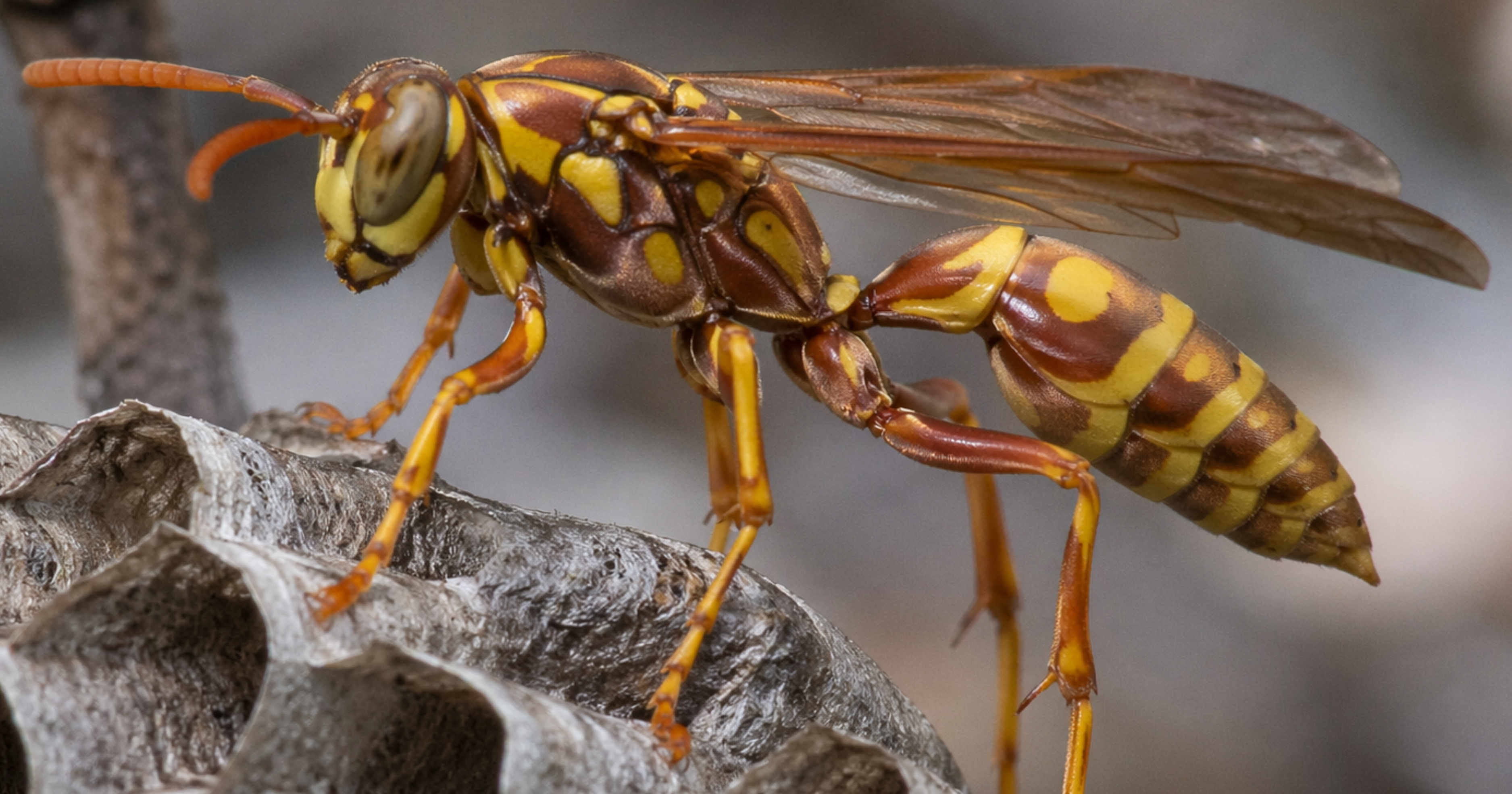
Paper wasps are social wasps best known for building the familiar open, umbrella-shaped nests made from chewed plant fibre mixed with saliva. Unlike hornets and many yellowjacket-type wasps, their nests usually have exposed hexagonal cells with no outer paper envelope. In most regions, the common “paper wasps” people notice around buildings belong to the genus Polistes, though other social wasps may also be called paper wasps in everyday speech.
They are important predators of other insects, but they also become pests when they build nests in doorways, roof spaces, patios, window frames, play areas, or high-traffic outdoor spaces. Paper wasps are generally less defensive than yellowjackets, but they will defend a nest if they feel it is threatened.
In southern Africa, wasps are part of a large native fauna, and the term “paper wasp” is used broadly in public language, so identification should be based on the nest structure and body form, not just colour. SANBI's guide to wasps and bees in southern Africa reflects that southern Africa has a rich wasp diversity rather than one single “paper wasp.”
The two clearest clues are:
Paper wasps build a single exposed comb of cells, often suspended by a narrow stalk. This is one of the easiest ways to separate them from many hornet- and yellowjacket-type wasps, whose nests are often enclosed in a larger paper shell.
Paper wasps typically have a slimmer, longer-legged look than stockier yellowjackets. When flying or walking, their long legs are often more noticeable. That lean build is part of why many people describe them as more “elegant” or “angular” than other wasps.
They can sting, and the sting can be painful. For most people, the main risk is local pain and swelling, but for people with venom allergies, stings can be medically serious. That is true of wasp stings generally, not just paper wasps.
The important distinction is this:
A paper wasp away from its nest is often far less confrontational than people expect. A paper wasp at or near its nest can become highly defensive very quickly.
So the real danger is often location, not just species.
This is one of the most misunderstood parts of their biology.
Adult paper wasps often feed on sugary liquids such as nectar and other carbohydrate sources, but the colony also depends on protein from prey insects, especially for raising larvae. Adults hunt caterpillars and other soft-bodied insects, chew them into a pulp, and feed that to developing young.
That means paper wasps are not just nuisance insects. They are also predators, and in some settings they help suppress garden pests.
Most people know paper wasps make “paper.” Far fewer appreciate how impressive that actually is.
Paper wasps scrape weathered wood or plant fibres, chew the fibres, mix them with saliva, and create a lightweight, structured building material that is strong enough to hold brood cells and survive outdoor conditions. The use of paper as nest material is a defining trait across multiple wasp groups, but the open-comb architecture of paper wasps is especially elegant and efficient.
That alone is impressive — but here is the more interesting part:
Their nest material is not just structural
Research on social wasps has shown that substances involved in nest care and larval interactions can have antimicrobial effects, helping reduce microbial threats in the colony environment. A recent study on social wasp seed-cleaning and salivary effects supports the broader point that secretions associated with social wasp behaviour can suppress microbial growth.
This means the paper wasp's “paper” is not merely cardboard-like shelter. Its nest system is part of a living hygiene strategy: architecture, saliva chemistry, brood care, and behaviour all work together.
That is one reason paper wasps are so successful. Their power is not just the sting. It is their ability to create a functional micro-fortress that shelters, organises, and protects the colony.
This is one of the most fascinating known abilities in the wasp world.
Research on certain Polistes paper wasps, especially Polistes fuscatus, shows that they can recognise individual wasp faces. Studies suggest they process faces in a surprisingly sophisticated way, using individual facial patterns to distinguish one wasp from another.
This is not known for every paper wasp species, so it should not be overstated as universal. But it is a real and striking trait in some paper wasps, and it shows that these insects are not simple, interchangeable colony machines.
In social colonies where rank, rivalry, cooperation, and reproduction matter, recognising individuals can help keep order. That makes face recognition a kind of social intelligence advantage.
So one of the hidden reasons paper wasps are formidable is this: some of them are not just builders and hunters — they are also visually sophisticated social negotiators.
Paper wasps are drawn to structures because buildings offer:
Those features mimic the protected sites they naturally seek for colony founding. The problem for people is that these ideal sites are often exactly where humans pass most often: eaves, patio beams, roof edges, shutters, garage lintels, and window frames.
Many people say paper wasps look more alert and aware than other insects. That impression is not entirely imagined.
Wasps in the genus Polistes are visually oriented, and in some species, research shows surprisingly advanced visual processing tied to social recognition. Even where face recognition is not proven for a particular local species, paper wasps do rely heavily on visual cues, nest position, and social interactions.
That contributes to the eerie sense that they are “tracking” activity around the nest.
The paper wasp's strength comes from a powerful combination:
You may be looking at paper wasps when you notice:
The paper wasp is powerful not because it is the fiercest wasp, but because it combines smart nest engineering, efficient social living, targeted defence, and in some species surprisingly advanced recognition abilities into one highly successful insect design.
Paper wasps are not just stinging pests. They are architects, hunters, and highly organised social insects. Their open paper nests, defensive behaviour, and clever colony design make them successful almost everywhere they find shelter. The key is to understand them accurately: not as mindless attackers, but as intelligent nest-defenders whose real strength lies in engineering, coordination, and precision.
Next: how we treat wasps, wasp guarantees, wasp identification guide. Book wasp control in Cape Town · Wasps Cape Town hub. Read wasp treatment safety.
Polistes — open-comb nests; sting risk rises at the nest. Your written quote governs treatment scope and timing (often dusk-led).
Nest near people or unsure wasp vs bee? Use get a quote.
Nest-led treatment and safe removal follow national wasp methodology on your quoted scope — do not disturb the colony yourself.
Wasp identification guide · Yellowjacket / hornet-type guide · Mud dauber guide · How we treat wasps, Wasp guarantees, Wasp control by area. Hub: wasps.