Pest guide · fly family
National fly methodology: fly control hub, how we treat flies, fly guarantees, fly control by area. Identification: fly identification. House fly guide, Fruit fly guide, Drain fly guide.
Calliphoridae (blow flies)
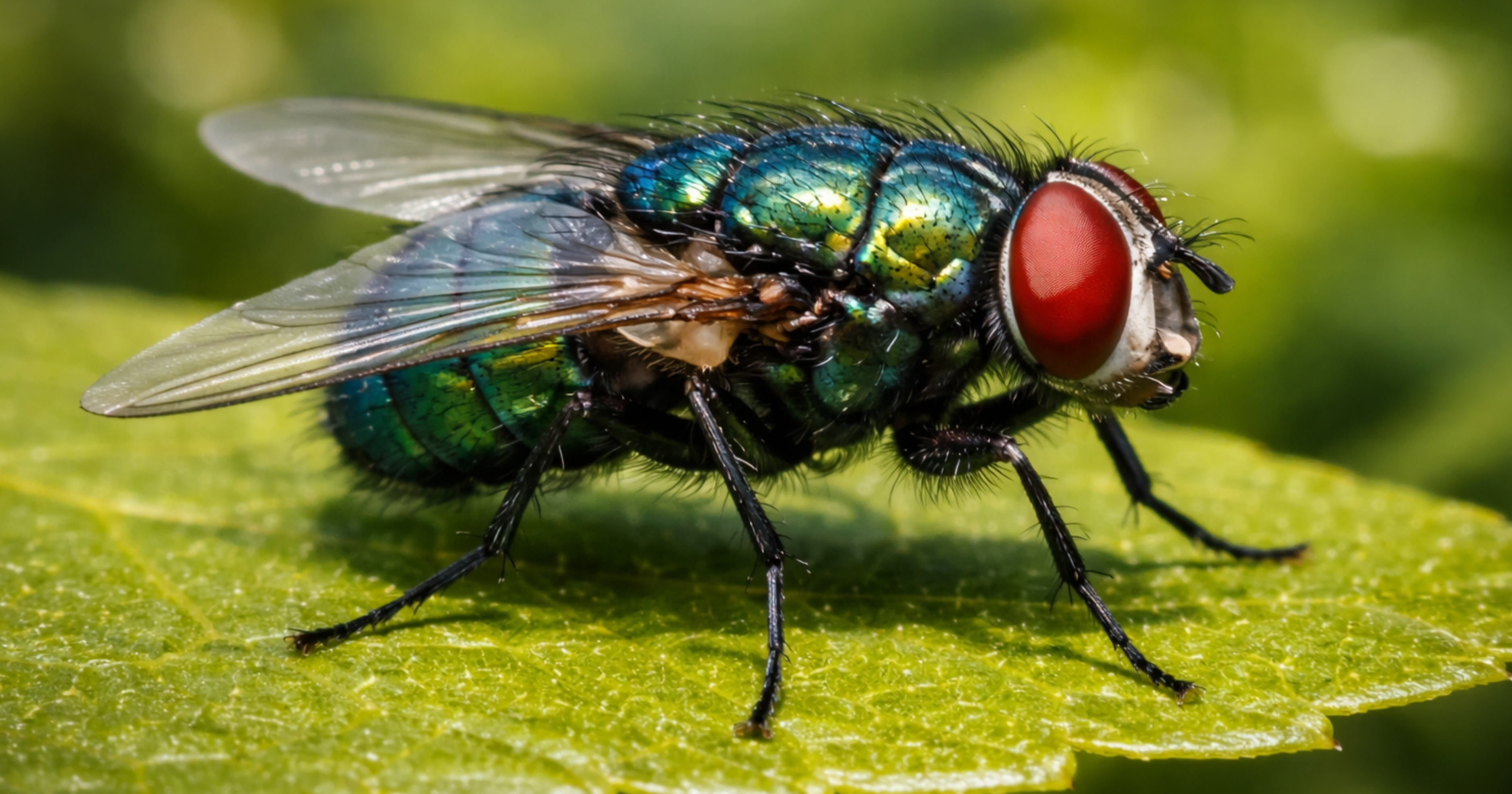
The blow fly is not just a “big noisy fly.” Blow flies are a family of fast-finding, metallic-bodied flies built to detect and exploit the briefest opportunities in nature: carrion, wounds, waste, and other rich organic material. Their real strength is not brute force or nuisance alone. It is a combination of rapid detection, fast colonisation, and high-performance larval development that makes them some of the most effective resource-finding insects on earth.
“Blow fly” usually refers to flies in the family Calliphoridae. Many species are metallic green, blue, bronze, or blackish, and several are tied to decomposing organic matter, carcasses, animal waste, and wounds. Because the name covers a family rather than a single insect, people often treat all blow flies as identical, which is not quite true. Different species vary in habitat, temperature preference, forensic significance, and veterinary importance.
Many blow flies are recognised by:
Blow flies matter because they are not random visitors. They are signal insects. Their presence often suggests one of a few underlying conditions:
That is why a blow fly problem is often less about “the fly” and more about what the fly has found.
Adult blow flies are attracted to nutrient-rich organic material where their larvae can feed. Veterinary sources note that in normal conditions many important species lay eggs in feces or decaying animal carcasses, while some are also attracted to moist wounds, soiled wool, or contaminated hair coats in living animals. Eggs can hatch within about 24 hours when conditions are moist.
Most people think the blow fly's main power is that it is “dirty.”
That misses the remarkable part.
Its deeper advantage is rapid resource detection and colonisation. Blow flies are famous in forensic science because they are often among the first insects to arrive when a suitable resource appears, especially fresh carrion. Their timing is so reliable that forensic entomology uses them as a biological clock to help estimate time since colonisation and, in some situations, minimum postmortem interval.
A resource like carrion or an untreated wound is temporary and competitive. The insect that finds it first gains the advantage. Blow flies are built for exactly that race. They respond rapidly to the chemical signals released by suitable material and move in before many other organisms do.
The hidden strength of the blow fly is not just flying to bad smells.
It is the ability to:
That combination is what makes blow flies so supreme in their niche.
One of the most interesting and lesser-known facts about blow flies is that dense larval groups can create maggot masses that become warmer than the surrounding environment. This matters biologically and forensically because temperature strongly affects development. Studies on blow fly ecology and forensic development repeatedly focus on temperature, larval density, and survival because these factors can substantially change growth rate and competition.
In plain language, blow fly larvae do not just feed — in dense groups they can create a more favourable microenvironment for development. That is one reason they can process a food source so efficiently. This is an inference supported by the temperature- and density-focused blow fly literature.
Blow flies are difficult not because they are subtle, but because they are fast indicators. When a suitable source appears, they often arrive quickly, breed quickly, and produce conspicuous adult or larval activity. That speed is exactly why they are so important in both pest work and forensic science.
One of the most overlooked truths about blow flies is that their reputation as “dirty flies” does not capture how biologically sophisticated they are. They are among the best-known examples of insects whose development is so predictable and useful that scientists use them to reconstruct timelines in forensic investigations.
If you want one accurate answer, it is this:
It wins by getting there first.
Many insects can use decaying material. Many insects can lay eggs fast. Many insects can exploit waste. But blow flies stand out because they combine:
That is what makes them so formidable.
The blow fly is one of nature's fastest responders. It is not powerful because it is glamorous or feared, but because it is exquisitely tuned to opportunity. Calliphoridae succeed by finding rich temporary resources early, colonising them fast, and turning them into a thriving next generation before the opportunity disappears. That is what makes the blow fly so familiar, so useful to science, and so difficult to ignore.
Next: how we treat flies, fly guarantees, house fly guide, fruit fly guide, drain fly guide, fly identification guide. Book a get a quote. Read fly treatment safety.
Calliphoridae — carrion and wound cues, myiasis context, forensic first colonisers vs house fly confusion.
Metallic flies at bins or voids after a spike? Book through our quote flow for inspection-led, source-removal-aligned programmes.
We work from the biology: locate carrion, meat waste, or wound drivers first, then align treatment and advice to your quoted scope—standard fly methodology and guarantee framing.
How we treat flies, Fly guarantees, Fly control by area, House fly guide, Fruit fly guide, Drain fly guide, Fly identification guide. Hub: fly control.