Pest guide · fly family
National fly methodology: fly control hub, how we treat flies, fly guarantees, fly control by area. Identification: fly identification. Fruit fly guide, Drain fly guide, Blow fly guide.
Musca domestica
The house fly is so common that people often underestimate it. But Musca domestica is one of the most successful human-associated insects on earth. Its real strength is not just fast breeding. It is a combination of mechanical pathogen transfer, liquid-feeding biology, sensory “tasting” with the feet, and an extraordinary ability to exploit human waste and food systems.
The house fly, Musca domestica, is the familiar grey fly found around homes, farms, food waste, manure, and buildings worldwide. Reviews describe it as a major synanthropic fly, meaning it thrives in close association with humans and human activity. That is why it is so consistently linked to homes, livestock units, food-handling areas, refuse, and sanitation problems.
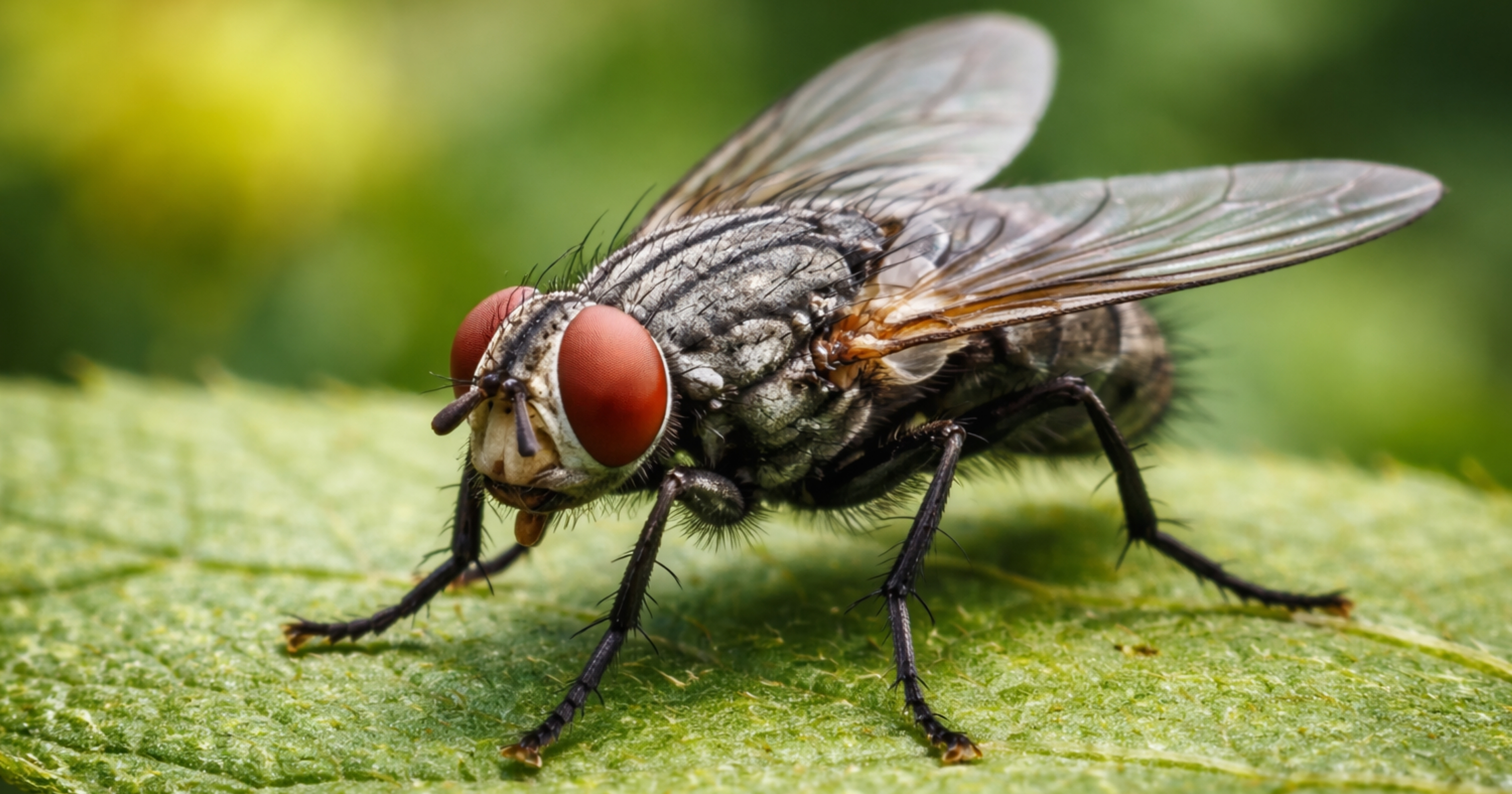
Adult house flies are usually grey to dark grey, with four dark longitudinal stripes on the thorax, red compound eyes, and a single pair of clear wings. They are not metallic like blow flies, and they are usually more compact and less shiny than many people expect. SANBI's overview and standard entomology references describe the adult as a non-biting fly with sponging mouthparts.
What to look for
House flies matter because they are not just annoying — they are important mechanical carriers of microbes. Reviews and field studies show that house flies can pick up pathogens from feces, waste, and contaminated organic matter, then move them to food, surfaces, animals, and people. They are repeatedly described as vectors or possible vectors of numerous pathogens, especially enteric bacteria and other disease agents.
The key word here is mechanical. A house fly does not need to “infect” you in the way a mosquito transmits malaria. Instead, it physically transfers contamination on its body, feet, mouthparts, vomit-like regurgitation droplets, and feces.
House flies breed in decaying organic matter, especially material that is moist, nutrient-rich, and microbially active. That includes manure, rotting food waste, spoiled feed, and other decomposing organic substrates. Reviews of synanthropic flies stress that these materials are central to both nutrient acquisition and pathogen pickup.
That is one of the biggest reasons they are so closely tied to human environments: people constantly create ideal fly resources through waste, food handling, livestock operations, and organic refuse.
Most people think the house fly's main strength is reproduction.
That is true, but it is not the deepest answer.
Its more interesting and lesser-known advantage is this: the house fly is built to sample, test, dissolve, and exploit surfaces incredibly efficiently.
SANBI notes that house flies use chemosensory receptors on their feet to detect suitable food when they land, especially sugar-rich solutions. Because they feed with a sponging proboscis, they also wet and dissolve suitable solid food before ingesting it. Reviews of synanthropic flies explain that this feeding system helps them acquire nutrients — and, importantly, pick up and redistribute microbes.
A house fly does not need to bite to be powerful. It can land on many surfaces, taste with its feet, test food quickly, liquefy edible material, feed, and move on. That makes it a highly efficient explorer of human environments. The same design that makes it excellent at finding food also helps explain why it is so effective at moving contamination.
The hidden strength of the house fly is not brute force or venom.
It is surface exploitation:
That combination makes it one of the most efficient contamination shuttles in the insect world.
House flies are supreme survivors because they are classic waste exploiters. Modern reviews emphasize that synanthropic flies are tightly linked to how they obtain nutrients and pathogens from animal waste, organic decomposition, and human-associated refuse. The house fly does not merely tolerate these environments — it is highly adapted to them.
That means human settlements constantly create fly opportunity. Poor waste handling, exposed food residue, manure accumulation, organic bins, and dirty service areas are not random attractants. They are resource systems that suit the biology of the fly.
House flies are difficult because they combine:
That is why fly problems often return quickly when sanitation slips. A house fly problem is rarely just “a few insects.” It usually points to a resource and hygiene system somewhere nearby that keeps producing them. This is an inference directly supported by the species' breeding and feeding biology.
One of the most overlooked facts about house flies is that they are not just passive dirt-carriers. Current reviews describe them as important players in microbial ecology, with microbes surviving on and in the fly and moving through its feeding and excretion processes. That makes the fly more biologically significant than the old cartoon version of “a bug that landed on rubbish.”
If you want one accurate answer, it is this:
It turns human mess into mobility and opportunity.
Many insects breed in decay. Many insects feed on liquids. Many insects move quickly. But the house fly stands out because it combines:
That is what makes it such a successful pest.
The house fly is one of the clearest examples of how an ordinary-looking insect can become extraordinary through design. Musca domestica succeeds because it is perfectly built for the human world: our waste, our food, our buildings, our animals, and our habits. It does not need venom, a sting, or a bite. Its power lies in mobility, sensory efficiency, and contamination transfer. That is what makes it so familiar — and so formidable.
Next: how we treat flies, fly guarantees, fruit fly guide, drain fly guide, blow fly guide, fly identification guide. Book a get a quote. Read fly treatment safety.
Musca domestica — sponging vs biting, mechanical vectors, breeding sources vs adult swatting.
Flies in the prep line or bins cycling again? Book through our quote flow for source-first, sanitation-aligned programmes.
We trace breeding drivers first, then manage adults on your quoted scope—standard fly methodology and guarantee framing.
How we treat flies, Fly guarantees, Fly control by area, Fruit fly guide, Drain fly guide, Blow fly guide, Fly identification guide. Hub: fly control.