Pest guide · fly family
National fly methodology: fly control hub, how we treat flies, fly guarantees, fly control by area. Identification: fly identification. House fly guide, Drain fly guide, Blow fly guide.
Drosophila melanogaster
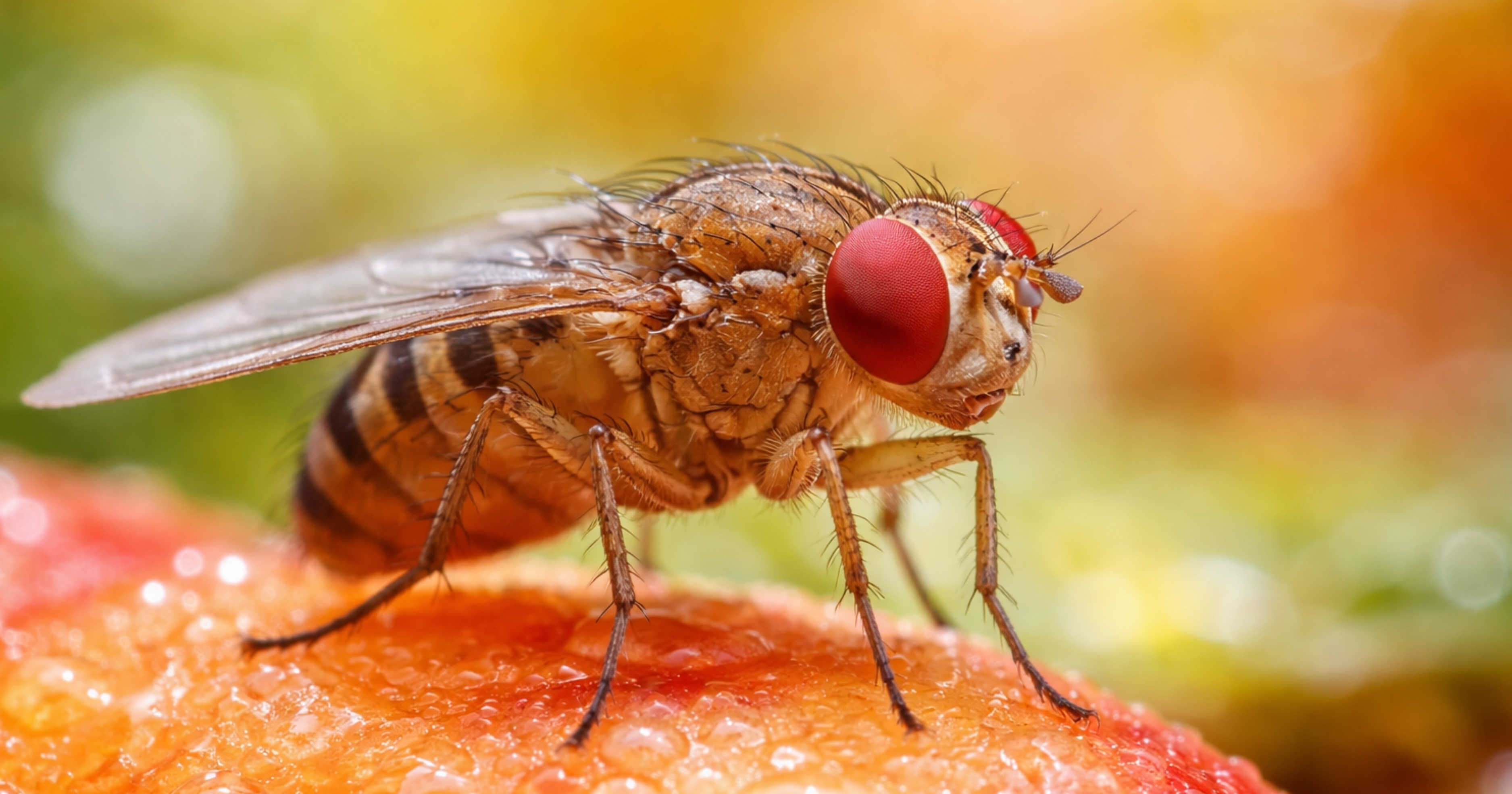
The household fruit fly is one of the smallest pests people notice, but it is one of the most biologically specialised. Drosophila melanogaster is not drawn to fresh fruit in the simple way most people think. Its real attraction is to yeast and fermentation, and that hidden relationship is the key to why it appears so suddenly around kitchens, bars, bins, and food-prep spaces.
The common household fruit fly is a tiny fly in the family Drosophilidae, with Drosophila melanogaster the best-known representative. Britannica describes it as a small fly widely known both as a nuisance around fermenting food and as a major scientific model organism. It is also often called a vinegar fly or pomace fly, which is actually a clue to its true ecology.
That matters because the usual name, fruit fly, is only partly accurate. These flies are strongly associated not with clean, intact fruit, but with overripe, damaged, fermenting, or microbially active plant material, especially where yeasts are growing.
Household fruit flies are tiny, usually yellow-brown to tan, with red eyes in the classic wild form and a banded abdomen. Britannica and SANBI both describe the common fruit fly as a very small fly with a light brown body and prominent red eyes.
What to look for
This is the first major truth people usually miss.
Fruit flies are not mainly chasing “fruit” as such. They are strongly attracted to microbial activity, especially yeasts associated with fermentation. Research shows that yeast, rather than fruit volatiles alone, plays a major role in attracting Drosophila melanogaster and supporting feeding, egg-laying, and larval development.
In plain language
A banana on the counter is not the full story. What matters is when fruit, juice, wine, beer, syrup, mop water, bin residue, or food debris begins to ferment or support yeast growth. That is when the place becomes highly attractive to fruit flies.
Fruit flies breed in fermenting organic matter. Indoors, that often means:
A key point here is that fruit flies are not the same as drain flies. People often confuse them. Drain flies belong to a different group and have a fuzzy, moth-like appearance, while fruit flies are smoother, smaller, and more strongly tied to fermenting sugars and yeast-rich residues. The ecology is different even when both can appear near sinks. This distinction is an inference supported by the fruit-fly sources above and standard entomological separation of these groups.
Fruit flies do not bite and are not the dramatic pest some others are, but they matter because they reproduce quickly, exploit tiny neglected residues, and can become highly annoying in kitchens, bars, food businesses, and homes. Britannica notes their close association with rotting fruit and fermenting beverages in places such as kitchens and pubs.
Their importance is also practical: a visible cloud of fruit flies usually means there is a hidden fermenting source somewhere nearby. The flies are not the root problem by themselves; they are often a biological signal pointing to overlooked organic buildup. That conclusion follows directly from their yeast- and fermentation-linked ecology.
Most people think the fruit fly's secret is fast breeding.
That is only part of it.
Its deeper advantage is its highly tuned relationship with yeast and fermentation chemistry. Research repeatedly shows that Drosophila melanogaster is strongly adapted to locate substrates rich in microbial activity, especially yeast. Yeast supports adult feeding and is important for larval development, and fly attraction often tracks the microbial condition of the substrate rather than the fruit itself.
This gives fruit flies a huge ecological edge. Instead of searching randomly for “food,” they are effectively searching for a microbially pre-processed nursery:
The fruit fly's hidden strength is not just that it likes fruit.
It is that it is a fermentation specialist. It uses chemical cues from yeast and rotting substrates to find the exact kind of temporary, nutrient-rich environment where its offspring can succeed. That is what makes it so efficient in human spaces full of sugary residues and forgotten organic matter.
One of the most impressive things about fruit flies is that they are built for ephemeral resources. Fermenting fruit and sugary residues do not last long. They appear, change quickly, and disappear. Research on Drosophila-yeast interactions shows these flies are adapted to locate and use these short-lived microbial hotspots efficiently.
That means the species is not merely hardy. It is superb at exploiting brief windows of opportunity. In a home or business, that translates to very rapid appearance when conditions become favourable.
Fruit flies are difficult because the breeding source can be tiny, hidden, and easy to ignore:
Because the flies are responding to fermentation chemistry, even a small amount of residue can support activity. So the visible flies are often easier to notice than the real source. That is an inference directly supported by their yeast-linked ecology.
One of the most overlooked facts about fruit flies is that they are among the most important animals in science. Britannica notes that Drosophila melanogaster became one of the major model organisms in genetics and biology. That does not make it less annoying in a kitchen, but it does mean this tiny nuisance insect is also one of the best-studied animals on earth.
If you want one accurate answer, it is this:
It detects fermentation better than people detect the source.
Many insects exploit food. Many insects breed quickly. Many insects use odour to find resources. But the common fruit fly stands out because it combines:
That is what makes it such a persistent nuisance.
The household fruit fly is one of the clearest examples of how a tiny pest can be powerful because it is exquisitely specialised. Drosophila melanogaster does not merely chase fruit. It tracks fermentation, yeast, and microbial opportunity, which lets it find ideal breeding sites in the smallest neglected residues around human food spaces. That is what makes it so small — and so successful.
Next: how we treat flies, fly guarantees, house fly guide, drain fly guide, blow fly guide, fly identification guide. Book a get a quote. Read fly treatment safety.
Drosophila melanogaster — fermentation cues, yeast-rich substrates, drain flies vs fruit flies.
Fruit flies clustering around prep lines or bins? Book through our quote flow for source-first, sanitation-aligned programmes.
We trace fermenting sources and drain-adjacent residues first, then align treatment with your quoted scope—standard fly methodology and guarantee framing.
How we treat flies, Fly guarantees, Fly control by area, House fly guide, Drain fly guide, Blow fly guide, Fly identification guide. Hub: fly control.