Pest guide · fly family
National fly methodology: fly control hub, how we treat flies, fly guarantees, fly control by area. Identification: fly identification. House fly guide, Fruit fly guide, Blow fly guide.
Psychodidae (moth flies)
The drain fly is one of the easiest pests to underestimate. It looks soft, tiny, and harmless — more like a miniature moth than a serious nuisance fly. But its success comes from a very specific strength: it is adapted to live and breed in the slimy organic film that builds up in drains, plumbing voids, sewage-associated areas, and other constantly damp microhabitats. Its real advantage is not speed or aggression. It is the ability to turn thin layers of wet organic residue into a protected nursery.
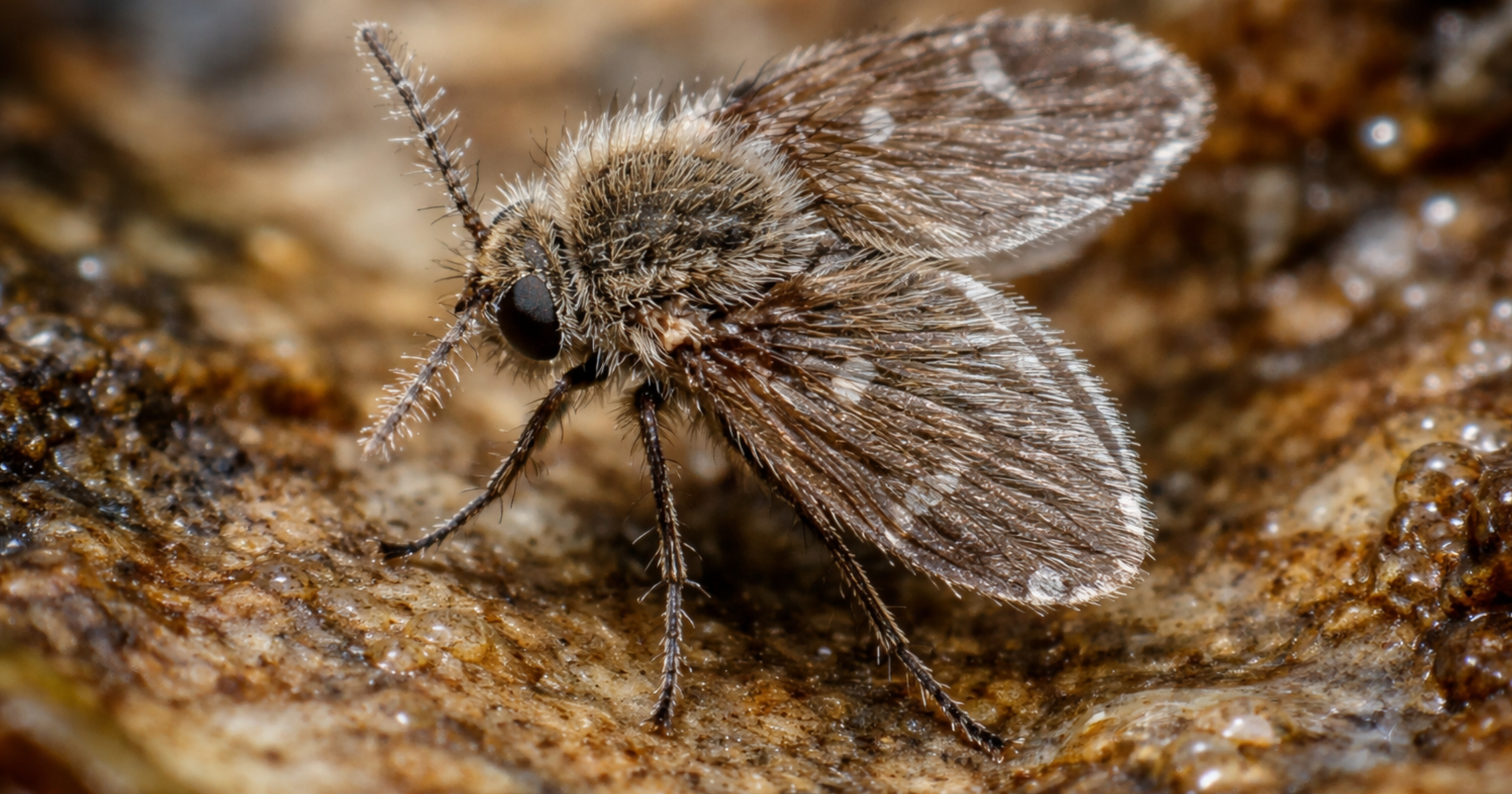
Drain flies are small flies in the family Psychodidae. University and extension sources note that the indoor kinds are often called moth flies because the adults have fuzzy bodies and hairy wings that give them a moth-like appearance. They are usually found resting near sinks, showers, tubs, floor drains, and other moist plumbing-associated areas.
This matters because “drain fly” is a functional common name, not a perfect species label. For a pest page, the important point is that these are the small, fuzzy, weak-flying flies associated with decaying organic matter in wet places, especially drain biofilm.
Adult drain flies are typically small, dark to grayish, fuzzy flies with hairy wings held roof-like over the body when resting. Texas A&M, UC IPM, and other extension sources all describe them as weak flyers that often move only short distances and are often seen resting on walls near breeding sites.
What to look for
This is the most important fact about them: drain flies do not breed because a place is simply “wet.” They breed where there is wet, decaying organic material, especially the slimy film that coats the inside of drains and plumbing surfaces. UC IPM says their development often occurs in the slimy organic matter coating sink or shower drains, and other extension sources say larvae feed on the gelatinous or slimy material that accumulates in drains.
That means they can breed in places such as:
Drain flies are usually more of a nuisance pest than a dramatic biting or stinging threat. UC IPM notes they do not bite people or animals, but they can still matter because their presence signals organic buildup and moisture issues that allow them to breed. UC IPM also notes they could transmit pathogens and trigger allergies, which is why they should not simply be dismissed as harmless little flies.
Their real significance in buildings is often diagnostic. A drain fly problem frequently means that somewhere in the plumbing or damp structure there is persistent organic sludge or wet residue supporting development. In other words, the flies are often a symptom of a sanitation or plumbing condition, not just a random insect invasion.
Most people think drain flies succeed because they are tiny.
That is only part of the story.
Their deeper advantage is that their larvae are adapted to live in biofilm-like organic slime in places where many other insects cannot thrive easily. Extension sources repeatedly emphasize that the larvae develop in the slimy organic coating inside drains and similar wet, decaying material.
A pest that needs open food is easier to notice and remove. A pest whose young can develop inside a thin, wet film clinging to hidden plumbing surfaces is much harder to spot. That slime layer is sheltered, moist, food-rich, and often hidden from normal cleaning.
The drain fly's hidden strength is not aggression.
It is the ability to turn micro-layers of wet organic residue into a breeding habitat.
That makes the species unusually good at surviving in:
Adult drain flies are weak flyers. At first that sounds like a weakness. But it actually tells you something important: they usually do not need to travel far because the breeding site is close and protected. Texas A&M and UC IPM both note that adults are weak fliers and remain near the source.
That means once a good breeding site exists, the population can persist locally without needing wide dispersal. The adults stay near the drains, walls, and surfaces around the source, while the real engine of the infestation remains hidden in the organic film. This is an inference directly supported by their weak-flight behavior and source association.
Drain flies are difficult because the breeding site is usually hidden, slimy, damp, and easy to miss. Simply rinsing a drain or pouring water down it may not remove the organic film stuck to the pipe walls. Kentucky extension specifically notes that brushing is important to remove the organic film, which is why superficial treatment often fails.
They are also hard to diagnose because the adults may be the first thing people notice, while the actual source may be deeper in the drain, under a toilet rim, in a floor drain, or tied to a plumbing defect somewhere else in the structure.
One of the most overlooked facts about drain flies is that they are often warning insects. A recurring infestation can point to more than just a dirty sink. It may indicate hidden organic buildup, poor drain maintenance, leaking waste lines, or even damaged drainage beneath or around the structure.
If you want one accurate answer, it is this:
It can breed in the thin organic film other pests barely use.
Many flies need open rot. Many flies need exposed food waste. Many flies are easier to trace. But drain flies stand out because they combine:
That is what makes them so persistent in buildings.
The drain fly is a perfect example of a pest that wins through specialization. It is not fast, fierce, or dramatic. Psychodid drain flies succeed because they exploit one of the most overlooked habitats in a building: the damp organic film hidden inside drains and plumbing-associated voids. That is what makes them so easy to dismiss — and so persistent when the real source is left in place.
Next: how we treat flies, fly guarantees, house fly guide, fruit fly guide, blow fly guide, fly identification guide. Book a get a quote. Read fly treatment safety.
Psychodidae — moth flies, biofilm larvae, brushing vs rinse-only myths, fruit fly confusion.
Adults on tiles but slime still in the trap line? Book through our quote flow for source-first drainage-aware programmes.
We align with extension logic: remove larval substrate (film) and correct moisture or plumbing drivers on your quoted scope—standard fly methodology and guarantee framing.
How we treat flies, Fly guarantees, Fly control by area, House fly guide, Fruit fly guide, Blow fly guide, Fly identification guide. Hub: fly control.