Pest guide · moles
National mole methodology: mole control hub, how we treat moles, mole guarantees, mole control by area. Identification: mole identification.
This page is about Bathyergus suillus (a bathyergid mole-rat). Golden moles are a different family — confirm species before control; threatened golden moles need non-lethal options. Your quote governs trapping or fumigation scope.
Bathyergus suillus
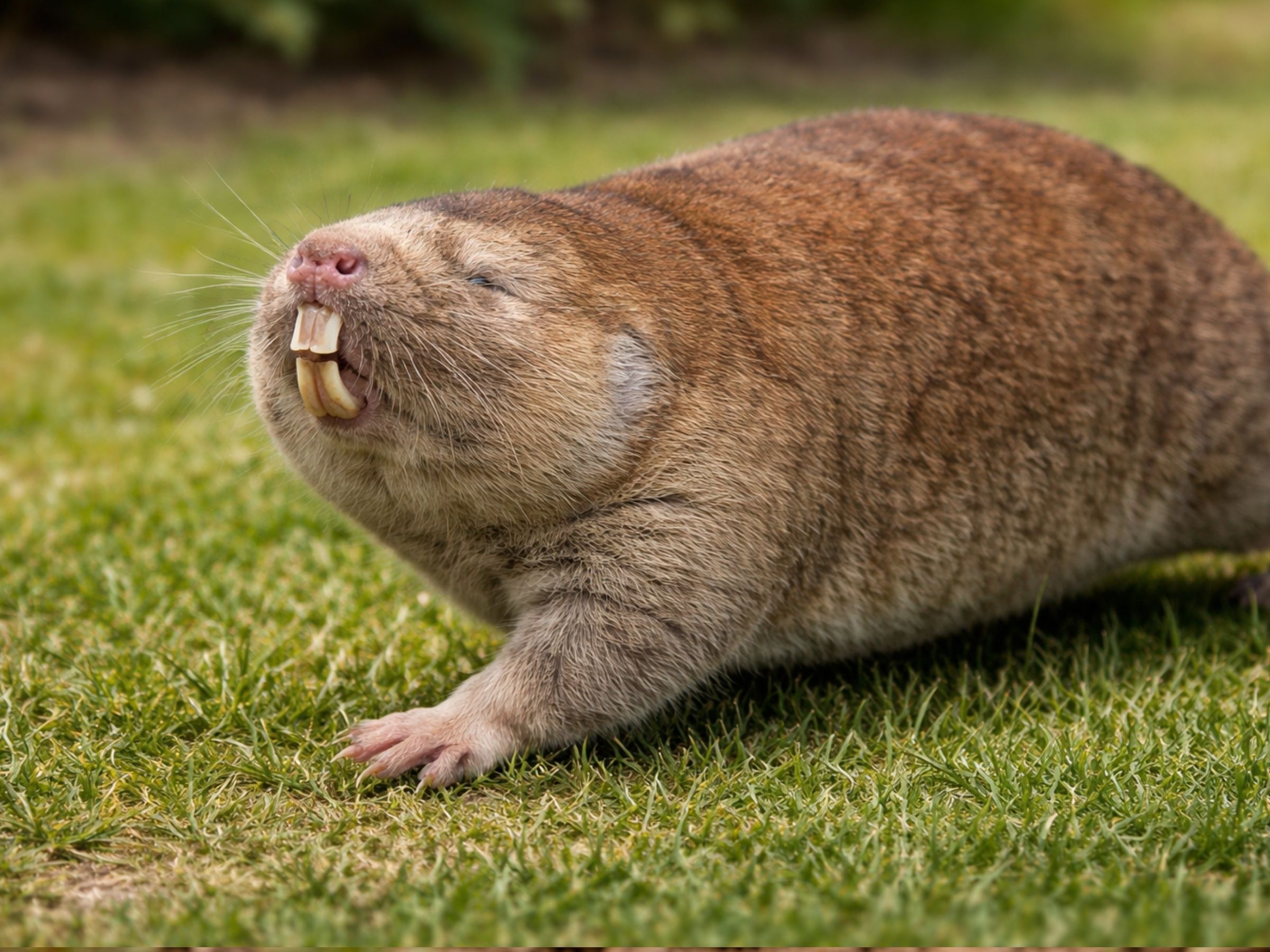
The Cape dune mole-rat is one of South Africa's most powerful underground mammals. Bathyergus suillus is not a true mole and not a golden mole, but a large, solitary, burrowing rodent built for life in loose coastal soils. Its real strength is not just digging. It is a combination of incisor-based excavation, exceptional underground territoriality, and highly specialized digging anatomy that makes it one of the most formidable subterranean mammals in the Cape.
The Cape dune mole-rat, Bathyergus suillus, is the largest African mole-rat and one of the largest truly subterranean mammals in the world. It is endemic to South Africa's coastal sandy and loamy soils, especially along parts of the west and south coast, generally below 300 metres above sea level. SANBI describes its range as discontinuous along the west coast and tied to suitable loose soils.
This matters because people often misidentify it. It is not a golden mole, and it is not closely related to the true moles of Europe or North America. It is a rodent — a very specialized one — with large protruding incisors, reduced external features for underground life, and a body built for powerful tunnelling.
The Cape dune mole-rat is a stout, cylindrical animal with:
SANBI describes the Cape dune mole-rat as occurring in loose sandy and loamy soils along South Africa's west and south coast, including alluvial sandy soils in riverine areas. It is strongly tied to friable soils, because digging costs rise dramatically in harder ground.
That is why it turns up most often in:
The Cape dune mole-rat is generally solitary and highly territorial. Unlike the famous naked mole-rat, which lives in social colonies, this species usually maintains its own burrow system and aggressively excludes neighbours. SANBI and Biodiversity Explorer both describe it as solitary, with individual burrows spaced apart.
That solitary lifestyle is important. It means each animal invests heavily in its own tunnel network and feeding territory, rather than sharing work with a colony. Research on burrow systems describes it as large, aggressive, and restricted mainly to mesic sandy soils where the energetic cost of digging remains manageable.
This is where a lot of myths start.
The Cape dune mole-rat is a plant eater, not an insectivore like a golden mole. SANBI states that it consumes underground roots and bulbs, as well as grasses and green forbs from above ground. It is also independent of standing water, meeting its moisture needs from food.
So the honest version is this: if you have Cape dune mole-rats in a cultivated or landscaped area, the issue is not just tunnelling. The animal can also feed on underground plant material and above-ground vegetation. That makes it very different from the Cape golden mole.
People usually notice Cape dune mole-rats because of:
Because they are large, solitary, and powerful diggers, their signs are often more substantial than those of smaller subterranean mammals. A property owner may never see the animal itself, but the burrow system gives it away.
Most people think the Cape dune mole-rat's main power is brute strength.
That is only part of the story.
Its deeper advantage is incisor-driven excavation combined with highly specialized scratch-digging anatomy. Research on bathyergid fossils and living species shows that African mole-rats are functionally specialized for digging, and that Bathyergus suillus has pronounced bone and muscle adaptations associated with scratch-digging. A 2023 morphology study specifically found large architectural values and many glycolytic fibres in essential scratch-digging muscles of this species.
Digging underground is expensive. The soil pushes back, oxygen is lower, and every tunnel costs energy. The Cape dune mole-rat solves that problem not with one trick, but with a combined system:
The hidden strength of the Cape dune mole-rat is that it is not just a digger.
It is a soil-processing specialist. It can use its teeth and musculoskeletal system together to turn loose coastal ground into defendable territory and feeding space. That is what makes it so formidable underground. This is an inference supported by the morphology and natural-history literature.
One of the most overlooked truths about the Cape dune mole-rat is that it is not merely underground — it is underground and territorial. Biodiversity Explorer describes it as aggressively territorial, with each animal maintaining its own separate burrow system. That means this is not a passive little burrower. It is an animal shaped by constant boundary defence in a three-dimensional subterranean world.
That territoriality is a big advantage. A solitary mole-rat that can hold a resource-rich burrow system controls food, shelter, and breeding opportunity directly. In its environment, that is power.
The Cape dune mole-rat is difficult to manage because it combines:
In other words, it is not simply passing through soft ground. It is building, feeding, and defending a functioning subterranean territory. That is why superficial disturbance often does little when the habitat remains suitable. This is an inference from its burrowing ecology and territorial behaviour.
One of the most interesting truths about the Cape dune mole-rat is that it is the largest African mole-rat. That is easy to miss because most people never see one above ground. Its size matters biologically, because large body size increases digging cost and helps explain why the species is especially tied to mesic sandy soils where tunnelling is energetically feasible.
If you want one accurate answer, it is this:
It turned soft coastal soil into private underground territory.
Many mammals burrow. Many rodents gnaw. Many underground animals avoid conflict. But the Cape dune mole-rat stands out because it combines:
That is what makes it one of South Africa's most formidable subterranean rodents.
The Cape dune mole-rat is one of the clearest examples of how extreme underground life can shape an animal. Bathyergus suillus is not just a burrower and not just a “mole.” It is a large, powerful rodent built to cut, push, defend, and feed beneath the surface of South Africa's sandy coast. That is what makes it so unusual — and so impressive.
Next: how we treat moles, mole guarantees, mole identification guide, Cape golden mole guide, Hottentot golden mole guide, Common mole-rat guide, Fynbos golden mole guide. Book mole control in Cape Town · Mole Control Cape Town hub. Read mole treatment safety.
Bathyergus suillus — Least Concern bathyergid; herbivore with large burrows on coastal sands—book trapping or exclusion on your quote paperwork.
Need active-run assessment on your quote? Use get a quote.
We assess active runs and species context first; trapping and optional certified fumigation stay on your paperwork.
Cape golden mole guide · Hottentot golden mole guide · Common mole-rat guide · Fynbos golden mole guide · How we treat moles, Mole guarantees, Mole control by area, Mole identification guide. Hub: mole control.