Pest guide · moles
National mole methodology: mole control hub, how we treat moles, mole identification.
Near Threatened (SANBI / IUCN). Do not kill or trap this species lethally. Confirm identity with an expert; prefer non-lethal assessment and habitat-aware advice where fynbos-linked soils may apply.
Amblysomus corriae
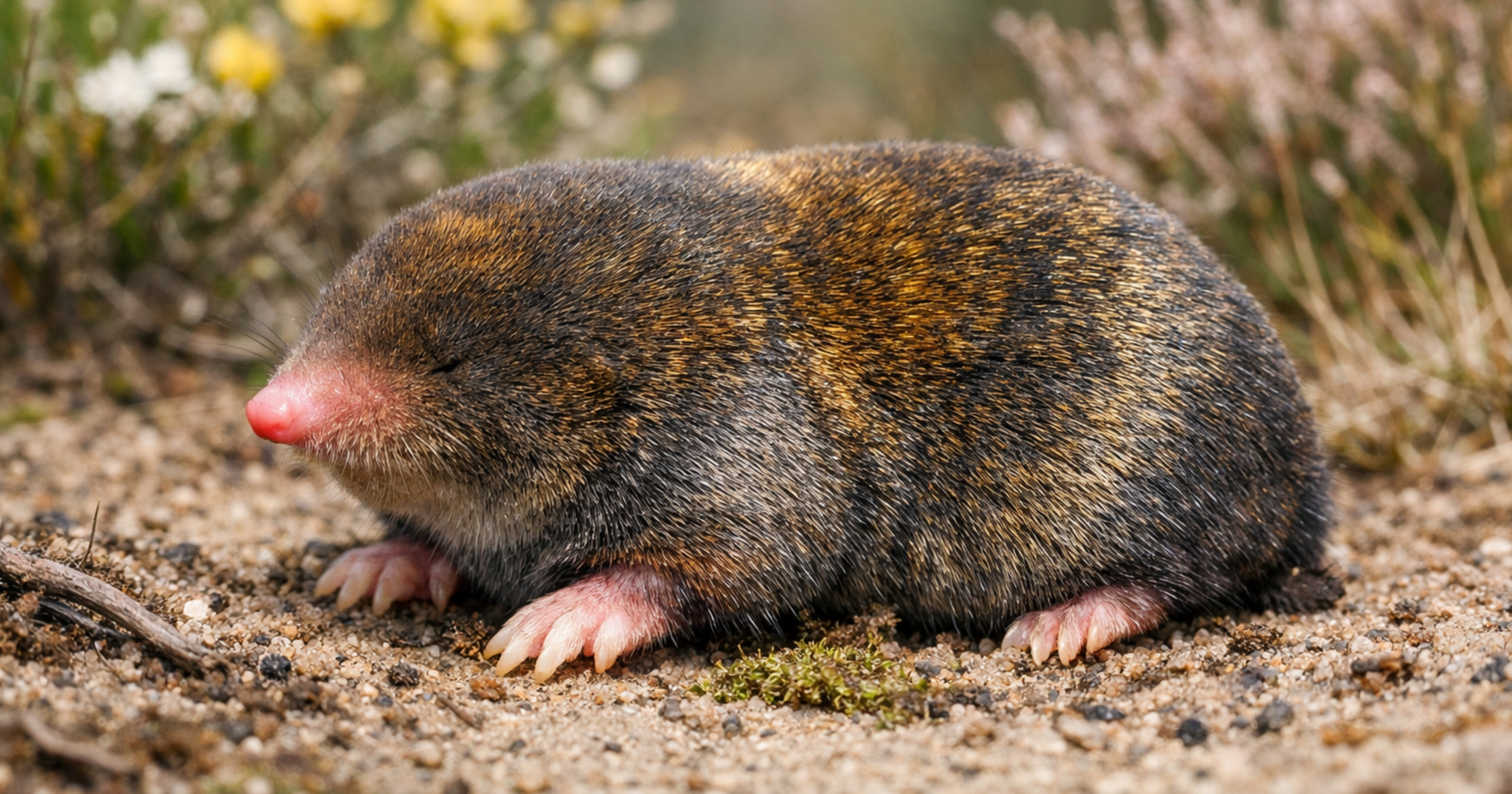
The Fynbos golden mole is one of the Cape's most remarkable hidden mammals. Amblysomus corriae lives mostly below the surface in soft, workable soils, where sight matters little and vibration matters enormously. Its real strength is not just digging. It is a combination of subterranean specialization, vibration-sensitive hearing, and adaptation to friable soils across fynbos-linked landscapes that makes it an extraordinary underground hunter.
The Fynbos golden mole, Amblysomus corriae, is a species in the golden mole family Chrysochloridae. SANBI's Red List pages and the South African mammal assessment identify it as a distinct species endemic to South Africa. The assessment also notes taxonomic revision: the species now includes forms previously treated as subspecies within other golden mole groupings.
That matters because people often confuse golden moles with two completely different kinds of animals: true moles from the Northern Hemisphere and mole-rats, which are subterranean rodents. The Fynbos golden mole is neither. It is an African golden mole — part of a separate mammalian lineage specialized for underground life.
Like other golden moles, the Fynbos golden mole has a compact, cylindrical body, dense glossy fur, reduced eyes hidden beneath skin and fur, no visible external ears, and powerful digging foreclaws. The conservation assessment describes it as a soft-soil specialist and places it within a family of highly similar subterranean mammals, so identification in the field is usually based on a mix of location, habitat, size, and soil context, not just a casual glance.
What to look for
SANBI records the Fynbos golden mole from the Western Cape, from the Groot Winterhoek area near Porterville in the north, southeast along southern Cape mountains, then across parts of the coastal plain and mountain systems toward Humansdorp in the Eastern Cape. The assessment emphasizes that it is endemic to South Africa and tied to particular habitat and soil conditions within this range.
Despite the name, it is not restricted only to pristine fynbos in the narrowest sense. The assessment says it occurs in soft soils and regions supporting adequate food sources in the form of invertebrates, and that it has also survived in some human-altered habitats such as residential gardens and agricultural areas, though large-scale habitat loss remains a concern.
This is one of the most important truths about the species: the key is not just “fynbos,” but friable soil. SANBI's pages repeatedly stress that the species is limited to soft soils that support foraging and tunnelling. Its prevalence in rocky montane habitats is said to be restricted to scattered microhabitats of friable soils.
That means the Fynbos golden mole is not just a plant-community specialist. It is a soil-condition specialist. A landscape may look botanically suitable, but if the soil is too hard or too rocky, it becomes much less useful to the animal. That is an inference directly supported by the repeated emphasis on friable soil in the assessment sources.
The conservation assessment states that the species depends on soft soils and regions supporting adequate food sources in the form of invertebrates. That makes it an insectivorous or invertebrate-feeding subterranean mammal, not a root-eating rodent.
This is one of the biggest myths to correct on a webpage: if people see disturbed soil, they often assume the animal is eating bulbs, roots, or vegetable crops. In the case of the Fynbos golden mole, the evidence points instead to an underground hunter feeding mainly on small invertebrates in suitable soil.
Most people do not see the animal itself. They notice surface signs in soft soil, shallow runs, or subtle disturbance in suitable habitat. Because the species is secretive and subterranean, direct sightings are far less common than signs of underground passage. This follows from the species' ecology as described in the Red List assessment and its placement among golden moles generally.
Most people think the Fynbos golden mole's main power is digging.
That is only half the story.
Its deeper power is substrate-vibration sensing. Golden moles are famous for highly specialized underground sensory systems, and the Fynbos golden mole sits within that same biological design. The South African assessment places it within a family of subterranean mammals whose lives depend on exploiting soft soils and underground prey, and golden moles more broadly are known for using the ground itself as a sensory medium. For this page, the most honest species-level framing is that the Fynbos golden mole's likely special strength is detecting and using vibrations in friable ground where vision is of little use. That is a cautious inference grounded in golden mole family biology and the species' soft-soil, invertebrate-hunting ecology.
Underground, darkness is constant and sight offers little advantage. An animal that can detect prey movement or disturbance through the substrate has an enormous edge. In the Fynbos golden mole's world, the ground is not just something to dig through — it is a sensory surface. This is the best-supported explanation for why golden moles are so specialized and why soft soils matter so much.
The hidden strength of the Fynbos golden mole is not brute force alone. It is the ability to live in a world where soil texture, underground prey, and vibration cues are more important than light. That is what makes it so impressive.
One of the more interesting truths in the South African assessment is that the species is not yet considered severely fragmented, even though it has suffered habitat loss and some population reductions. It has also persisted in some transformed habitats such as gardens and agricultural land.
That is a real advantage. It means the Fynbos golden mole is not as fragile in day-to-day terms as people might assume from its hidden lifestyle. It is specialized, yes — but not helpless. It can still persist where the right soil conditions remain.
The Fynbos golden mole is difficult to observe because it is:
That hidden life is part of why golden moles seem mysterious. They are often present without being obvious, especially where soft soils allow quiet underground movement.
One of the most overlooked facts about the Fynbos golden mole is that it is not simply a “fynbos animal” in a vegetation sense. Its survival is bound just as strongly to soil mechanics as to plant community. For this species, workable ground is as important as the broader habitat label. That is an inference, but it is one directly supported by the assessment's repeated emphasis on friable soil.
If you want one accurate answer, it is this:
It turned soft ground into a hidden hunting world.
Many small mammals burrow. Many underground mammals avoid light. Many secretive animals disappear into vegetation. But the Fynbos golden mole stands out because it combines:
That is what makes it so extraordinary.
The Fynbos golden mole is one of the Cape's most specialized hidden mammals. Amblysomus corriae is not just a little animal in the soil. It is a finely adapted underground hunter shaped by friable ground, secretive movement, and a sensory world most people never notice. That is what makes it so unusual — and so remarkable.
Next: mole identification guide, Cape golden mole guide, Hottentot golden mole guide. For mole-rats: Cape dune mole-rat, common mole-rat. Book assessment: mole control in Cape Town · Mole Control Cape Town hub. Read mole treatment safety.
Amblysomus corriae — Near Threatened. Do not use lethal control; seek expert identification and non-lethal options in potentially suitable habitat.
Unsure what species you have? Start with mole identification or get a quote for a species-aware visit—not standard mole-trapping where threatened golden moles may occur.
Near Threatened golden moles require non-lethal assessment first. We help distinguish golden moles from mole-rats and route you to humane options when the footprint overlaps sensitive habitat.
Mole identification guide · Cape golden mole guide · Hottentot golden mole guide · How we treat moles. Hub: mole control.