Pest guide · moles
National mole methodology: mole control hub, how we treat moles, mole guarantees, mole control by area. Identification: mole identification.
This page covers Cryptomys hottentotus (colonial bathyergid). Golden moles are insectivores in a different family — confirm ID before control. Your quote governs trapping or fumigation scope.
Cryptomys hottentotus
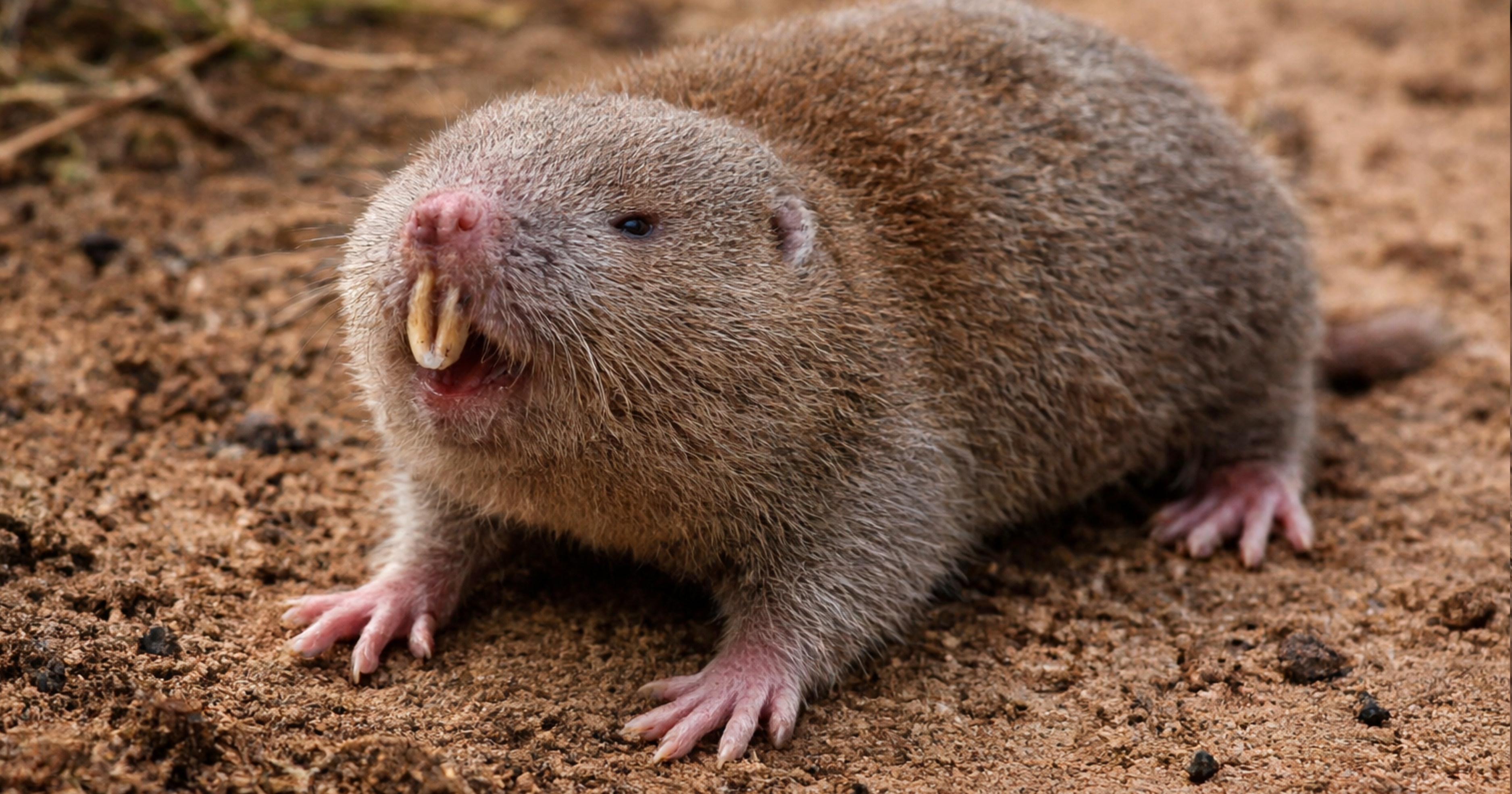
The common mole-rat is one of southern Africa's most effective underground engineers. Cryptomys hottentotus is not a true mole and not a golden mole, but a social, chisel-tooth-digging rodent built for life below the surface. Its real strength is not just tunnelling. It is a combination of colony living, tooth-based excavation, and specialization for underground plant feeding that makes it one of the most successful subterranean mammals in the region.
The common mole-rat, Cryptomys hottentotus, is a burrowing rodent found in southern Africa and is widely referred to as the African mole-rat or common blesmol in regional sources. Biodiversity Explorer uses all three English names for the same species.
This matters because people often mix it up with:
The common mole-rat is a compact, cylindrical rodent with:
Like other African mole-rats, it is a chisel-tooth digger. That means the incisors do much of the cutting through soil, rather than the animal relying only on the forefeet. Recent morphology work describes Cryptomys species as chisel-tooth diggers, and broader bathyergid anatomy studies show that this digging system is a major part of their specialization for underground life.
The common mole-rat occurs in southern Africa, and in South African sources it is especially associated with the Cape and other suitable habitats where soils allow burrowing. SANBI's Highveld mole-rat account also uses C. hottentotus as the comparison species and notes that it tends to avoid stony soils, which helps separate its habitat preference from some close relatives.
That point is important for homeowners and landowners: these animals are not randomly distributed. They are strongly influenced by soil workability and food below ground.
Unlike the Cape dune mole-rat, which is generally solitary, the common mole-rat lives in social colonies. Animal Diversity Web describes it as social, and research on colony structure has treated Cryptomys hottentotus as one of the classic social African mole-rats.
This is one of the species' biggest biological advantages.
A colony can:
This is an inference, but it is strongly supported by the species' social structure and subterranean feeding ecology.
The common mole-rat is herbivorous, not insectivorous. Animal Diversity Web states that it feeds mainly on geophytes — plants with underground storage organs such as bulbs, corms, and tubers — as well as grass rhizomes and fibrous roots. Isotopic and ecological studies on the species support this strong reliance on underground plant resources.
This is one of the biggest truths about the species: it is not just an animal that digs through soil. It is an animal that digs for underground food stores.
People usually notice common mole-rats because of:
They are sometimes treated as nuisances in gardens and agricultural areas. SANBI's Highveld mole-rat assessment explicitly notes that Cryptomys hottentotus and close relatives are occasionally persecuted as agricultural pests and because homeowners complain about nuisance activity in gardens.
Most people think the common mole-rat's main power is digging.
That is only part of the story.
Its deeper advantage is cooperative underground living combined with chisel-tooth excavation. Recent work on common mole-rat morphology highlights the importance of structural adaptation along environmental gradients, while broader bathyergid studies show that chisel-tooth diggers are highly specialized for subterranean performance. The common mole-rat is not just a rodent with big teeth. It is part of a lineage in which the skull, incisors, and body are tuned for cutting through soil and extracting buried food.
Underground living is costly. Soil resists movement, oxygen is lower, and food is patchy. The common mole-rat solves that problem with a powerful combination:
The hidden strength of the common mole-rat is that it can turn underground food patches into a shared, defended colony resource. It is not merely tunnelling blindly. It is operating as a social excavator of buried food. This is an inference, but it follows directly from the species' sociality, diet, and digging mode.
This part often gets missed because people focus only on the nuisance side.
Animal Diversity Web notes that the tunnelling of common mole-rats helps improve soil drainage and soil turnover. SANBI makes similar comments for related mole-rats, describing them as ecosystem engineers that modify soils and can improve infiltration and water-holding properties.
So while they can absolutely be a problem in the wrong place, they are also animals that reshape soil in ecologically meaningful ways.
The common mole-rat is difficult to manage because it combines:
In other words, it is not just passing through a property. It is often using that space as a functioning underground feeding territory. That is why superficial disturbance often does little when food and soil conditions remain favorable. This is an inference based on the species' burrowing ecology and diet.
One of the most interesting facts about the common mole-rat is that it is part of a mammal group that has repeatedly evolved unusual sensory and physiological adaptations to underground life. While the most dramatic pain-insensitivity findings are best documented in other African mole-rat species rather than standard C. hottentotus, the common mole-rat still sits within one of the most specialized subterranean rodent families on earth.
If you want one accurate answer, it is this:
It turned buried food into a social underground economy.
Many mammals burrow. Many rodents gnaw. Many underground animals live alone. But the common mole-rat stands out because it combines:
That is what makes it one of southern Africa's most effective subterranean rodents.
The common mole-rat is one of the clearest examples of how underground life can shape an animal into something remarkably specialized. Cryptomys hottentotus is not just a burrower and not just a garden nuisance. It is a social, plant-feeding, tooth-digging rodent built to turn soil into shelter, food, and colony territory. That is what makes it so unusual — and so impressive.
Next: how we treat moles, mole guarantees, mole identification guide, Cape golden mole guide, Hottentot golden mole guide, Cape dune mole-rat guide, Fynbos golden mole guide. Book mole control in Cape Town · Mole Control Cape Town hub. Read mole treatment safety.
Cryptomys hottentotus — social colonies on workable soils; humane trapping or exclusion when quoted — distinguish from golden moles (insectivores, different family).
Need active-run assessment on your quote? Use get a quote.
We map active tunnels and species context first; trapping and optional certified fumigation stay on your paperwork.
Cape golden mole guide · Hottentot golden mole guide · Cape dune mole-rat guide · Fynbos golden mole guide · How we treat moles, Mole guarantees, Mole control by area, Mole identification guide. Hub: mole control.