Pest guide · moles
National mole methodology: mole control hub, how we treat moles, mole guarantees, mole control by area. Identification: mole identification.
Other golden mole species can be threatened—confirm ID before any lethal control. This page focuses on Amblysomus hottentotus (Least Concern); your quote governs trapping or fumigation scope.
Amblysomus hottentotus
The Hottentot golden mole is one of the most remarkable small mammals in southern Africa. Amblysomus hottentotus is built for underground life: compact, powerful, nearly sightless, and exquisitely tuned to the world of soil and vibration. Its real strength is not just digging. It is a combination of subterranean specialization, vibration sensitivity, and highly efficient underground living that makes it one of the region's most extraordinary hidden mammals.
The Hottentot golden mole, Amblysomus hottentotus, is a species of golden mole in the family Chrysochloridae. Animal Diversity Web describes it as the most widely distributed golden mole in southern Africa, occurring through parts of South Africa and into Eswatini and southern Mozambique, while SANBI describes it as widespread and adaptable in South Africa.
Despite the name, it is not closely related to the true moles of Europe or North America. It is part of a distinct African lineage of mammals specialized for burrowing life. That is one of the biggest facts people get wrong right at the start.
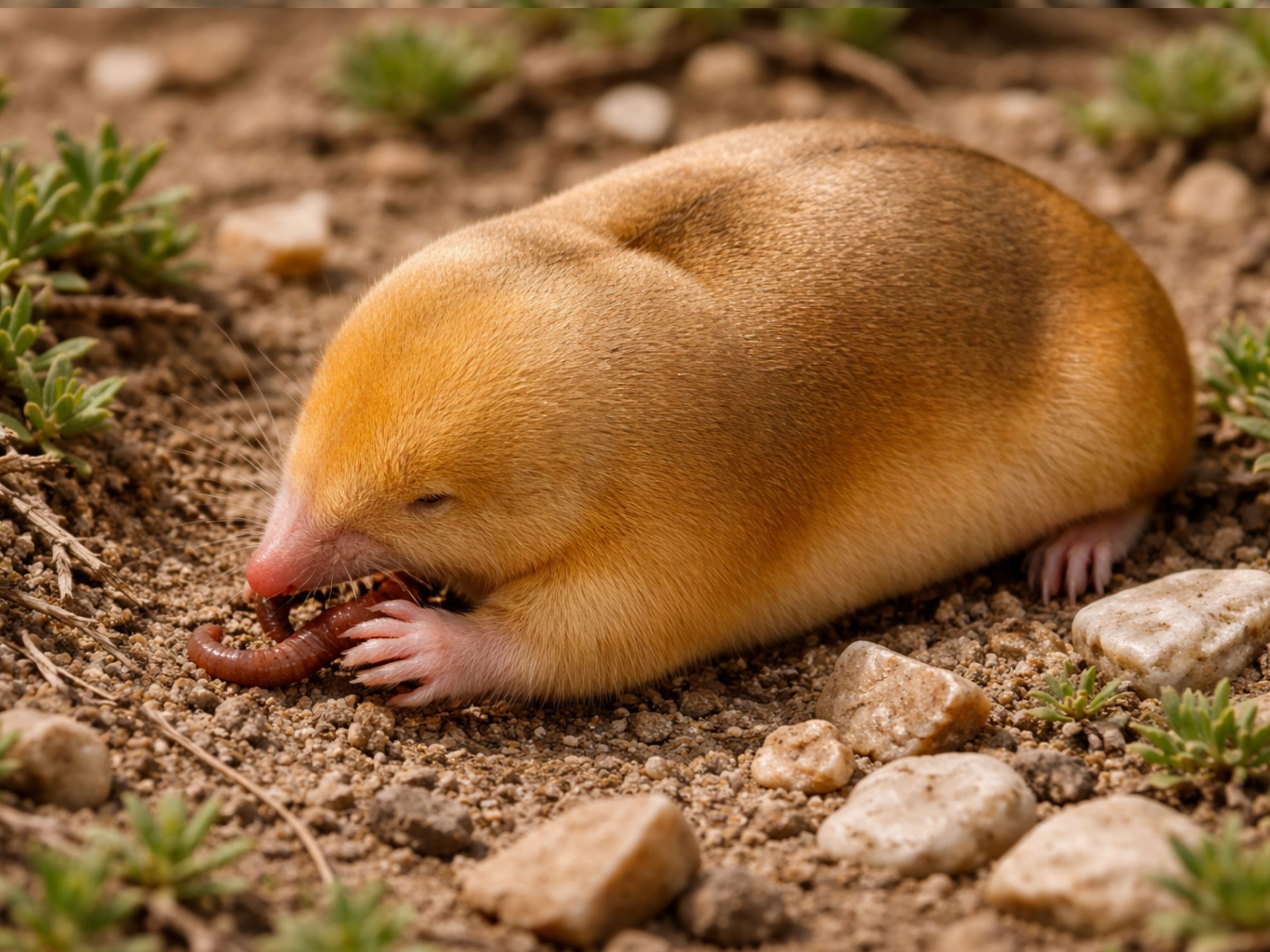
The Hottentot golden mole has a compact, cylindrical body, dense silky fur, very reduced eyes hidden beneath skin and fur, no visible outer ears, and strong digging foreclaws. Like other golden moles, it is shaped less like a surface mammal and more like a living wedge for moving through friable soil.
What to look for
SANBI describes the species as occupying a wide variety of woodland and grassland habitats in South Africa, also occurring in Afromontane forest, marshes, coastal dunes, and the margins of Fynbos and Nama-Karoo in the south of its range. It is said to be particularly abundant in moist soils near waterbodies, though it can also occur far from surface water where soil is friable and invertebrate prey is abundant.
That matters because people often assume golden moles are highly fragile specialists that vanish from changed landscapes. SANBI's assessment is more nuanced: this species is adaptable and can persist in a range of habitats, including mildly transformed ones.
The Hottentot golden mole spends most of its life below ground in tunnel systems and foraging runs. Animal Diversity Web describes golden moles of this kind as largely solitary, subterranean insectivores using burrows and friable soil to hunt underground prey. The species is so secretive that people usually notice signs of tunnelling before they ever see the animal itself.
GBIF's species summary also notes that Hottentot golden moles are highly sensitive to disturbance and will retreat quickly from superficial burrows into deeper tunnels or bolt-holes when disturbed. That helps explain why direct sightings are uncommon even where the species is present.
People usually notice Hottentot golden moles because of:
But this is where myths start.
A golden mole in a garden does not mean the animal is eating roots like a rodent. The species is insectivorous and tied to soils rich in invertebrate prey. When it appears in a garden, it is usually there because the soil is diggable and the feeding conditions are good, not because it is raiding bulbs like a mole-rat. This is an inference supported by its insectivorous biology and habitat preferences.
Most people think the Hottentot golden mole's main power is digging.
That is only part of the story.
Its deeper advantage is sensing the ground as information. Research on fossorial mammals specifically mentions Amblysomus hottentotus in discussions of seismic signal use, including foot-stomping and vibrational communication or detection. More broadly, golden moles are famous in sensory biology for their extreme sensitivity to substrate-borne vibration, and that family-level pattern is central to how they function underground.
Underground, vision is almost useless. A mammal that can use the soil itself as a channel for information gains a huge advantage. It can detect movement, prey, rivals, and disturbance without relying on sight. For a subterranean hunter, that is an extraordinary edge. This is partly direct evidence from the seismic-signal literature and partly a biological inference from golden mole sensory specialization.
The hidden strength of the Hottentot golden mole is not brute force.
It is the ability to read vibrations through the ground:
That is what makes it so extraordinary.
This is one of the least appreciated truths about the species.
People often imagine small subterranean mammals as extremely vulnerable and habitat-limited. SANBI's assessment says the opposite for this species: it is widespread, adaptable, and does not appear to be in decline, with an ability to thrive in mildly transformed habitats and occurrence in protected areas.
That adaptability is a real advantage. It means the Hottentot golden mole is not just a specialist trapped in pristine habitat. It can function in a variety of soils and landscapes, provided the underground conditions remain suitable.
The Hottentot golden mole is difficult to see because it is:
GBIF's summary is especially useful here: when disturbed, it retreats from superficial tunnels to deeper burrows or bolt-holes. That makes surface encounters brief and uncommon.
One of the most interesting truths about the Hottentot golden mole is that golden moles are not just reduced-eyed burrowers — they are part of one of the most unusual sensory experiments in mammal evolution. The Hottentot golden mole is one of the species used in discussions of seismic signal use by fossorial mammals, which tells you how biologically distinctive it really is.
If you want one accurate answer, it is this:
It turned the soil into both shelter and information.
Many mammals dig. Many mammals hide. Many mammals reduce vision in dark spaces. But the Hottentot golden mole stands out because it combines:
That is what makes it so remarkable.
The Hottentot golden mole is one of the clearest examples of how strange and elegant underground life can be. Amblysomus hottentotus is not just a little burrower beneath the lawn. It is a highly specialized African mammal that survives by treating soil not only as shelter, but as a living sensory world. That is what makes it so hidden — and so extraordinary.
Next: how we treat moles, mole guarantees, mole identification guide, Cape golden mole guide, Cape dune mole-rat guide, Common mole-rat guide, Fynbos golden mole guide. Book mole control in Cape Town · Mole Control Cape Town hub. Read mole treatment safety.
Amblysomus hottentotus — Least Concern; humane trapping when damage warrants—always distinguish from threatened golden mole species.
Need active-run assessment on your quote? Use get a quote.
We assess active runs and species context first; trapping and optional certified fumigation stay on your paperwork.
Cape golden mole guide · Cape dune mole-rat guide · Common mole-rat guide · Fynbos golden mole guide · How we treat moles, Mole guarantees, Mole control by area, Mole identification guide. Hub: mole control.