Pest guide · moles
National mole methodology: mole control hub, how we treat moles, mole guarantees, mole control by area. Identification: mole identification.
The yellow golden mole is listed Near Threatened (IUCN) in site identification data — confirm species and conservation status before any lethal control; your written quote governs scope.
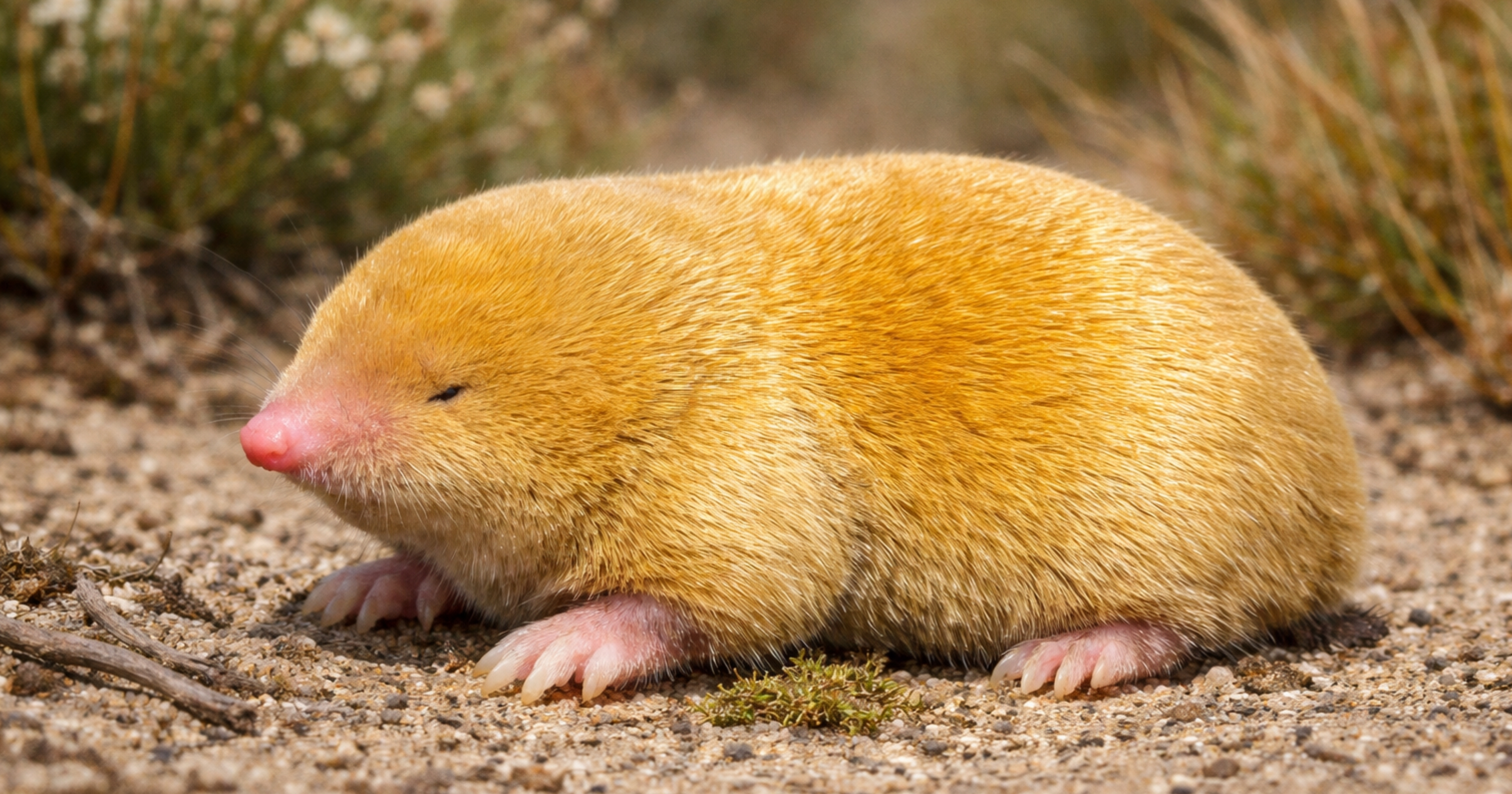
Calcochloris obtusirostris
The yellow golden mole is one of southern Africa's most specialized underground mammals. It is not a true mole, not a rodent, and not just a “garden digger.” Its real strength is not brute force. It is a combination of strictly fossorial living, sandy-soil specialization, and extraordinary sensitivity to ground vibrations that makes it an exceptional subterranean hunter.
In South African usage, the yellow golden mole refers to a golden mole in the genus Calcochloris, currently treated by SANBI Red List pages as Calcochloris obtusirostris in South Africa, especially in northern KwaZulu-Natal and adjacent sandy lowland habitats. SANBI describes it as strictly fossorial and tied to light sandy soils, sandy alluvium, and coastal sand dunes, especially near rivers and waterways.
That matters because golden moles are often confused with:
They are none of those. Golden moles are part of the African mammal order Afrosoricida, a distinct lineage of highly specialized subterranean mammals.
The yellow golden mole has the classic golden mole body plan:
Like other golden moles, it is built for moving through loose substrate rather than for obvious above-ground life. SANBI's habitat notes also make clear that this species is closely tied to light sandy ground, which helps explain why it is seen in some places and absent from harder soils.
SANBI places the South African yellow golden mole mainly in northern KwaZulu-Natal, with the broader range extending into southern Mozambique and beyond, depending on taxonomic treatment. It is associated with the Mozambique sand plain, coastal sand forests, savanna-woodland mosaics, sandy alluvium, and related lowland sandy systems.
This is one of the big truths about the species: it is not randomly underground anywhere. It is strongly linked to workable, light sandy substrates.
The yellow golden mole is described by SANBI as strictly fossorial, meaning it is an underground specialist rather than an occasional burrower. Like other golden moles, it lives in tunnels and forages below the surface for animal prey. Golden moles are insectivores and are highly sensitive to vibrations produced by prey or movement in the substrate.
That is the key to understanding the animal. It is not mainly a root-eater or bulb-eater. It is an underground predator.
Direct species-specific diet summaries are thinner than for some better-studied mammals, but mammal diet databases and general golden mole sources indicate that Calcochloris obtusirostris feeds mainly on earthworms, insects, termites, and other small animal prey, with occasional small vertebrate prey in broader golden mole literature. Golden moles as a group are consistently described as insectivorous and sensitive to prey vibrations underground.
So the honest version is this: the yellow golden mole is mainly a subterranean carnivore/insectivore, not a plant-feeding burrower like a mole-rat.
People usually notice yellow golden moles because of:
Because the species is tied to light sandy soils and can occur close to human settlement in suitable habitats, it may show up in rural gardens or sandy landscaped spaces.
Most people think a golden mole's great power is digging.
That is only half the story.
Its deeper and far more extraordinary advantage is seismic sensing. Research on golden moles shows that many species have greatly enlarged middle-ear ossicles, especially the malleus, believed to be used in the detection of ground vibrations through inertial bone conduction. Studies on golden mole ears and seismic response make clear that this is one of the most remarkable sensory specializations in the group.
In darkness underground, eyesight contributes very little. A mammal that can detect subtle vibrations in sand or soil gains a huge advantage: it can locate prey, sense disturbance, and navigate a hidden world where vision is nearly useless.
The hidden strength of the yellow golden mole is that it can effectively read the ground:
That is what makes golden moles so extraordinary.
One of the most overlooked facts about the yellow golden mole is how tightly it is linked to light sandy habitats. SANBI repeatedly describes it as restricted to light sandy soils, sandy alluvium, and coastal sand dunes. That is not a minor detail. It means this animal is not just a generic burrower — it is a specialist in a very particular underground medium.
A mammal adapted to sand has a major advantage in those environments: lower digging resistance, fast shallow movement, and efficient hunting in a substrate that transmits useful vibrations. This last point is partly an inference from the seismic-hearing literature and the habitat data.
The yellow golden mole is hard to observe because it is:
In practice, people usually see the signs before they ever see the animal.
One of the most remarkable facts about golden moles is that their ear anatomy is so unusual that researchers study it specifically to understand how mammals detect substrate-borne vibration. The enlarged malleus and other middle-ear specializations are not ordinary mammal features — they are part of a very unusual underground sensory system.
If you want one accurate answer, it is this:
It turned sand into a sensory hunting medium.
Many mammals dig. Many mammals hide underground. Many mammals reduce reliance on sight in darkness. But the yellow golden mole stands out because it combines:
That is what makes it one of the most extraordinary little mammals in southern Africa.
The yellow golden mole is one of the clearest examples of how strange and elegant underground life can become. It is not just a burrower and not just a “small mole.” It is a highly specialized sandy-soil predator that survives by sensing vibrations, moving through loose ground, and hunting in darkness beneath the surface. That is what makes it so unusual — and so impressive.
Next: how we treat moles, mole guarantees, mole identification guide, Hottentot golden mole guide, Cape golden mole guide. Book mole control in Cape Town · Mole Control Cape Town hub. Read mole treatment safety.
Calcochloris obtusirostris — confirm ID and conservation status before control; Near Threatened in site data; humane assessment first.
Need active-run assessment on your quote? Use get a quote.
We assess species context and active runs before any scope; trapping and fumigation stay on your paperwork.
Hottentot golden mole guide · Cape golden mole guide · How we treat moles, Mole guarantees, Mole control by area, Mole identification guide. Hub: mole control.