Pest guide · termites
National termite methodology: termite hub, how we treat termites, termite guarantees, termite control by area. Identification: termite identification. Compare: subterranean termite guide, dampwood termite guide, harvester termite guide.
Internal timber colonies · frass and kick-out holes · no soil contact
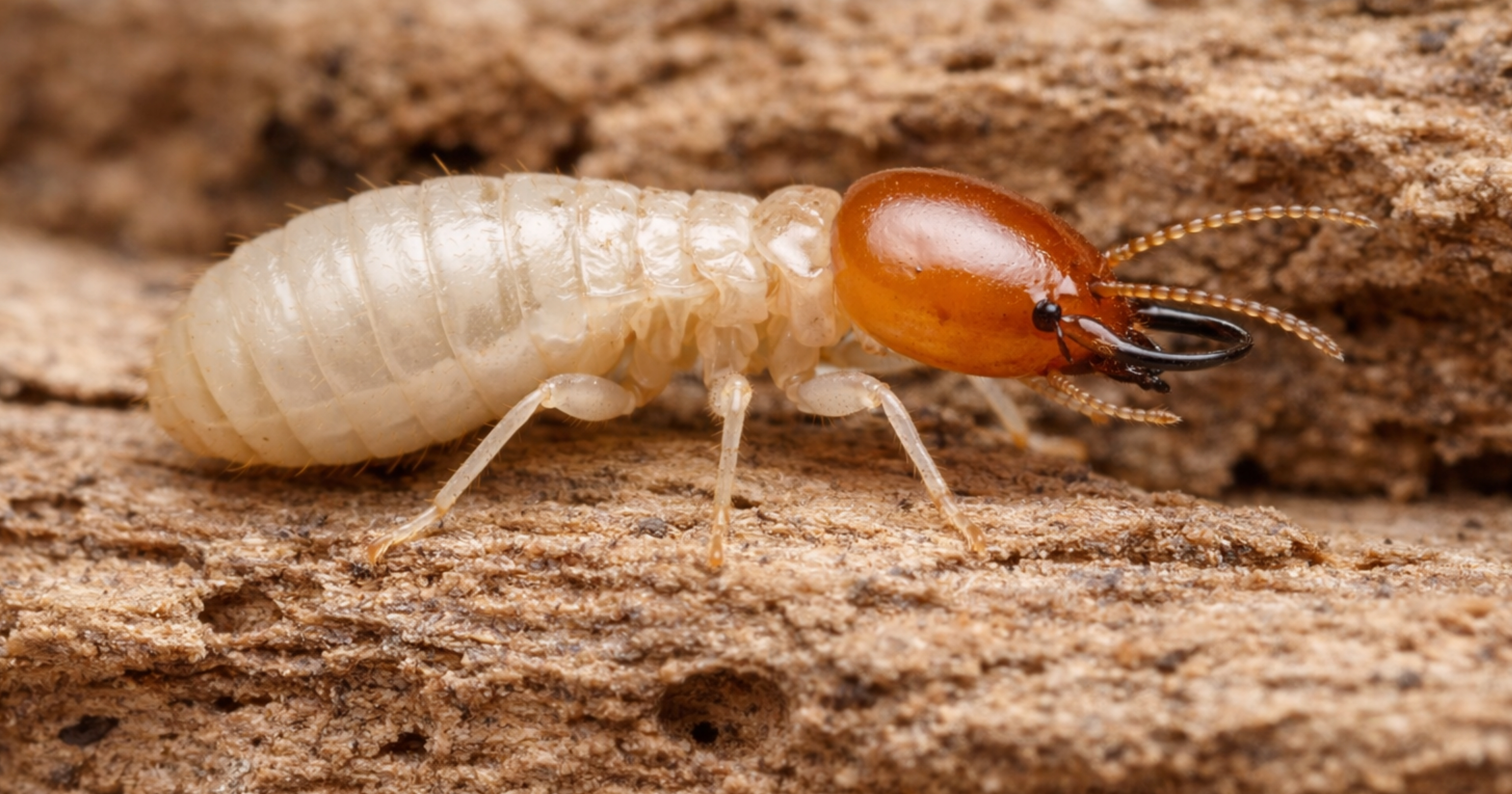
Drywood termites are among the most deceptive timber pests because they can live entirely inside wood, often for long periods, without needing contact with the soil. That makes them very different from subterranean termites, which rely on soil and mud tubes. Their real strength is not speed or size, but the ability to turn a piece of timber into a self-contained hidden colony.
A drywood termite is a termite that infests dry, sound wood and nests directly inside that wood rather than in the ground. UC IPM states clearly that drywood termites nest in wood, not in soil, and other pest references note that they can infest structural timber, beams, floors, walls, roof timbers, and even furniture.
For a South African pest page, that distinction is the most important one to explain properly: drywood termites are internal timber colonists. They do not need the classic soil-to-wood connection that subterranean termites need.
Drywood termites are often identified more by their signs than by seeing the insects themselves. The best-known sign is frass — their hard, pellet-like droppings — which are pushed out through tiny kick-out holes in infested wood. Extension and pest references describe these pellets as very small, often resembling coarse pepper or coffee grounds, and characteristically six-sided when examined closely.
Drywood termites are serious pests because they can live quietly inside timber itself, with little or no obvious external activity. Unlike subterranean termites, they do not have to show you mud tubes to reach the food. Their colony is already inside the food source. That allows damage to build up slowly and remain hidden until timber sounds hollow, becomes thin-skinned, or starts to fail.
This is why they are so often underestimated. People tend to associate termites with soil, visible tubes, or dampness. Drywood termites break that expectation completely.
Most people think the biggest difference is simply that drywood termites live in wood.
That is true, but the deeper advantage is this:
Drywood termites can establish a colony entirely inside a single piece of wood or a connected timber system, without needing the continuous outside support network that subterranean termites need from the soil. That makes them biologically elegant and practically difficult. A colony can live, feed, shelter, and reproduce inside the same timber zone.
A subterranean termite often has to maintain routes from soil to structure.
A drywood termite can simply stay inside the structure.
That means:
This is the real “special power”: its hidden advantage is not just eating dry wood. It is the ability to create a sealed internal life system inside timber. That is what makes drywood termites so deceptive and so stubborn. This is an inference directly supported by the fact that they nest entirely within wood and do not require soil contact.
One of the most interesting drywood termite traits is that they do not simply let waste build up randomly in their galleries. They produce distinctive, dry, pellet-shaped frass and eject it through tiny openings. That means the colony can keep its internal galleries more usable while leaving behind one of the most important diagnostic clues for inspectors.
This is a small detail, but biologically it is impressive. The termite is not just tunnelling and feeding — it is managing internal housekeeping inside a sealed timber environment. That helps explain why these colonies can remain stable and hidden for long periods. This is an inference grounded in the documented frass-ejection behaviour.
Drywood termites succeed because they combine:
That combination makes them less like “soil termites that reached wood” and more like specialists in internal timber occupation. That is what makes them so different and so troublesome. This is an inference based on the sources above.
A species such as Cryptotermes brevis, one of the best-known drywood termites, is notable because it can live completely inside timber structures or wooden articles without any outside water source. That is a remarkable biological adaptation and helps explain why drywood termites can be spread in infested wood, furniture, and timber items.
Pellets, kick-out holes, or hollow-sounding joinery mean book a professional inspection—do not assume “just dust” or old damage. For scope and programme choice, get a quote aligns with national termite methodology; your written quote prevails.
The drywood termite is one of the most deceptive timber pests because it does not need the outside support system people usually associate with termites. Its real supremacy lies in internal occupation. It can turn timber into shelter, food, nursery, and fortress all at once — and that is what makes it so difficult to spot and so costly when ignored.
Next: how we treat termites, termite guarantees, termite control by area, subterranean termite guide, dampwood termite guide, harvester termite guide, termite identification guide. Book termite control in Cape Town. Read termite treatment safety.
Pellet frass and kick-out holes point to drywood ecology; mud tubes and soil-linked routes point to subterranean termites; persistently wet timber and large open galleries point to dampwood; clipped grass on bare soil often points to harvesters. Your quote defines inspection and treatment scope.
Seeing frass or suspect hollow timber? Use get a quote for inspection-led scheduling.
We inspect first, confirm drywood versus subterranean, dampwood, harvester, or other causes, then quote localised wood treatment or fumigation when appropriate—national termite methodology; your quote prevails.
Subterranean termite guide, Dampwood termite guide, Harvester termite guide, How we treat termites, Termite guarantees, Termite control by area, Termite identification guide. Hub: termite control.