Pest guide · bird family
Related proofing context: feral pigeon, house sparrow, Indian myna, Hadeda ibis. Methodology: how we treat birds.
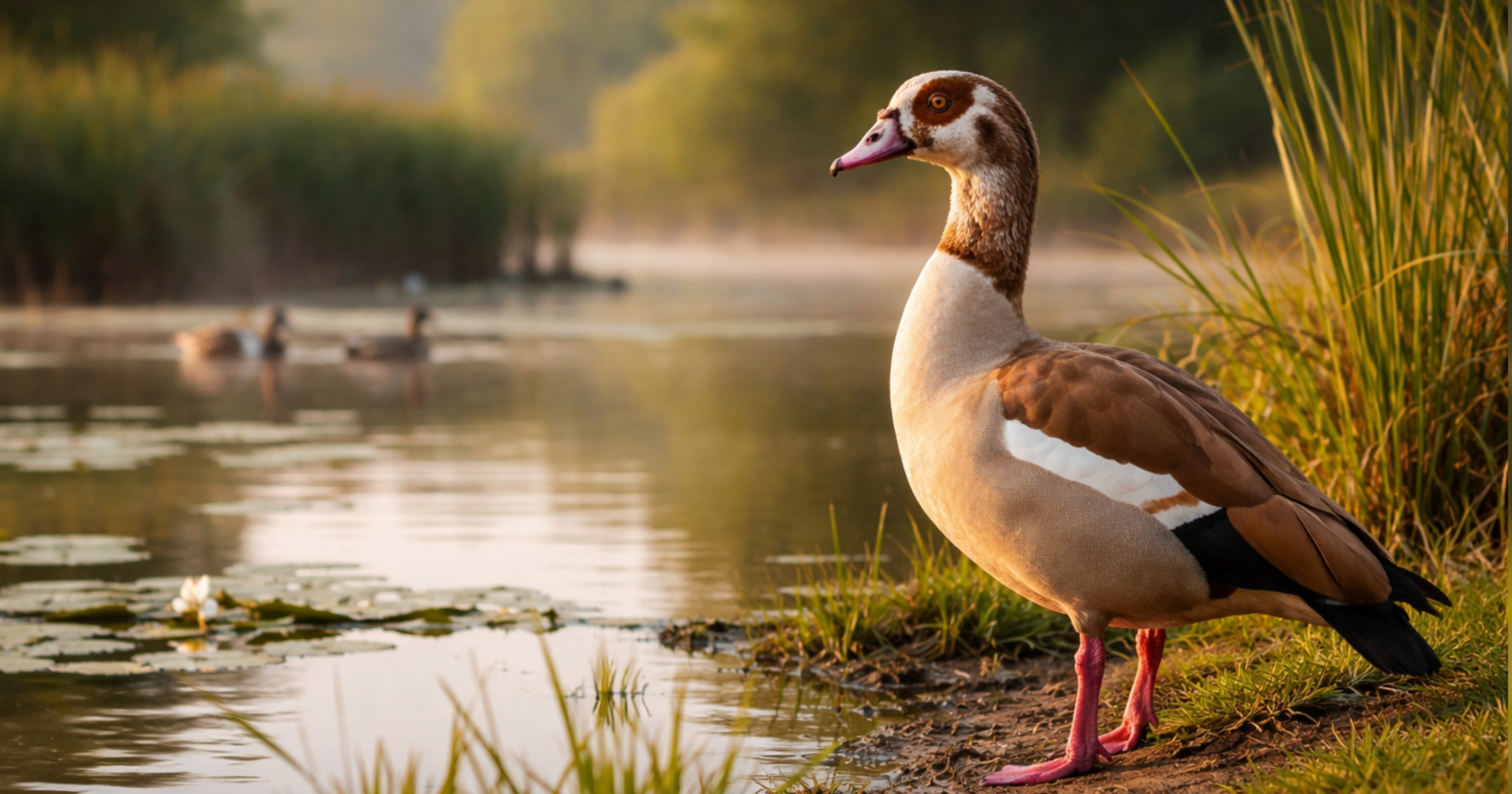
Alopochen aegyptiaca
The Egyptian goose is not just a noisy bird beside a pond. Alopochen aegyptiaca is a tough, adaptable African waterbird that thrives where short grass, open sightlines, and nearby water come together. Its real strength is not just aggression. It is a combination of grazing efficiency, highly mobile family defence, and flexible nesting behaviour that lets it turn parks, golf courses, farm dams, and suburban water bodies into ideal habitat.
The Egyptian goose, Alopochen aegyptiaca, is an African member of the duck and shelduck group, not a “true goose” in the strict taxonomic sense. In South Africa it is native and widespread, and BirdLife South Africa describes it as highly adaptable, using both natural wetlands and heavily modified human landscapes.
That point matters. Around estates and managed landscapes, people often talk about Egyptian geese as if they are foreign intruders. In South Africa, the better description is this: they are native birds taking advantage of modern man-made habitat features. Farm dams, ornamental ponds, irrigated lawns, and open greenbelts have helped increase their numbers in parts of the Western Cape and elsewhere.
Egyptian geese are large, upright, long-legged waterbirds with a very distinctive look. They have:
What to look for
Egyptian geese are strongly attracted to a very specific landscape formula: short, open grazing lawns + nearby water + low predator pressure.
That is why they do so well on golf courses, suburban dams, office parks, estates, school grounds, sports fields, and similar spaces. Research and South African management material both point to large open lawn patches and close proximity to water as key attraction factors. On golf courses especially, irrigated grass and artificial water bodies create almost perfect conditions for them.
This is the first big truth to understand: Egyptian geese do not succeed in urban areas by accident. They succeed because many modern landscapes are effectively custom-built goose habitat.
One of the most misunderstood things about Egyptian geese is that they do not only nest on the ground near water. They are remarkably flexible nesters. They may use tree cavities, ledges, holes, structures, and even the nests of other birds. A review of nest use found Egyptian geese are widely reported to usurp or use other birds' nests, and they have been recorded using a broad variety of nesting sites. That flexibility is a major reason they are hard to predict and hard to exclude.
Common nesting sites include
Egyptian geese matter mainly because of fouling, aggression, and habitat conflict.
BirdLife South Africa and City of Cape Town material both note that these birds can become nuisance birds in large numbers. Their droppings foul lawns and hard surfaces, and City material notes heavy fouling of water bodies as well.
Research specifically examining aggression found Egyptian geese are widely regarded as strongly aggressive toward other bird species, especially while breeding. Reports include displacing other birds from territories or nest sites.
Their favoured habitat overlaps with premium human-managed space: golf courses, parks, estate dams, ornamental lakes, and manicured lawns. That is why the conflict is so visible. The birds are not merely present; they are often using the same areas people pay to maintain for recreation or appearance.
Most people think the Egyptian goose's main power is aggression.
That is only part of the story.
Its deeper, less appreciated advantage is landscape matching: it is exceptionally good at exploiting the exact mix of resources created by suburban and recreational design.
Research on suburban site selection and golf-course attraction shows the species is strongly drawn to open lawns for grazing, nearby water for safety and brood movement, open visibility for predator detection, and low-disturbance nesting opportunities.
A bird that needs dense reeds, isolated wetlands, or specialist feeding sites is easier to limit. Egyptian geese do not. They can use ordinary open grass next to ordinary artificial water. That makes them extraordinarily well suited to human landscapes.
The hidden strength of the Egyptian goose is not simply size or bad temper.
It is that it can turn a designed landscape into a highly efficient grazing-and-safety system: graze on short lawn, watch for threats over open ground, flee quickly to water, and raise goslings in the same connected space. That habitat-fit is what makes the species so dominant in parks, golf estates, and suburban dam systems.
This is the overlooked trait that really sets them apart.
Egyptian geese are not confined to one classic “waterbird nesting style.” The review literature shows they may use or take over a wide range of nest types, including nests built by other birds. That means they are not dependent on one narrow nesting resource.
That flexibility gives them a real advantage. A species that can only nest in one kind of hidden reed bed is limited. A species that can use tree cavities, structures, and appropriated nests has far more options.
Egyptian geese are difficult because they combine:
In other words, they are hard to manage because they are using the landscape exactly as it was laid out. That is why small, superficial deterrents often fail when the underlying habitat remains attractive. This is an inference from the habitat-selection and management studies.
One of the most overlooked facts about Egyptian geese is that their success is linked not only to water, but to short, heavily managed grass. That is why golf courses and similar estates attract them so strongly. Large lawns near water are not neutral features for this species; they are prime feeding habitat.
If you want one accurate answer, it is this:
It turns manicured space into habitat.
Many birds use dams. Many birds graze. Many birds defend young.
But the Egyptian goose stands out because it combines:
That is what makes it so successful in estates, parks, golf courses, and suburban wetland systems.
The Egyptian goose is one of the clearest examples of how a native bird can become a serious nuisance without being alien. Alopochen aegyptiaca succeeds because it is perfectly matched to a landscape people now create everywhere: open lawns, ornamental water, low disturbance, and scattered nesting opportunities. That is what makes it so familiar — and so difficult to ignore.
Next: how we treat birds, bird proofing guarantees, bird identification guide. Book a get a quote. Read bird treatment safety.
Alopochen aegyptiaca — indigenous South Africa framing, lawns-and-water habitat fit, nesting flexibility vs pond-only myths.
Fouling on lawns, dams, or roofs? Book through our quote flow for survey-led humane proofing where permitted.
We survey the attractive footprint—then install humane exclusion and proofing on the quoted scope so birds cannot reclaim the same loafing or nest sites.
Feral pigeon, house sparrow, Indian myna, Hadeda ibis. Hub: bird proofing.