Pest guide · bird family
Compare the larger roof nuisance: feral pigeon pest guide. Proofing paths: how we treat birds.
Passer domesticus
The house sparrow is one of the world's most familiar birds, but familiarity hides just how extraordinary it is. Passer domesticus has followed people across continents, settled into towns, farms and cities, and become one of the most successful human-associated birds on earth. Its real strength is not just boldness. It is a combination of cavity-nesting opportunism, social living, aggressive competition, and a deep evolutionary adaptation to human food systems.
The house sparrow, Passer domesticus, is a small, stout sparrow strongly associated with humans and human settlement. Britannica describes it as native to Eurasia and North Africa and now common across large parts of the world. It is one of the best-studied birds on earth, with Cornell noting that thousands of scientific papers have used it as a study species.
For South Africa, that matters in a practical way: this is not just a garden bird. It is a highly adaptable, introduced urban bird that can become a nuisance around buildings, roof spaces, signage, warehouses, service voids, and feeding areas where people unintentionally provide shelter and food.
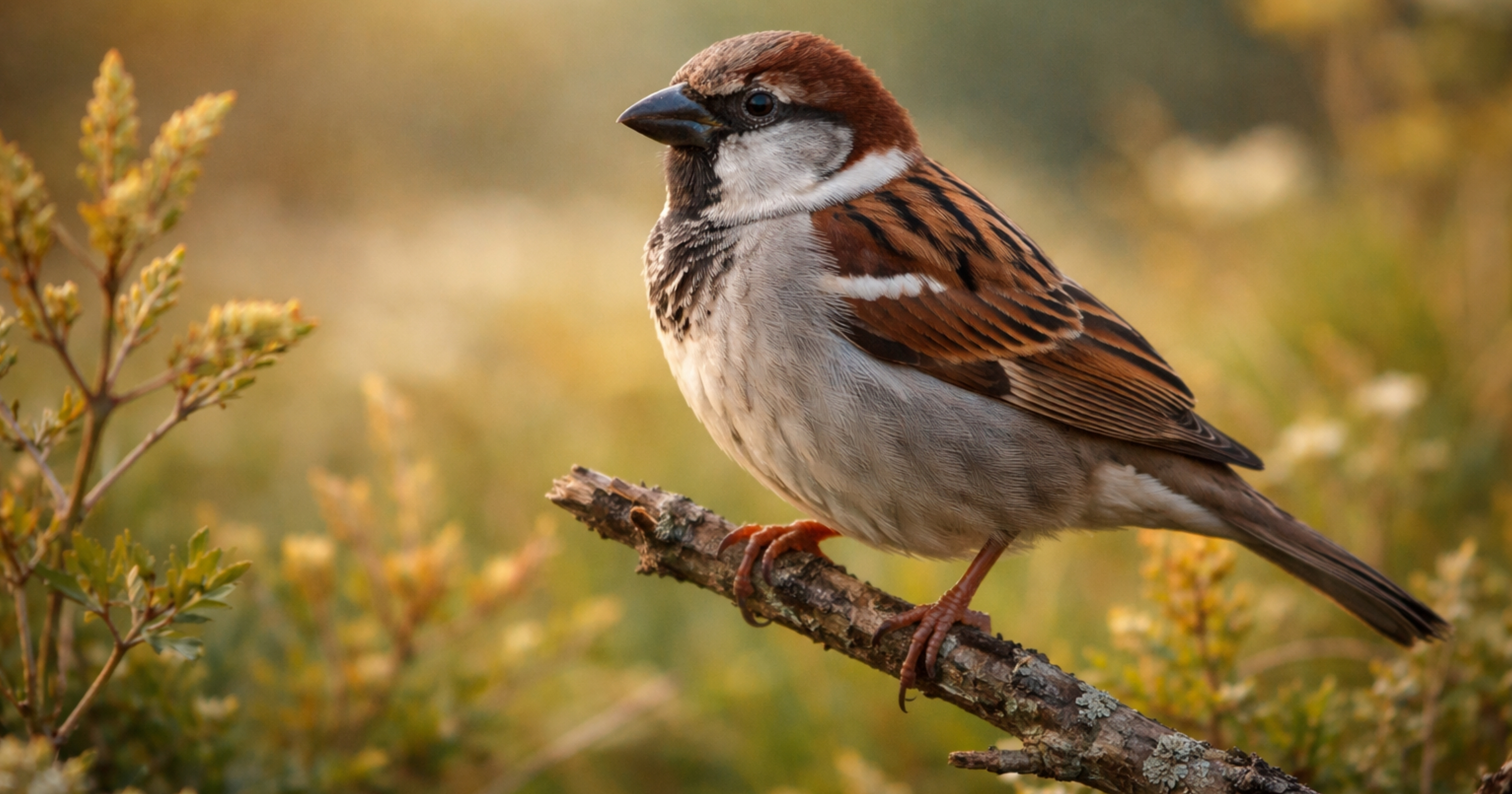
House sparrows are compact, thick-billed birds built for cracking seeds. Males and females look different. Males have a grey crown, chestnut tones, and a black bib, while females are plainer, usually brown and buff with a pale eyebrow and no black bib. Cornell and other bird references consistently note this strong sexual difference.
What to look for
Because they are one of the clearest examples of a human-commensal species — an animal that has adapted to living alongside people. The scientific literature describes the house sparrow as tightly linked to human settlement, and genomic work has specifically examined the species' transition into a human-commensal niche.
This is not just a lifestyle preference. It is one of the reasons they are so successful around buildings. Modern cities, older buildings, farms, restaurants, grain stores, stables, and service gaps create exactly the kind of shelter-and-food system a house sparrow can exploit.
House sparrows are cavity nesters. Cornell's life-history guide notes that they stuff nests into holes and recesses, often packing the cavity heavily with coarse material before lining it with finer material such as feathers, string, or paper. They also often nest close together, and neighbouring nests can even share walls.
That is one of the biggest practical facts for pest management. These birds do not need a tree hollow to succeed. They readily use:
The main issue with house sparrows is not that they are dangerous in the dramatic sense. The problem is that they are persistent, messy, aggressive, and infrastructure-friendly.
They build bulky nests in cavities, often reuse them, and live closely around people. This creates ongoing fouling, noise, nesting debris, blocked openings, and repeated occupation of exclusion-prone spaces. Because they often nest colonially or semi-colonially, a property can move from “a few sparrows” to a recurring building issue surprisingly quickly.
They are also well known for competing aggressively for nesting sites. Cornell notes that house sparrows aggressively defend nest holes and sometimes evict other birds from cavities. In North America, this is one reason they are treated as a serious invasive competitor around nest boxes.
Most people think the house sparrow's greatest advantage is boldness.
That is only half the story.
Its deeper, less widely known advantage is dietary adaptation to human starch-rich food systems. Genomic research on house sparrows found signatures of human commensalism in a region containing amylase-related genes, linked to starch digestion. Audubon's summary of that work explains the idea clearly: part of the house sparrow's global success is tied to genes that help it digest the starch-heavy foods that came with agriculture and human settlement.
That is a remarkable advantage.
It means house sparrows did not just become comfortable around people socially. They appear to have adapted biologically to a human-created food niche. Grain, livestock feed, processed scraps, crumbs, seed, and starchy agricultural foods are not just convenient accidents for them — they are part of the evolutionary story of why this species became so successful around us.
The hidden strength of the house sparrow is not merely that it nests in roofs.
It is that it became, in an evolutionary sense, a specialist at living off the world humans built. Its success is tied to:
House sparrows are not purely solitary nesters. Cornell notes that they sometimes build nests next to each other and that neighbouring nests may share walls. This is more important than it sounds. Colonial or semi-colonial nesting means one suitable building feature can attract repeated occupation and escalating nesting pressure.
That social structure gives them strength. A species that tolerates close neighbours around rich human shelter can multiply in problem areas far more easily than a bird that insists on wide spacing.
House sparrows are difficult because they are built for exactly the environments people create. They are comfortable around human activity, exploit cavities in buildings, live socially, defend nesting space aggressively, and feed effectively on the sorts of grains and scraps that accompany settlement. That means they are not merely visiting buildings. They are often integrated into the building environment.
Modern urban changes can even affect their nesting patterns. Recent urban nesting research found that nesting-site selection is strongly shaped by city structure and the availability of suitable cavities, reinforcing how dependent the species is on built form.
One of the most interesting truths about house sparrows is that although they are often treated simply as pests, they are also one of biology's most important model birds. Cornell notes that thousands of papers have been published on them, and eLife describes them as a major model organism for research in behaviour, ecology, physiology, and evolution.
That does not make them less of a problem on a building. But it does show that this is not a trivial bird. It is one of the most scientifically informative urban birds on earth.
If you want one accurate answer, it is this:
It turned human civilisation into habitat.
Many birds visit towns. Many birds use buildings occasionally. Many birds eat grain. But the house sparrow stands out because it combines:
That is what made it one of the world's most successful urban birds.
The house sparrow is one of the clearest examples of an animal that became powerful by mastering the human world. Passer domesticus is not simply a small brown bird in the background. It is a highly adaptable, socially flexible, cavity-nesting, food-savvy urban specialist whose success is tied directly to the way people build, feed, farm, and live. That is what makes it so familiar — and so formidable.
Next: how we treat birds, bird proofing guarantees, bird identification guide. Book a get a quote. Read bird treatment safety.
Passer domesticus — cavities, colonial pressure, starch adaptation narrative; proofing seals gaps and manages attractants.
Vents or roof noise? Book through our quote flow for survey-led humane exclusion.
We survey entry points and install mesh, vent covers, or sealing on the quoted footprint—so sparrows cannot reoccupy the same gaps.
Larger ledge nuisance: feral pigeon pest guide · Invasive cavity competitor: Indian myna pest guide · Egyptian goose pest guide · Hadeda ibis pest guide. Hub: bird proofing.