Pest guide · bird family
Related proofing targets: feral pigeon, house sparrow, Egyptian goose, Hadeda ibis. Methodology: how we treat birds.
Acridotheres tristis — common myna
The Indian myna is not just a noisy bird on a roof. Acridotheres tristis is one of the world's best-known invasive birds, famous for thriving in cities, taking over nest cavities, and adapting rapidly to human-made environments. Its real strength is not just aggression. It is a combination of cavity competition, social boldness, and exceptional dietary flexibility that lets it turn towns, farms, and buildings into prime habitat.
The Indian myna, or common myna, is Acridotheres tristis, a bird native to parts of Asia that has become established as an alien species in many regions of the world, including South Africa. SANBI describes it as an invasive bird, and the Global Invasive Species Database lists it among the world's worst invasive alien species. In South Africa, it is especially associated with human-modified areas, although recent work shows it can also spread beyond those urban strongholds.
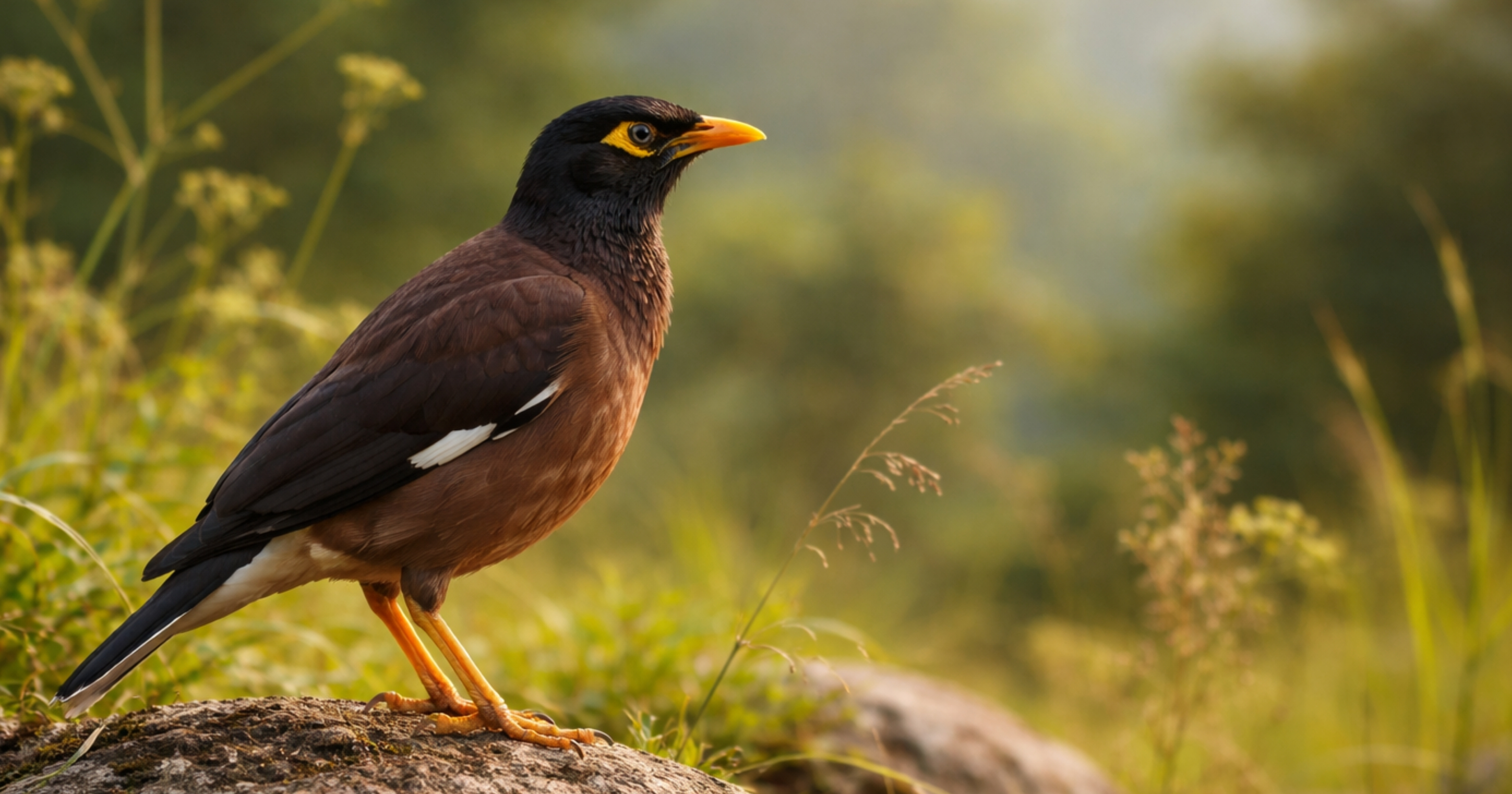
The Indian myna is a medium-sized, sturdy bird with a dark head, brown body, bright yellow beak, yellow legs, and a yellow patch of bare skin behind the eye. A white wing patch becomes obvious in flight or when the wing is partly open. Those facial colours and the confident, upright posture are some of the easiest field clues.
What to look for
Researchers describe common mynas as synanthropic, meaning they are strongly associated with human environments. In South Africa they have long shown a marked preference for towns, suburbs, agricultural edges, and other disturbed habitats. That gives them access to food, water, shelter, nesting cavities, and reduced fear of human activity all at once.
This matters for pest management because the bird is not merely passing through urban areas. It is a species built to exploit them.
Indian mynas are cavity nesters. They use holes in trees, but they also readily occupy gaps and recesses in man-made structures. Mynas often use crevices in building facades in towns—typical cavity use in human-modified areas. Their dependence on nest cavities is a major reason they come into conflict with both property owners and other birds.
Common nesting sites include
Indian mynas matter for three main reasons.
A growing body of research shows that common mynas are highly aggressive in cavity conflicts and often win those encounters, even against larger birds. This is one of the main ecological reasons they are considered invasive and problematic.
Because they are strongly synanthropic, they do especially well in urban settings, where food and nesting opportunities are concentrated. That makes them persistent around homes, commercial properties, schools, shopping areas, warehouses, and service yards.
The Global Invasive Species Database notes that flocks of common mynas can damage crops including grapes, apples, pears, strawberries, figs, apricots, and gooseberries. Around buildings, they also create familiar nuisance issues such as droppings, noise, roost mess, and repeated nesting in structural gaps.
Most people think the Indian myna's real power is aggression.
That is only part of the story.
Its deeper advantage is dietary flexibility.
A South African study on common mynas in non-native habitats found that they showed dietary flexibility that may improve their ability to forage successfully in new environments. A separate urban nutrition study described common mynas as a strong model for invasive species because they can navigate complex human food landscapes and actively regulate what they eat.
A bird that can only live on one narrow food source is easy to limit. A bird that can switch between insects, fruit, scraps, human-associated foods, and opportunistic urban resources is much harder to displace. That flexibility means the Indian myna is not tied to one season or one feeding niche. It can keep functioning across changing urban conditions.
The hidden strength of the Indian myna is not simply that it is bold.
It is that it can pair aggressive nesting behaviour with a remarkably flexible feeding strategy. That makes it one of the most effective urban colonisers among birds.
The Indian myna's aggression is not random bad temper. Research on interaction webs around cavity-bearing trees found common mynas to be major participants in aggressive interactions with other cavity-nesting birds. Another recent study reported that they frequently win such interactions.
That matters because it means they do not just find nesting opportunities — they often take and hold them.
Indian mynas are difficult because they combine:
That combination lets them succeed where many birds fail. They do not need pristine habitat. They need opportunity.
One of the most overlooked facts about Indian mynas is that their urban success is not just about junk-food scavenging. Research suggests they may be successful partly because they are nutritionally adaptable, not merely indiscriminate. That is a much more powerful trait than simple boldness, because it means they can maintain performance across many kinds of urban food landscapes.
If you want one accurate answer, it is this:
It combines urban fearlessness with strategic adaptability.
Many birds can use buildings. Many birds can eat scraps. Many birds can be aggressive. But the Indian myna stands out because it combines:
That is what makes it such a formidable invasive urban bird.
The Indian myna is one of the clearest examples of how an ordinary-looking bird can become extraordinary through adaptability. Acridotheres tristis succeeds not just because it is loud or aggressive, but because it is flexible, opportunistic, socially bold, and perfectly suited to the gaps and food systems of urban life. That is what makes it so familiar — and so difficult to ignore.
Next: how we treat birds, bird proofing guarantees, bird identification guide. Book a get a quote. Read bird treatment safety.
Acridotheres tristis — SANBI/GISD invasive framing, cavity wins, dietary flexibility vs noise-only narratives.
Roost fouling or cavity conflicts? Book through our quote flow for survey-led humane proofing.
We survey structures and install humane exclusion on the quoted scope—species logic informs where netting, spikes, or mesh matter.
Feral pigeon, house sparrow, Egyptian goose, Hadeda ibis. Hub: bird proofing.