Pest guide · cockroach family
Species programmes: German & brown-banded hub, German cockroach pest guide, Oriental cockroach pest guide, Brown-banded cockroach pest guide, American & Oriental hub. Identification: cockroach identification. Methodology: how we treat cockroaches.
Periplaneta americana
The American cockroach is one of the largest and most impressive pest cockroaches found around buildings, but its real power is not size alone. Periplaneta americana succeeds because it combines sewer tolerance, moisture-seeking behaviour, fast escape reflexes, and strong dispersal ability. It is a classic urban reservoir pest: often breeding out of sight in drains, plant rooms, basements, service ducts, and sewer-linked voids before appearing indoors.
The American cockroach, Periplaneta americana, is one of the world's most widespread large cockroach species and a major urban hygiene pest. It is strongly associated with warm, moist, dark environments, especially sewers, drains, latrines, cesspools, sewage systems, basements, boiler rooms, and other service spaces. Because it frequently moves between waste-associated habitats and human structures, health authorities and extension sources treat it as an important public-health pest.
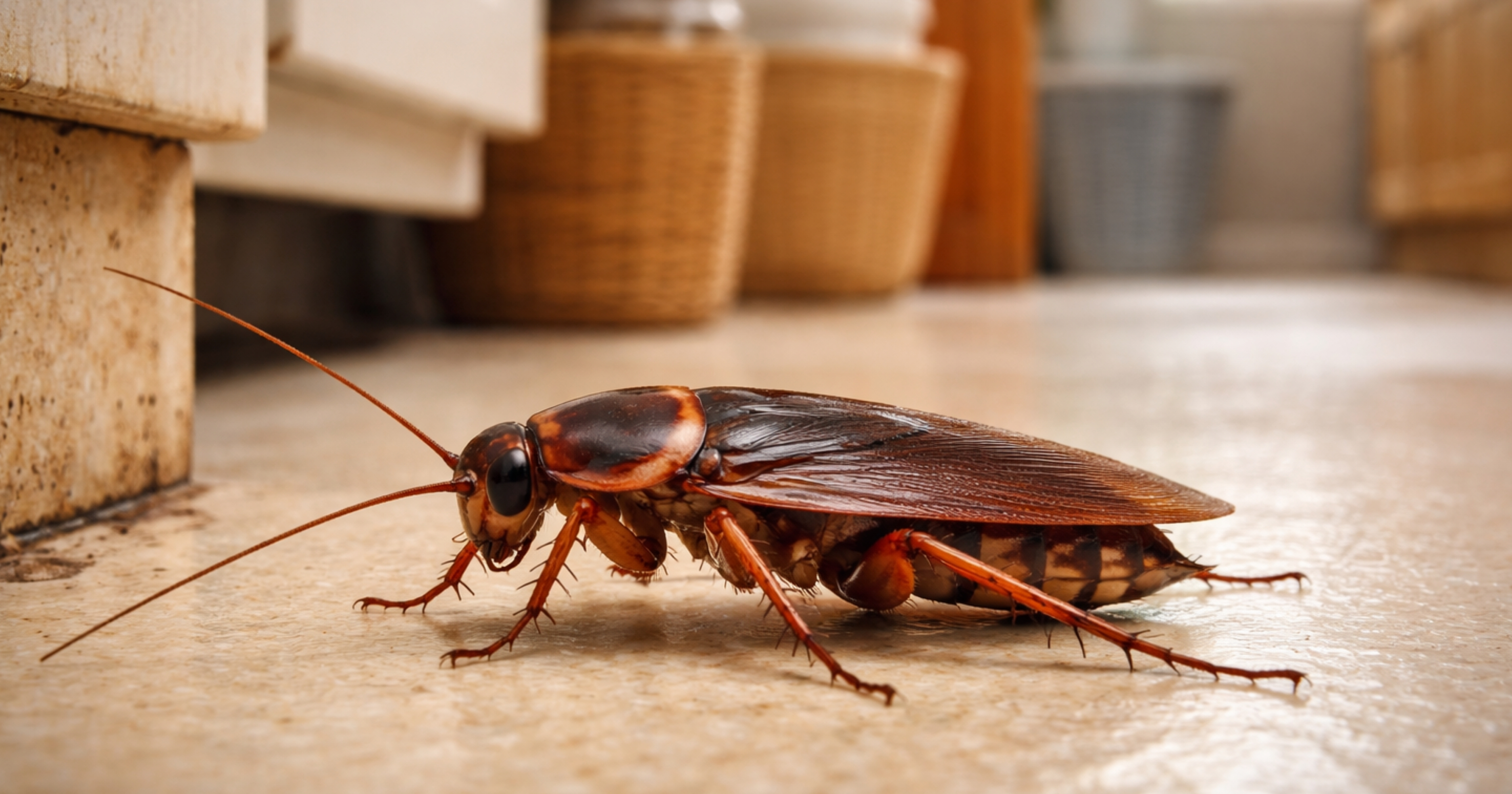
American cockroaches are large, reddish-brown cockroaches with a pale yellowish or tan margin or marking on the shield behind the head. Extension sources place adults roughly in the 32–54 mm range, making them much larger than German cockroaches. Adults have fully developed wings, and both sexes are winged.
What to look for
This is one of the most important truths about the species: American cockroaches often do not begin as a simple indoor cupboard pest.
University of Florida's extension guide describes them from places such as privies, latrines, cesspools, sewers, sewage treatment plants, dumps, caves, and other damp sheltered sites. Virginia Tech research likewise describes the species as an urban pest able to invade structures from non-residential reservoirs, which is a key reason infestations can seem to “return” after light surface treatment.
In plain language
They often live below, behind, or outside the visible problem:
The American cockroach matters for more than shock value.
Because it is associated with human waste environments and can move into occupied spaces, WHO and extension sources identify it as significant in relation to pathogen carriage, contamination risk, and allergens. More recent reviews also note that cockroaches, including major urban pest species, are linked with allergen exposure and can mechanically carry microorganisms of public-health concern.
That does not mean every roach you see is “infectious” in a simple way. It means the ecology of the species makes it a sanitation and contamination risk, especially where food handling, moisture, drainage, or structural defects are involved.
Most people think the American cockroach's main advantage is that it is big and hard to kill.
That is only part of the story.
Its more important and less widely appreciated advantage is its extraordinary sensory escape system. Classic neuroethology work on Periplaneta americana showed that it responds to tiny air movements with rapid, directional escape turns. These responses depend on sensory organs on the cerci at the rear of the body, allowing the insect to detect approaching threats and launch away with remarkable speed.
This is not a trivial laboratory curiosity. It helps explain a familiar real-world experience: the American cockroach often seems to explode into motion the instant a light comes on, a door opens, or a person approaches. That escape system gives it a huge survival edge in exposed environments like basements, service corridors, drains, and walls.
Its hidden strength is not just toughness.
It is near-instant threat detection plus directional escape, which makes the insect unusually difficult to catch, crush, or expose long enough for people to understand where it is really coming from.
American cockroaches prefer warm, moist conditions, but that does not make them fragile. Animal Diversity Web notes they can survive in drier areas if they have access to water, while extension sources emphasize their preference for humid, protected environments.
That means this species is unusually good at using transitional environments:
This reservoir lifestyle is one of the real reasons they feel “supreme” compared with more exposed pests. They do not need to live fully in the open domestic space. They can thrive in the hidden machinery of a building.
Penn State Extension notes that females produce dark brown egg capsules, or oothecae, about 5/16 inch long (roughly 8 mm), and that the capsule is typically dropped within about a day after formation. University of Florida's extension material also documents the egg case and immature stages.
This matters because control efforts often focus only on visible adults, while the population may include:
Yes — but this is one of those topics that gets distorted. Older life-history sources and modern extension material agree that adults are winged and capable of flight or gliding, especially in warm conditions. In many buildings they are more often seen running than flying, which is why people sometimes wrongly assume they cannot fly at all.
Better truth
American cockroaches are difficult because they combine:
That combination means the visible insects are often only the surface expression of a deeper structural problem.
One of the most overlooked facts about the American cockroach is that it is also an important scientific model organism. Recent life-history and genome-related papers describe Periplaneta americana not only as a hygiene pest, but also as a species used in physiology and developmental research.
That does not make it less of a pest. It does show that this is a biologically sophisticated insect, not just a crude scavenger.
If you want one accurate answer, it is this:
It dominates hidden infrastructure.
Many pests invade rooms. The American cockroach often invades the systems behind the room. It succeeds because it combines:
That is what makes it such a stubborn and impressive pest.
The American cockroach is one of the clearest examples of a pest that wins by staying mostly out of sight. Periplaneta americana is not just a large roach that wanders indoors. It is a moisture-loving, sewer-linked, infrastructure-adapted insect with remarkable sensory reflexes and strong dispersal ability. That is what makes it so memorable — and so difficult to eliminate properly.
Next: how we treat cockroaches, cockroach guarantees, cockroach identification guide. Book a get a quote. Read cockroach treatment safety.
Periplaneta americana — UF/VT reservoir framing, cerci escape biology, African origin vs common name.
Drains, basements, or repeat corridor sightings? Book through our quote flow for inspection-led reservoir-aware programmes.
We map reservoir routes and treat sewers, voids, and labelled harbourages on your quoted footprint—species logic matches American & Oriental programmes.
German cockroach pest guide, Oriental cockroach pest guide, Brown-banded cockroach pest guide, German & brown-banded hub, American & Oriental hub. Hub: cockroach control.