Pest guide · cockroach family
Species programmes: German & brown-banded hub, German cockroach pest guide, American cockroach pest guide, Brown-banded cockroach pest guide, American & Oriental hub. Identification: cockroach identification. Methodology: how we treat cockroaches.
Blatta orientalis
The Oriental cockroach is not just another kitchen roach. Blatta orientalis is a dark, moisture-loving species built for cooler, damp, low-light environments such as drains, crawl spaces, basements, meter boxes, sewer lines, and areas around leaking plumbing. Its real strength is not speed or climbing finesse. It is a combination of moisture tolerance, cool-site preference, sheltered egg placement, and survival in filthy organic habitats that makes it so persistent.
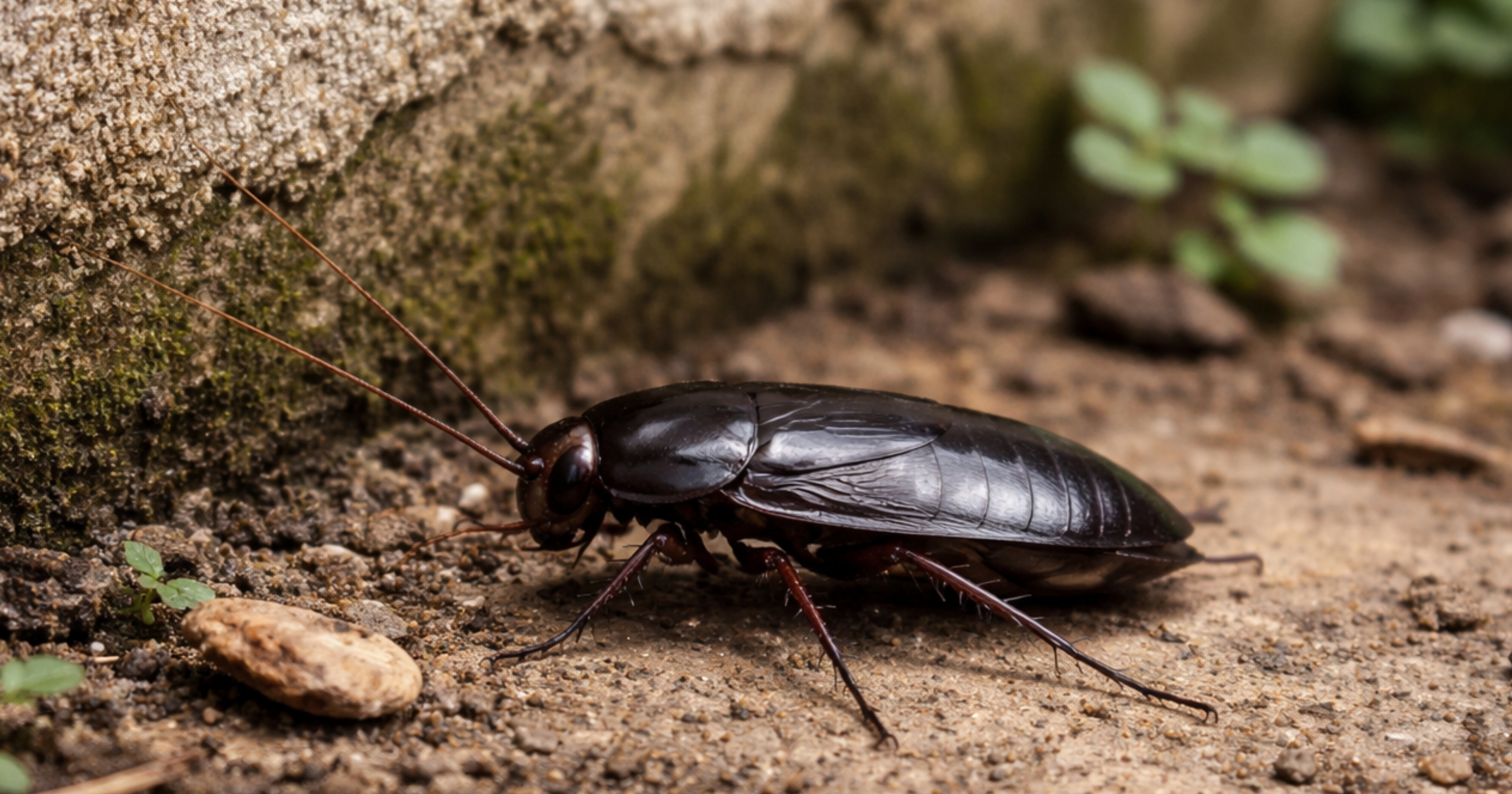
The Oriental cockroach, Blatta orientalis, is a large, dark cockroach species commonly associated with cool, damp, ground-level or below-ground areas. Extension sources consistently place it in sites such as basements, crawl spaces, floor drains, areas between soil and foundations, sewer pipes, under sinks, wet garages, and damp shaded outdoor zones. It is also often called a “water bug,” although that nickname can be misleading because it is still a cockroach, not a true aquatic insect.
Oriental cockroaches are typically dark brown to nearly black and are among the larger structure-infesting cockroaches, commonly around 1 to 1¼ inches long (about 25–32 mm). Males and females look noticeably different: males have short wings covering much of the abdomen, while females have very short, rudimentary wings and appear broader and heavier-bodied. Nymphs are wingless and resemble smaller, darker females.
What to look for
This is one of the most repeated half-truths in pest control.
Oriental cockroaches are often called water bugs because they are strongly associated with cool, wet, humid places and are commonly found around floor drains, sewer openings, leaking pipes, grease traps, and damp ground-level voids. But they are not true aquatic bugs. The nickname survives because of their moisture preference, not because they are actually water-dwelling insects in the biological sense.
This species is especially important because it breaks the usual mental picture people have of roaches as primarily warm-kitchen pests.
Multiple extension sources note that Oriental cockroaches prefer cooler temperatures and high humidity, unlike species such as the German cockroach, which are more strongly linked to warmer indoor sites. They are commonly found in basements, crawl spaces, garages, sewer pipes, floor drains, trash areas, wood piles, water meter boxes, dense vegetation, and damp areas around foundations.
That difference matters. It explains why people often miss the real source of an infestation. A property may look “clean inside,” yet still have a serious Oriental cockroach problem driven by moisture and exterior harborage, not food crumbs on a countertop. This is an inference from the habitat pattern described in the extension sources.
Oriental cockroaches matter because they are strongly linked to filthy organic environments and can move between those sites and human spaces. Extension and zoological sources describe them as living in sewers, garbage, drains, grease, and decaying organic material, and they are widely regarded as among the dirtiest of the structure-infesting cockroaches. They can contaminate food and surfaces, contribute allergens, and are associated with disease risk through mechanical transfer from unsanitary sites.
They are also known for producing a strong unpleasant odour, especially in heavier infestations.
Most people think the Oriental cockroach's success comes from being big and filthy.
That is not the deepest reason.
Its more interesting advantage is that it is better adapted than many household roaches to cooler, wetter, lower-oxygen structural niches — the exact places many people overlook and many other pest species do not dominate as well. Extension sources repeatedly single it out as unusual among cockroaches for preferring cool, damp, dark areas rather than the warmer habitats most roaches prefer.
That means the Oriental cockroach is not just a “dirty version” of another roach. It is a niche specialist. It is especially strong in:
Its hidden strength is moisture-driven habitat supremacy.
Many cockroaches need humidity, but Oriental cockroaches are particularly good at owning the cool-damp structural layer of a property. That makes them stubborn because the source is often not the obvious living area — it is the wet, dark, neglected infrastructure around and beneath it. This is a synthesis of the habitat evidence across the cited extension sources.
Female Oriental cockroaches produce about eight oothecae in a lifetime, with roughly 16 eggs per egg case. The egg case is carried briefly and then deposited in a protected, sheltered site near suitable conditions. Development is slow — sources give roughly 300 to 800 days, or around 1 to 2 years depending on conditions.
That slower life cycle may sound like a weakness, but it helps explain why infestations can become deeply established in stable damp sites. This species is built less for explosive fast-breeding kitchen infestations and more for long-term persistence in neglected moisture zones. That final sentence is an inference based on the species' long development time and preferred habitat.
Oriental cockroaches are difficult because they combine:
That means the infestation is often supported by the property itself: leaks, wet debris, blocked drainage, slab-edge gaps, floor drains, or exterior moisture pockets. When those conditions remain, superficial spraying alone often fails. That final sentence is an inference from the biology and habitat sources rather than a direct quote.
One of the most overlooked facts about the Oriental cockroach is that it is not primarily a high-heat kitchen specialist. Its real strength lies in the cool, wet underside of buildings and landscapes — the hidden moisture belt most people do not inspect first. That conclusion is drawn from repeated extension guidance placing this species in basements, crawl spaces, drains, sewer pipes, water meter boxes, and damp exterior harborage.
If you want one accurate answer, it is this:
It dominates the damp layer.
Many cockroaches can exploit human buildings. Many can contaminate food. Many need humidity. But the Oriental cockroach stands out because it combines:
That is what makes it such a stubborn pest.
The Oriental cockroach is one of the clearest examples of a pest succeeding not through speed or glamour, but through niche mastery. Blatta orientalis is built for the dark, damp, neglected layer of a property — the drains, wet voids, sewer links, and shaded harborage most people overlook. That is what makes it so persistent, and that is what makes it such a serious structural pest.
Next: how we treat cockroaches, cockroach guarantees, cockroach identification guide. Book a get a quote. Read cockroach treatment safety.
Blatta orientalis — water-bug nickname vs biology, flightless dimorphism, cool-damp niche vs German kitchen framing.
Damp basements, meter boxes, or drain lines? Book through our quote flow for moisture-aware, species-matched programmes.
We trace moisture-linked harbourage and treat sewers, voids, and labelled zones on your quoted footprint—American & Oriental logic applies.
German cockroach pest guide, American cockroach pest guide, Brown-banded cockroach pest guide, German & brown-banded hub, American & Oriental hub. Hub: cockroach control.