Pest guide · cockroach family
Species programmes: German & brown-banded hub, German cockroach pest guide, American cockroach pest guide, Oriental cockroach pest guide, American & Oriental hub. Identification: cockroach identification. Methodology: how we treat cockroaches.
Supella longipalpa
The brown-banded cockroach is one of the most misunderstood indoor roaches. It is smaller than the American cockroach, less famous than the German cockroach, and often missed because it does not depend as heavily on wet kitchen and bathroom conditions. Its real strength is not just survival. It is a combination of warmth-seeking behaviour, dry-habitat tolerance, and the ability to occupy elevated, scattered hiding places throughout a structure.
The brown-banded cockroach, Supella longipalpa, is a widespread indoor nuisance pest and public-health pest. UC IPM describes it as less common than the German cockroach in California, while current research describes it as a widespread invasive nuisance associated with built environments.
This species matters because it behaves differently from the “typical” cockroach people imagine. Many people assume all roaches want damp drains, greasy kitchens, and floor-level hiding places. Brown-banded cockroaches break that pattern. They are strongly associated with warmer, drier indoor microhabitats, including furniture, clutter, wall décor, hollow furniture legs, and electrical appliances.
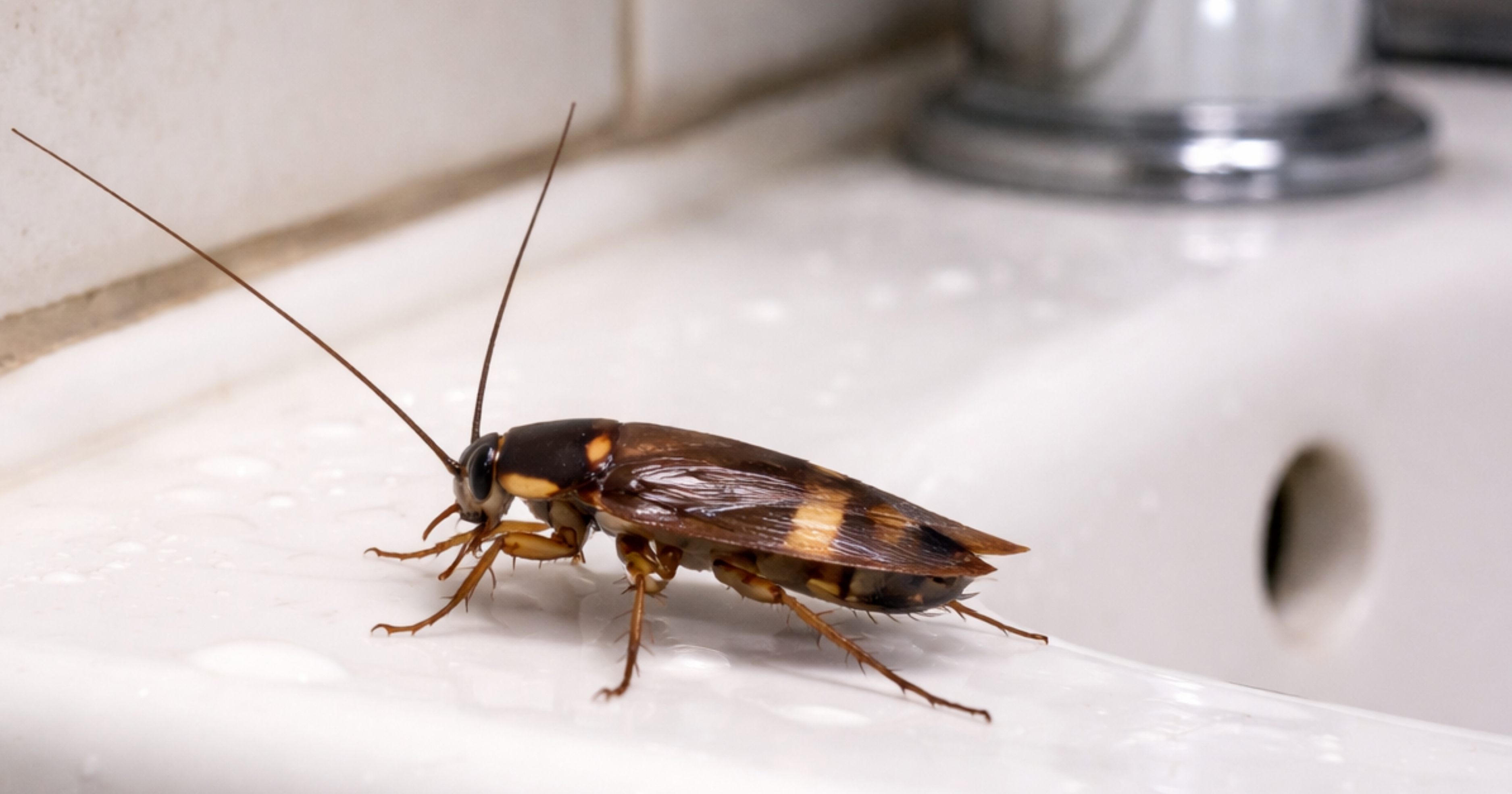
The easiest identifying feature is the light brown bands running across the body, especially visible on nymphs and on the wings of adults. This banding is what gives the species its common name. UF/IFAS and UC IPM both identify it as Supella longipalpa, commonly known as the brownbanded cockroach.
What to look for
This is one of the most important truths about the species.
UC IPM notes that the brown-banded cockroach prefers temperatures around 80°F (about 27°C), roughly 5° to 10°F warmer than those preferred by German cockroaches. It also favours crevices within or near electrical appliances, behind artwork and wall decorations, within hollow legs of furniture, and within clutter.
That means the brown-banded cockroach is often a whole-room or whole-building problem rather than a strictly kitchen-and-bathroom problem. It can spread into lounges, bedrooms, offices, schools, hospitals, and other warm interior areas where other roaches are less dominant. A patent summary and extension materials both note their importance in places such as schools, hospitals, and buildings where restricted pesticide use makes control harder.
Brown-banded cockroaches prefer warm, dry, sheltered spaces. Unlike moisture-loving roaches that cluster near plumbing, this species often hides:
This is why infestations are so often missed at first. People search under sinks, behind fridges, and around drains, but this species can be living quietly in areas they do not think to inspect.
The brown-banded cockroach is not just a nuisance because it is unpleasant to see. Research describes it as a public health pest, and published work has documented its association with pathogenic bacteria in urban environments, even while noting that some aspects of its role are still being studied.
Like other pest cockroaches, it matters because it can contaminate indoor spaces, occupy sensitive environments, and persist in hidden harbourages that people do not notice until the population is established. Its association with built environments and warm interior refuges makes it particularly relevant in apartments, offices, schools, hospitals, and long-term indoor infestations.
Most people think the brown-banded cockroach's main strength is simply that it is a cockroach.
That misses the important part.
Its deeper advantage is dry-habitat independence inside human structures. UC IPM makes this clear indirectly by showing that this species favours warm, sheltered locations like appliances, furniture, and wall-mounted items instead of relying mainly on wet plumbing zones.
A cockroach that depends heavily on damp sources is easier to predict. A cockroach that can live in warmer, drier, more widely distributed indoor hiding places is harder to locate and easier to underestimate. It can occupy elevated spaces, scattered rooms, and protected warm niches that homeowners and staff do not routinely inspect.
The brown-banded cockroach's hidden strength is not size or speed.
It is the ability to break the “wet-area cockroach” rule and colonise a building more diffusely:
That makes it one of the easiest indoor cockroaches to overlook and one of the most frustrating to track properly.
One of the most overlooked truths about this species is how strongly it exploits objects, not just rooms. UC IPM specifically lists electrical appliances, wall decorations, hollow furniture legs, and clutter as favoured harbourages. That means its success is tied not only to the building shell, but also to the way people furnish and fill buildings.
That is a major advantage. A species able to use hundreds of tiny man-made refuges scattered through a property does not need one big obvious harbourage. It can distribute itself through the environment in a much more cryptic way. This is an inference strongly supported by the listed harbourage types.
Brown-banded cockroaches are difficult because they do not always gather in the obvious places. Their harbourages can be small, warm, elevated, dry, and widely distributed. That makes casual inspection unreliable and allows infestations to persist in buildings where people focus only on kitchens, drains, and wet service areas.
This species also becomes especially troublesome in places where broad pesticide use is limited or undesirable, such as schools, hospitals, and nursing facilities. That point appears in the patent background and fits the broader extension guidance on indoor infestations in sensitive environments.
One of the least appreciated facts about the brown-banded cockroach is that its success is tied not merely to “dirt” or “poor hygiene,” but to microclimate and harbourage architecture. A relatively tidy building with warm appliances, furniture voids, decorative fixtures, and protected clutter can still support them very well. This is an inference directly supported by the harbourage and temperature information from UC IPM.
If you want one accurate answer, it is this:
It can live where people forget to look.
Many cockroaches need moisture-rich zones. Many cockroaches cluster near plumbing. Many cockroaches are discovered because they stay low and near kitchens. But the brown-banded cockroach stands out because it combines:
That is what makes it so deceptive as a pest.
The brown-banded cockroach is one of the clearest examples of how a pest can be dangerous precisely because it is easy to underestimate. Supella longipalpa is not the loudest or largest roach, but it is highly adapted to warm indoor life, especially in dry, protected, man-made hiding places people rarely inspect properly. That is what makes it so persistent — and so often missed until the infestation is well established.
Next: how we treat cockroaches, cockroach guarantees, cockroach identification guide. Book a get a quote. Read cockroach treatment safety.
Supella longipalpa — bands vs German stripes, warm dry scattered harbourages, schools and hospitals context.
Seeing roaches high on walls or behind décor—not under the sink? Book through our quote flow for harbourage-led, species-matched programmes.
We inspect object-led harbourages and treat labelled zones on your quoted footprint—German & brown-banded programme logic applies.
German cockroach pest guide, American cockroach pest guide, Oriental cockroach pest guide, German & brown-banded hub, American & Oriental hub. Hub: cockroach control.