Pest guide · cockroach family
Species programmes: German & brown-banded hub, American & Oriental hub, American cockroach pest guide, Oriental cockroach pest guide, Brown-banded cockroach pest guide. Identification: cockroach identification. Methodology: how we treat cockroaches.
Blattella germanica
The German cockroach is not just another roach. UC IPM describes it as the most common indoor cockroach and one of the most persistent species in structures, especially in kitchens, bathrooms, restaurants, hospitals, schools, warehouses, and multi-unit housing. Blattella germanica is one of the most successful indoor pests on earth, built for life close to food, moisture, warmth, and tight shelter. Its real strength is not size or toughness alone. It is a combination of rapid reproduction, intimate association with indoor spaces, strong edge-following behaviour, and a remarkable ability to evolve resistance — even behavioural resistance — to control measures.
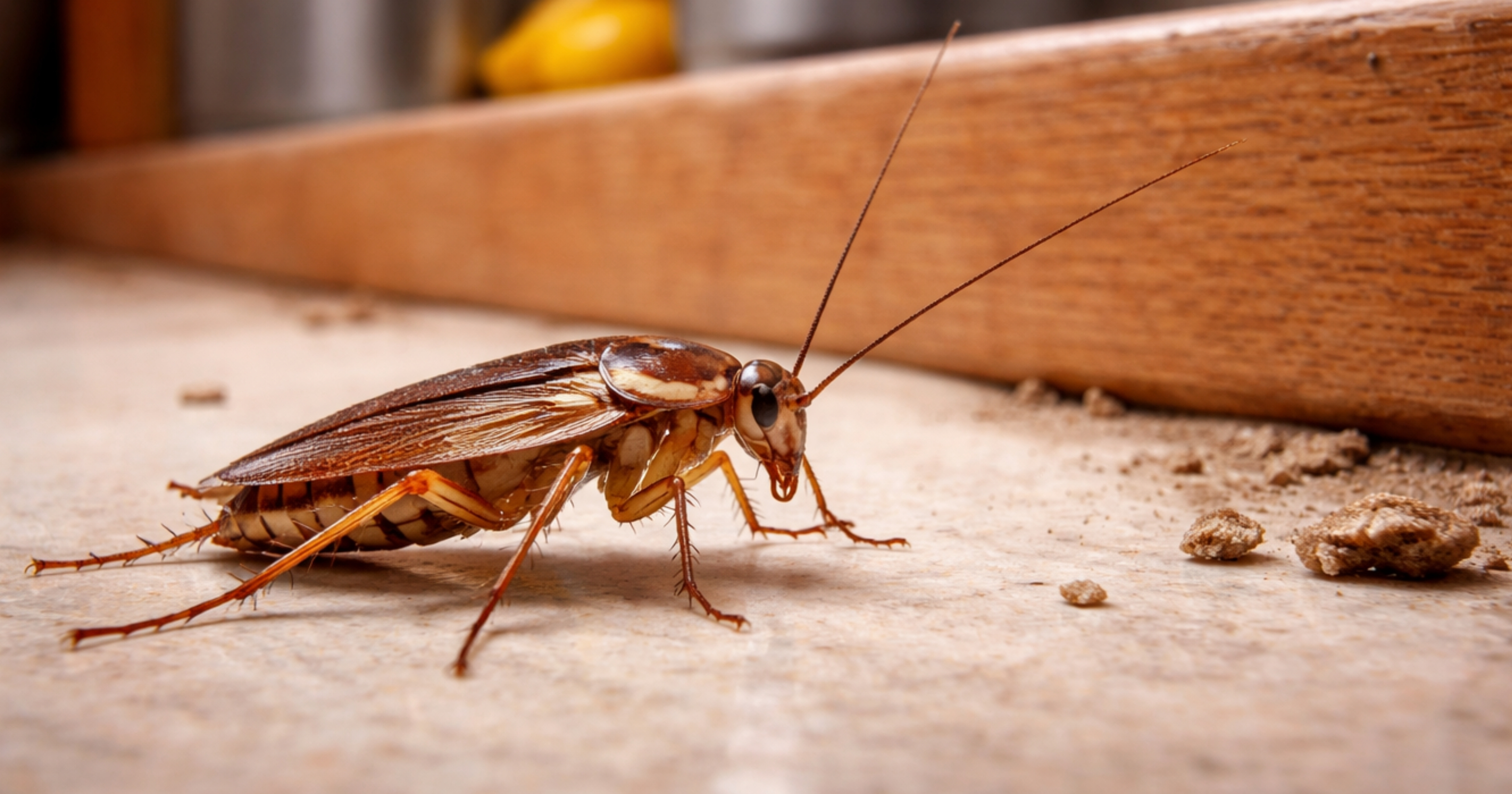
The German cockroach, Blattella germanica, is a small, light brown cockroach with two dark longitudinal stripes behind the head. UC IPM notes that it is primarily an indoor species, favouring warm, humid areas close to food and water, especially kitchens and bathrooms. Unlike larger outdoor roaches that may wander in from drains or gardens, German cockroaches are usually telling you something more serious: they are living and breeding inside the structure.
German cockroaches are usually smaller than the large roaches many people imagine. Adults are tan to light brown and are identified most reliably by the two dark parallel stripes on the pronotum, just behind the head. Nymphs are smaller, darker, and wingless. Females are often seen carrying a pale egg case protruding from the end of the abdomen. UC IPM and Rutgers both use that carried egg case as a key clue for this species.
What to look for
German cockroaches matter for more than disgust. EPA notes that cockroaches can carry bacteria on and within their bodies, contaminating food and surfaces, and that their feces, saliva, and shed skins are important indoor allergens. Cockroach allergens are strongly associated with asthma, especially in children and in dense urban housing environments, and inner-city asthma studies have focused heavily on German cockroach allergens such as Bla g allergens.
German cockroaches prefer warm, humid, dark harbourage close to food and water. UC IPM describes them as favouring temperatures around 70–75°F (about 21–24 °C) and concentrating in food-preparation areas, kitchens, and bathrooms. Severe infestations can spread more widely through the structure, but their core biology is strongly tied to indoor microclimates created by people.
Most people think the German cockroach's greatest power is simple reproduction.
That is only part of the truth.
Its deeper and more extraordinary strength is its ability to evolve behavioural resistance, not just chemical resistance. Studies on German cockroaches have shown glucose aversion: populations exposed to bait pressure evolved a trait that makes glucose taste deterrent instead of attractive, causing them to reject common bait ingredients. Later work showed this adaptation can expand through saliva-mediated sugar processing and even affect learned odour responses. That is a remarkable level of pest adaptation.
Many pests evolve tolerance to insecticides. German cockroaches went further: some populations evolved to avoid the food matrix meant to kill them. That means the species is not only chemically resilient; it can become behaviourally difficult to feed, which is one reason control failures happen when treatments are routine, repetitive, or poorly matched to the strain present.
The hidden strength of the German cockroach is adaptive decision-making at the population level.
Over generations, bait pressure can reshape what these cockroaches will and will not eat. That makes them one of the clearest examples of a household pest capable of rapid, heritable behavioural adaptation to modern control tactics.
One of the most important but underappreciated traits of the German cockroach is how the female handles the egg case. UC IPM notes that the female carries the ootheca for most of the roughly 30-day incubation period and drops it only near the time the eggs hatch. That gives the eggs more protection than in many other cockroach species, which deposit the ootheca much earlier. In practical terms, it improves offspring survival and helps explain the species' explosive reproductive success indoors.
UC IPM states that German cockroaches have the fastest reproductive cycle of the common pest cockroaches, and that a single female and her offspring can produce more than 30,000 individuals in a year under favourable conditions. That is one reason a “small sighting” should never be dismissed casually. With this species, low visible numbers can still mean a fast-growing hidden population.
UC IPM notes that cockroaches tend to congregate in corners and travel along edges of walls and surfaces. This is part of a broader cockroach tendency toward close contact with surfaces and narrow shelter. For German cockroaches, that matters immensely because modern kitchens, cupboards, appliance voids, drawer runners, kick plates, hinges, cable runs, and crack networks create a near-perfect maze of protected movement routes. Their strength is not just that they hide — it is that human interiors are full of exactly the kind of tight, dark, edge-defined spaces they are built to use.
German cockroaches are difficult because they combine fast reproduction, protected harbourage, nocturnal activity, allergen production, chemical resistance, and behavioural adaptation. They also exploit the exact places people struggle to access thoroughly: behind refrigerators, inside cabinet voids, beneath sinks, around dishwashers, within warm motor housings, and along crack-and-crevice routes. That makes them not just survivors, but true indoor specialists.
One of the most surprising truths about German cockroaches is that resistance can spill into courtship and feeding behaviour, not just toxicology. Research showed that glucose-aversion traits can alter food choice and even disrupt sexual communication when food cues and sugars are involved. That is extraordinary because it means pest control pressure can reshape the species' behaviour in ways far beyond simple survival after spraying.
If you want one accurate answer, it is this:
It is built for the spaces humans build, and it evolves quickly inside them.
German cockroaches combine indoor specialization, egg protection, rapid reproduction, allergen production, edge-following movement, and the ability to evolve both physiological and behavioural resistance. That combination is what makes them one of the most formidable structural pests in the world.
The German cockroach is one of the clearest examples of a pest that wins by intimacy, not drama. Blattella germanica does not need to be large, fast outdoors, or frightening to dominate. It succeeds by living where people cook, store food, create warmth, leak moisture, and build thousands of protected cracks. Add rapid reproduction and an extraordinary capacity to evolve around control pressure, and you have one of the most formidable indoor pests on earth.
Next: how we treat cockroaches, cockroach guarantees, cockroach identification guide. Book a get a quote. Read cockroach treatment safety.
Blattella germanica — UC IPM indoor framing, EPA allergen context, glucose aversion vs spray-only myths.
Kitchen or multi-unit activity? Book through our quote flow for inspection-led species-matched programmes.
We inspect harbourage patterns first—then run species-matched baiting and targeted programmes on the footprint named in your quote.
Programmes: German & brown-banded hub, American & Oriental hub, American cockroach pest guide, Oriental cockroach pest guide, Brown-banded cockroach pest guide. Hub: cockroach control.