Pest guide · moles
National mole methodology: mole control hub, how we treat moles, mole guarantees, mole control by area. Identification: mole identification.
The giant golden mole is listed Endangered (IUCN) in site identification data — never use lethal control on suspected threatened golden moles; confirm species and report to conservation when appropriate; your written quote governs scope.
Chrysospalax trevelyani
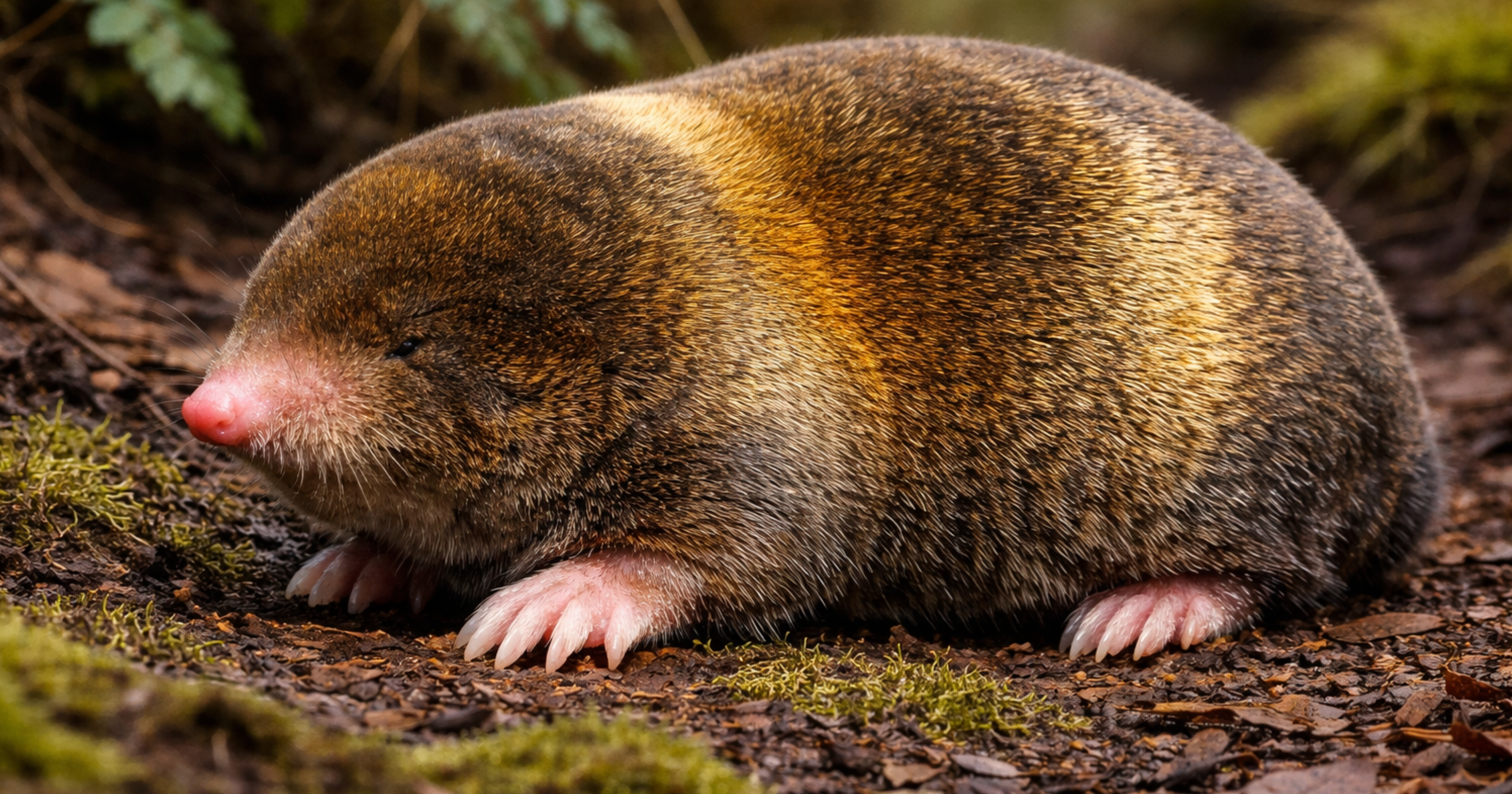
The giant golden mole is one of South Africa's most remarkable and least-seen mammals. Chrysospalax trevelyani is not a true mole, not a rodent, and not just a burrowing oddity. Its real strength is a combination of forest-floor specialization, subterranean power, and extraordinary vibration sensing, which allows it to hunt and move through darkness with astonishing efficiency.
The giant golden mole is a member of the family Chrysochloridae, the African golden moles. SANBI records it from the Transkei Coastal Scarp forests and Amathole Mistbelt forests of the Eastern Cape, where it depends on soft soils, deep leaf litter, and well-developed undergrowth. It is absent from commercial forestry plantations and avoids rocky or steep terrain.
This matters because people often confuse it with true moles or mole-rats. It is neither. Animal Diversity Web places it in the order Afrosoricida, a distinct African mammal lineage, separate from true moles and from rodents such as mole-rats.
The giant golden mole is the largest of all golden moles, reaching about 20–24 cm in length. It has a dense, glossy brown coat, a wedge-shaped head, no visible external ears, eyes covered by skin, and powerful digging claws. Sources also note that its outer fur is longer and coarser than in other golden moles, which helps set it apart.
The giant golden mole is endemic to South Africa and highly localized in the Eastern Cape. SANBI's habitat summary makes clear that this species is tied to indigenous forest patches with the right soil and litter structure, which is one reason it is so restricted and vulnerable.
Unlike sand-specialist golden moles, the giant golden mole is a forest-floor and soft-soil specialist. It uses chambers and passages underground, but it also forages in surface runways and in leaf litter, especially at night and in cool, cloudy conditions. Animal Diversity Web describes semi-permanent tunnels of about 10 metres linked by surface pathways used in hunting.
It is mainly solitary. Reports also note that during colder periods it may use sheltered sites among tree roots and can enter torpor-like energy-saving states.
The giant golden mole is an insectivorous predator, not a root-eater. Sources describe its diet as including millipedes, giant earthworms, crickets, cockroaches, grasshoppers, snails, and worms. That makes it very different from mole-rats, which feed heavily on underground plant material.
People usually do not see the animal itself. They may notice:
Its rarity in sightings comes from its subterranean lifestyle, restricted range, and strong dependence on dense indigenous forest habitat.
Most people think the giant golden mole's main power is digging.
That is only part of the story.
Its deeper advantage is seismic sensing — the ability to detect vibrations through the ground. Research on golden moles shows that their middle ear, especially the malleus, is highly specialised for substrate-borne vibration detection. This is one of the most extraordinary sensory systems in any underground mammal.
In darkness underground or under leaf litter, sight is of little use. A mammal that can detect subtle ground vibrations gains a major advantage in finding prey and sensing disturbance. That is the real reason golden moles are so extraordinary: they do not merely dig through the ground — they listen to it.
The giant golden mole's hidden strength is that it can turn the forest floor into a sensory field:
become usable information. That is what makes it one of the most specialised underground hunters in South Africa. This is an inference supported by the golden mole sensory literature and the species' habitat use.
One of the lesser-known facts about the giant golden mole is that its fur is described as longer and coarser than in other golden mole species. That fits its ecology well: unlike desert or dune golden moles, it works through forest soils and thick litter, where a tougher coat likely helps in moving through abrasive organic material. The fur point is directly sourced; the functional interpretation is a reasonable inference.
The giant golden mole is threatened mainly because of habitat loss and fragmentation. SANBI and other summaries point to forest degradation, clearing, replacement by plantations, and other human pressures as the main reasons for decline. Its dependence on very specific indigenous forest structure makes it especially sensitive.
One of the most striking facts about the giant golden mole is that it is both the largest and one of the rarest golden moles. That combination is unusual: it is a big, powerful specialist, but one tied to such a narrow habitat type that most people will never encounter it in the wild.
If you want one accurate answer, it is this:
It turned the forest floor into a hidden hunting world.
Many mammals burrow. Many mammals reduce reliance on sight. Many underground animals are small and generalized. But the giant golden mole stands out because it combines:
That is what makes it so extraordinary.
The giant golden mole is one of the finest examples of how extraordinary South African mammals can be. Chrysospalax trevelyani is not just a burrower and not just a rare forest animal. It is a highly specialised subterranean hunter that survives by sensing vibrations, moving through soft forest soils, and exploiting a hidden world most animals cannot use. That is what makes it so unusual — and so remarkable.
Next: how we treat moles, mole guarantees, mole identification guide, Yellow golden mole guide, Hottentot golden mole guide, Cape golden mole guide. Book mole control in Cape Town · Mole Control Cape Town hub. Read mole treatment safety.
Chrysospalax trevelyani — Endangered (IUCN) in site data; never harm or trap as a generic garden mole; report possible sightings to conservation authorities.
Need help with lawful, species-appropriate assessment? Use get a quote.
We do not target Endangered species; confirm context on your quote and prioritise conservation reporting when identification is uncertain.
Yellow golden mole guide · Hottentot golden mole guide · Cape golden mole guide · How we treat moles, Mole guarantees, Mole control by area, Mole identification guide. Hub: mole control.