Pest guide · moles
National mole methodology: mole control hub, how we treat moles, mole guarantees, mole control by area. Identification: mole identification.
Grant’s golden mole is listed Vulnerable (IUCN) in site identification data — never use lethal control on suspected threatened golden moles; confirm species and prefer conservation reporting in dune habitat; your written quote governs scope.
Eremitalpa granti
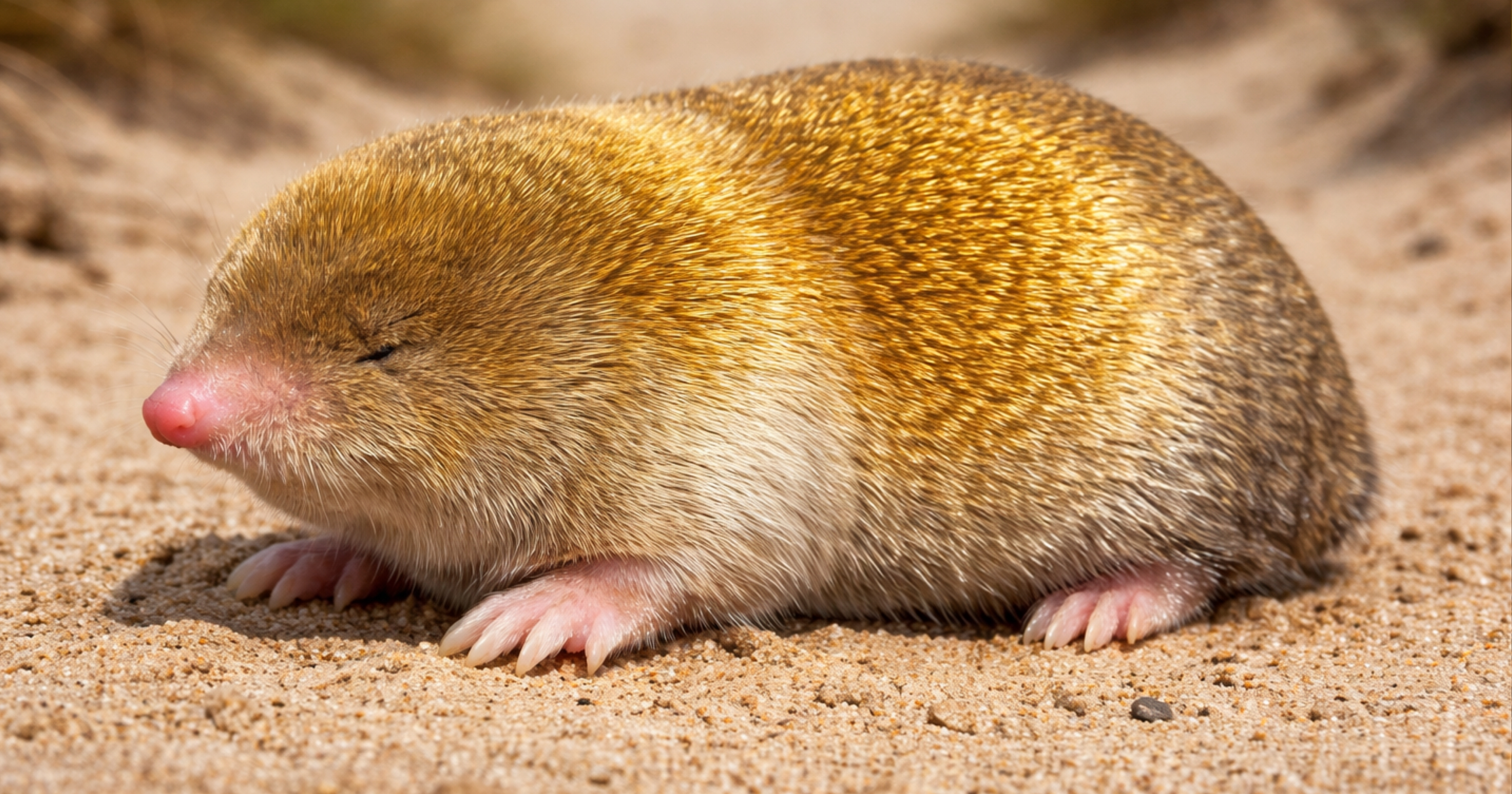
Grant’s golden mole is one of the strangest and most specialized mammals in southern Africa. Eremitalpa granti is not a true mole, not a rodent, and not just a small burrower in the sand. Its real strength is a combination of desert-sand specialization, near-surface “sand swimming,” and extraordinary sensitivity to ground vibrations that allows it to survive where few mammals can.
Grant’s golden mole is a golden mole in the family Chrysochloridae, not a true mole of the Northern Hemisphere. In South Africa, SANBI records it from the western coastal dune systems and other soft sandy habitats of the west coast. It prefers soft sands of coastal dune crests and can also occur in inter-dune swales where the sand remains loose enough for movement.
This matters because people often confuse it with:
Grant’s golden mole is different from all of them because it is especially tied to desert and dune sand rather than ordinary garden soil.
Grant’s golden mole is a small, compact, highly streamlined mammal with:
Its body is rounded and smooth in a way that suits loose sand remarkably well. Images and species accounts consistently show an animal that looks less like a classic digging mammal and more like a living sand-shaped form.
In South Africa, SANBI places Grant’s golden mole mainly in the western coastal sandy systems, especially the Strandveld and Succulent Karoo biomes. It is strongly associated with soft unconsolidated sands, including dune crests and some inter-dune areas with vegetation, provided the substrate is not too compacted.
That is one of the most important truths about the species: it is not just underground “anywhere.” It is a specialist of very loose sand.
Grant’s golden mole is famous for moving through loose sand in a way often described as “sand swimming.” It spends much of its life below or just beneath the surface, especially in dune systems where compact tunnelling is less useful than moving through friable substrate. Research summaries on golden moles describe Eremitalpa granti as a nocturnal, surface-foraging or near-surface foraging mammal with rudimentary vision and strong reliance on substrate-borne cues.
Instead of behaving like a classic deep-burrowing mole, it is better understood as a desert-sand specialist that uses the physical properties of loose substrate to move, forage, and orient itself.
Grant’s golden mole is mainly an animal-eater, not a root-feeder. Research on its behavior in the Namib and adjacent dune systems shows it forages toward sand hummocks and patches that hold much of the living biomass of the desert, including prey-rich microhabitats. One image source also documents it feeding on a locust, which fits the broader view that it targets small desert invertebrates.
So the honest version is this: Grant’s golden mole is not a plant-damaging burrower like a mole-rat. It is a small desert predator of invertebrate-rich sand habitats.
People rarely see Grant’s golden mole because it is:
In loose dunes, surface traces can vanish fast under wind action, which makes the animal even harder to detect than firmer-soil golden moles. This is an inference from its habitat and foraging style, both of which are well supported by the literature.
Most people think Grant’s golden mole’s main power is digging.
That is only part of the story.
Its deeper and far more extraordinary advantage is seismic sensing. Field and anatomical studies show that Eremitalpa granti can use substrate-borne vibrations to orient toward dune hummocks and prey-rich areas. Research on fossorial southern African mammals found evidence that the golden mole can detect prey items and termite colonies using cues in the substrate. Other work on golden mole ears shows that several species have massively hypertrophied mallei in the middle ear, thought to enhance low-frequency vibration sensitivity through inertial bone conduction.
In loose desert sand, sight is almost useless and scent can be patchy. A mammal that can detect subtle vibration patterns has a huge advantage. It can orient toward prey-rich hummocks, sense disturbance, and navigate a landscape that would otherwise seem almost empty.
The hidden strength of Grant’s golden mole is that it can read the sand:
That is what makes it one of the most extraordinary little mammals in southern Africa.
One of the most fascinating things about Eremitalpa granti is that it does not just wander randomly through sand. Research summaries say it moves between dune grass hummocks and other patches that hold much of the desert’s living biomass. In other words, it appears to use the dune landscape strategically, focusing effort where prey is most likely to be concentrated.
That means its real advantage is not only sensory. It is also landscape intelligence shaped by evolution: an ability to exploit the most productive spots in an otherwise sparse desert system. This is an inference from the vibration-orientation studies.
Grant’s golden mole is vulnerable because it depends on a narrow habitat type: loose coastal and desert sands. Species tied so tightly to specific substrate conditions are sensitive to habitat degradation, fragmentation, and changes that compact or disturb the dune system. SANBI’s regional status of Vulnerable reflects that concern.
One of the most remarkable facts about Grant’s golden mole is that it is one of the clearest known examples of a mammal using ground-borne vibrations in an open desert system to help locate biologically rich spots. That is not ordinary “good hearing.” It is a very unusual form of environmental sensing.
If you want one accurate answer, it is this:
It turned loose desert sand into a sensory map.
Many mammals burrow. Many mammals reduce reliance on sight. Many small predators hunt insects. But Grant’s golden mole stands out because it combines:
That is what makes it so extraordinary.
Grant’s golden mole is one of the finest examples of how extreme habitat can shape an animal into something extraordinary. Eremitalpa granti is not just a burrower and not just a rare desert mammal. It is a highly specialized sand hunter that survives by sensing vibrations, moving through loose substrate, and exploiting the richest patches of an otherwise harsh landscape. That is what makes it so unusual — and so remarkable.
Next: how we treat moles, mole guarantees, mole identification guide, Yellow golden mole guide, Giant golden mole guide, Hottentot golden mole guide, Cape golden mole guide. Book mole control in Cape Town · Mole Control Cape Town hub. Read mole treatment safety.
Eremitalpa granti — Vulnerable (IUCN) in site data; west-coast and Namib-adjacent dunes — never harm or trap as generic garden pests; report uncertain sightings appropriately.
Need species-appropriate advice on your quote? Use get a quote.
We do not treat threatened species as routine garden pests; confirm habitat and identification on your quote and prioritise conservation-appropriate responses when status is uncertain.
Yellow golden mole guide · Giant golden mole guide · Hottentot golden mole guide · Cape golden mole guide · How we treat moles, Mole guarantees, Mole control by area, Mole identification guide. Hub: mole control.