Pest guide · spiders
National spider methodology: spider hub, how we treat spiders, spider guarantees, spider control by area. Identification: spider identification. Related: brown button spider guide, violin spider guide, sac spider guide, rain spider guide, baboon spider guide, huntsman spider guide, cellar spider guide, golden orb weaver guide, wolf spider guide, jumping spider guide.
Latrodectus — especially L. indistinctus in South African usage
The black button spider is one of the most feared spiders in South Africa, partly because it is genuinely medically important and partly because people often confuse it with other dark spiders. In South African usage, the black button spider is a widow spider in the genus Latrodectus, most notably Latrodectus indistinctus. Its venom is neurotoxic, and black button spiders are among the medically significant spiders discussed in southern African toxicology references.
Its real strength is not speed or brute force. Its supremacy lies in high-efficiency trap-and-inject predation: it builds a durable, irregular web, hangs safely within it, and uses potent venom to subdue prey much larger than its body size would suggest. The spider does not need to chase like a wolf spider or jump like a jumping spider. It turns silk and venom into a remote-control hunting system. This is an inference supported by its web-building and medically significant widow-spider venom biology.
A black button spider is a widow spider in the genus Latrodectus. South African references identify the black button spider as Latrodectus indistinctus, distinct from the brown button spider. Occupational-health and biodiversity references both place it among the neurotoxic button spiders of southern Africa.
For a South African pest guide, the most important truth is this: a black button spider is not just “the American black widow by another name.” It is the local South African widow-spider form, with its own identification features, habitat patterns, and local medical context.
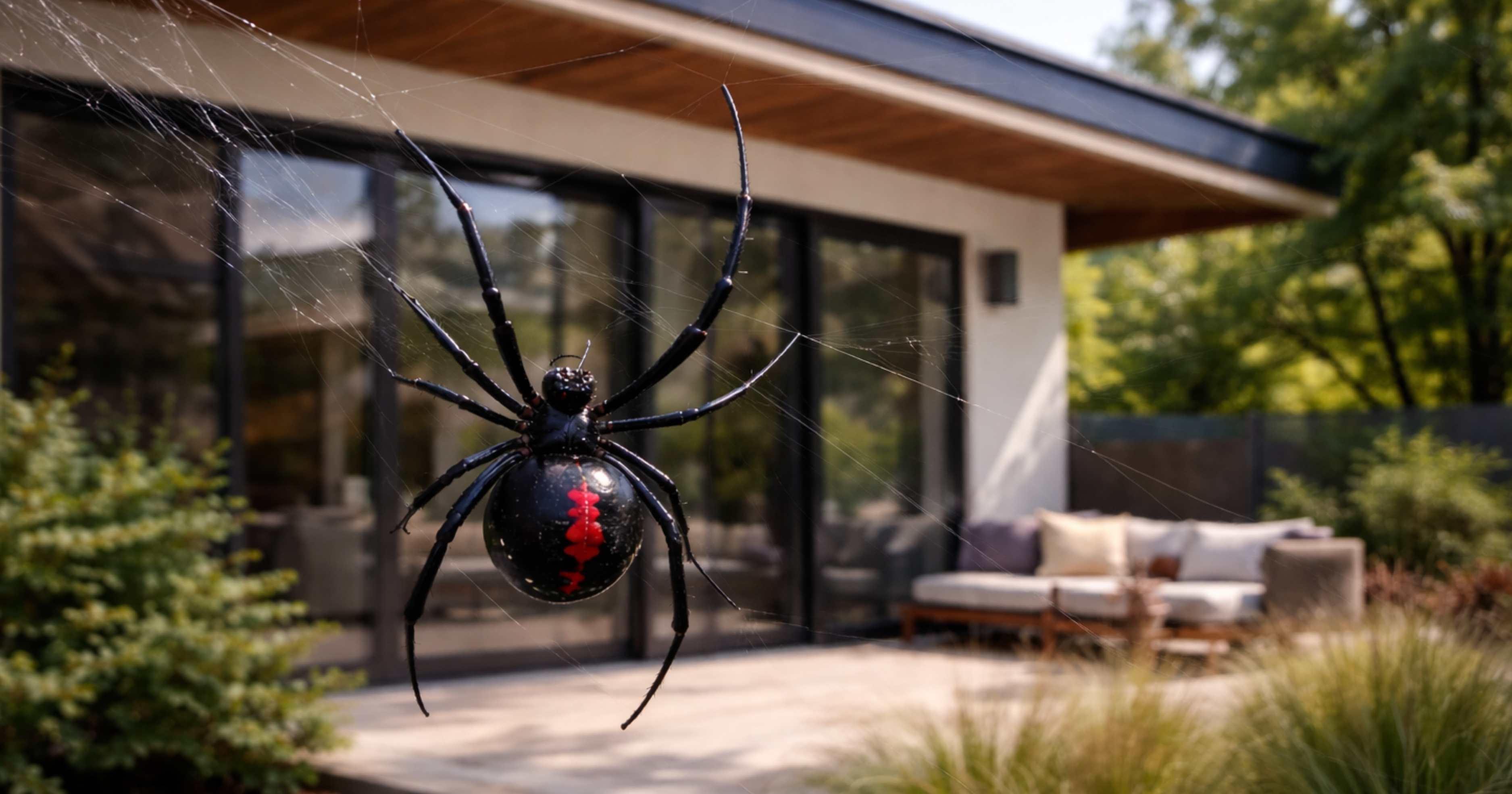
Black button spiders are usually identified by a combination of body shape, colour, web, and egg sac features. African Snakebite Institute describes the female as pitch black, often with some red or purple on the upper rear part of the abdomen, rather than the classic American hourglass image people expect. ARC and Biodiversity Explorer also note that the egg sacs are an important clue: black button spider egg sacs are smooth and round, unlike the spiky sacs associated with brown button spiders.
The black button spider matters because it combines a secretive lifestyle with medically important venom. Southern African medical references classify button spiders among the neurotoxic spiders, and the African Snakebite Institute notes that bites are dangerous enough to require proper medical attention, even though the spiders are generally not aggressive and usually prefer avoidance.
People often misunderstand the risk because they expect a dangerous spider to behave boldly. In reality, the black button spider is usually retiring and web-bound, but that does not make it harmless. Its danger comes from the potency of the venom, not from a habit of roaming around attacking people.
Most people think the biggest issue is simply the venom.
That is true, but the deeper advantage is this:
Black button spiders do not rely only on venom. Their hidden advantage is the combination of strong silk, irregular three-dimensional web design, and a hanging ambush position. ARC notes that the species uses the same web over a long period and builds a retreat with strong supporting lines. That means the spider is not merely sitting in a random tangle — it is operating from a durable trap architecture.
A hunter that chases prey has to expose itself.
A black button spider lets the web do the first part of the work.
That means:
This is an inference based on its established widow-spider web architecture and venom use. This is the real “special power.” Its hidden advantage is not just toxicity. It is the ability to turn silk, structure, and patience into a highly efficient prey-capture machine. That is what makes the animal so effective and so easy to underestimate.
One of the most useful and least appreciated facts about South African button spiders is that the egg sac shape helps separate species. ARC and African Snakebite Institute note that black button spiders produce smooth, round egg sacs, while brown button spiders are associated with more spiky sacs. That makes the egg sac one of the best field clues when the spider itself is hard to inspect clearly.
This matters because many people focus only on body markings and miss the web area entirely. But in widow-spider identification, the surrounding architecture — web, retreat, and egg sacs — can be just as informative as the spider. This is an inference supported by the identification guidance above.
False. They are related widow spiders in the same genus, but the South African black button spider is part of the local Latrodectus group and should not be reduced to imported American imagery alone. Local references specifically distinguish South African button-spider identification from the classic American hourglass expectation.
Better truth. The black button spider is a South African widow spider, not simply a copy of the American black widow.
False. South African sources note that black button spiders may show red or purple infusion on the upper rear of the abdomen, and local identification does not depend on the classic underside hourglass pattern people know from overseas black widow illustrations.
Better truth. Local widow-spider identification must be based on South African features, not only American markings.
False. African Snakebite Institute describes them as inoffensive and notes that when disturbed they often drop and curl up. Their danger is real, but aggression is not their defining trait.
Better truth. They are usually defensive and retreating, not actively confrontational.
False. Many harmless spiders are dark, and even within button spiders there is confusion between black button, brown button, and false button spiders. Correct identification depends on the shape, web, markings, and egg sacs, not just “black spider = widow.”
Better truth. Colour alone is not enough. Web and egg sac clues matter a lot.
False. The black button spider builds an irregular, messy web, not an orb. A messy web does not rule out a medically important spider.
Better truth. Some of the most medically important web spiders build untidy-looking trap webs.
False. For black versus brown button spiders, the egg sac is one of the most practical field identifiers: black button sacs are smooth, while brown button sacs are spiky.
Better truth. Sometimes the egg sac is the clue that solves the ID.
Black button spiders succeed because they combine:
That combination makes them less like roaming hunters and more like hidden web-based venom specialists. That is what makes them so effective.
A surprisingly important fact is that black and brown button spiders can often be separated by egg sac texture alone. That is one of the most practical identification features for South African households, because the spider may not always be visible in a good position, but the egg sac often remains in view.
Suspected bites warrant medical attention on southern African guidance for button spiders. Do not prod the web or handle the spider for ID—use distance and professional help for removal on your quoted scope. Get a quote routes identification-led spider methodology.
The black button spider is one of South Africa's most misunderstood spiders because people tend to notice only the fear around the name. Its real supremacy lies in quiet efficiency. It does not need to roam, chase, or bluff. It builds a durable trap, waits in safety, and relies on one of the most effective silk-and-venom combinations in the spider world. That is what makes it such a successful predator — and such an important species to identify correctly.
Next: brown button spider guide, violin spider guide, sac spider guide, rain spider guide, baboon spider guide, huntsman spider guide, cellar spider guide, golden orb weaver guide, wolf spider guide, jumping spider guide, how we treat spiders, spider guarantees, spider identification guide. Book spider control in Cape Town. Read spider treatment safety.
Latrodectus — identification-led harbourage treatment on quoted scope; medically significant species deserve distance and professional assessment when bites are suspected.
Webbing in high-traffic areas? Use get a quote for a safe plan.
We identify problem species and harbourages first, then treat and advise on sealing—national spider methodology; your quote prevails.
Brown button spider guide, Violin spider guide, Sac spider guide, Rain spider guide, Baboon spider guide, Huntsman spider guide, Cellar spider guide, Golden orb weaver guide, Wolf spider guide, Jumping spider guide, How we treat spiders, Spider guarantees, Spider control by area, Spider identification guide. Hub: spider control.